Tadalafil: Four Stereoisomers, Five Entries at 389.41, One Column
Five catalogued entries share tadalafil's formula to the last hydrogen, and the drug has two stereocentres the name does not mention. What separates them is not a better detector but a different column, plus the arithmetic that decides which entries are isomers and which are salts.
Note: product names shown in red (marked with ↗) are links - click through to the product page for structure, CAS number, purity and lead time.
Key points
Key points
- Tadalafil↗ is C22H19N3O4 at 389.41 and carries two stereogenic centres, one at the ring fusion and one at the carbon bearing the benzodioxole. Four configurations exist and the drug is one of them, which the International Nonproprietary Name does not state[1].
- Five numbered entries beyond the parent sit on exactly the same formula and mass, so a trace at m/z 390 is blind to every one of them. Identity has to come from retention against a characterised standard[2].
- The cis and trans diastereomers differ in shape and separate on an ordinary reversed-phase column. The enantiomer does not, and needs a chiral selector, so no single method covers both jobs[3].
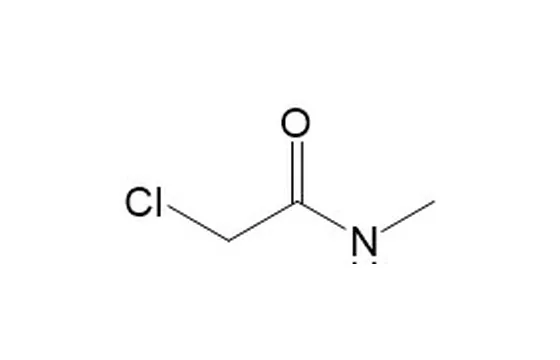
- The ring closure consumes chloroacetyl chloride, and the catalogue carries the coupled byproduct 2-chloro-N-methylacetamide at C3H6ClNO, 107.54: an alkyl chloride with no useful chromophore, which the release method cannot see[4].
On paper tadalafil is one of the best-documented impurities in its class: nine pharmacopoeial letters, over a hundred numbered entries, a well-worn synthesis. In practice it is one of the hardest to control, and the reason is arithmetic rather than chemistry. Five entries beyond the parent have the same formula to the last hydrogen, and no mass spectrometer separates them.
The way in is to count atoms before counting peaks: two centres built in one non-stereospecific step, one oxidation ladder that closes arithmetically but never positionally, and one small alkyl chloride that arrives with the ring closure.
A name that does not contain the configuration
The drug is (6R,12aR)-6-(1,3-benzodioxol-5-yl)-2-methyl-2,3,6,7,12,12a-hexahydropyrazino[1,2:1,6]pyrido[3,4-b]indole-1,4-dione. Two atoms are stereogenic: C6, which carries the benzodioxole, and C12a, the fusion carbon shared by the piperazine and the carboline. Two centres give four configurations, and the drug is the cis pair. The other three are the enantiomer and two trans diastereomers[1].
None of that survives into the salt name on the label or the assay value on the certificate. A specification reading tadalafil, 99.5 per cent by area, has said how much material elutes in the main peak and nothing about which configuration it is. On an achiral column a co-eluting enantiomer contributes to that same area and is counted as drug.
The pharmacopoeial answer is to treat the enantiomer as a specified impurity with its own limit and its own method, rather than folding it into a general organic-impurity test[3]. That decision drives everything downstream, including how many standards a laboratory has to buy.
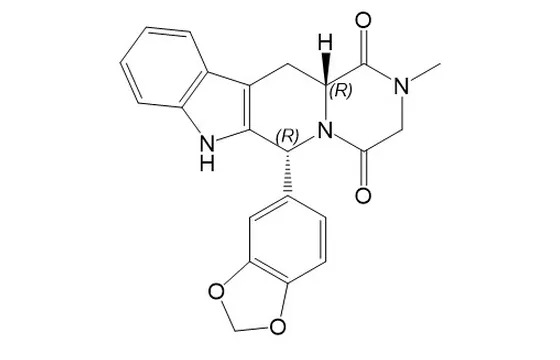
Five entries at 389.41 that a mass trace cannot separate
Sort the catalogue by formula instead of name and a cluster appears at once. Six rows sit at C22H19N3O4, 389.41: the parent, EP Impurities A, B and C, entry 7 and entry 79. One oxidation higher, five rows sit at C22H19N3O6, 421.41. Two hydrogens fewer and one oxygen more gives 403.39, C22H17N3O5, and five rows land there[1].
The same-formula five are the ones that matter. Protonated they give m/z 390.4; fragmented they lose the same methylenedioxy unit and the same methylamine, because those groups sit on the same skeleton in the same places. Whatever the collision energy, the difference between the drug and its enantiomer is not a difference in fragments.
What makes it worse is that the letters carry no structural information. EP Impurity A, B and C are a supplier mapping of a monograph, and different houses have mapped the same letters onto different isomers. Reading a letter as though it identified a configuration is the usual way to buy the wrong standard: the bottle says EP Impurity A, the method was validated against a trans diastereomer, and the peak in the sample is the enantiomer.
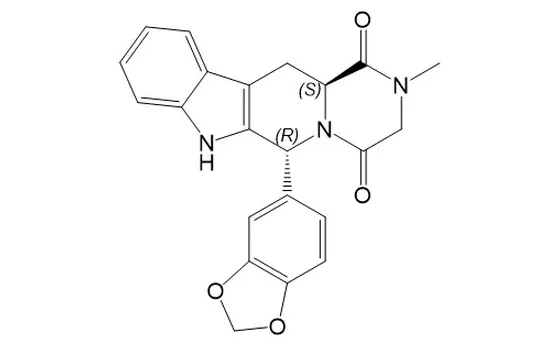
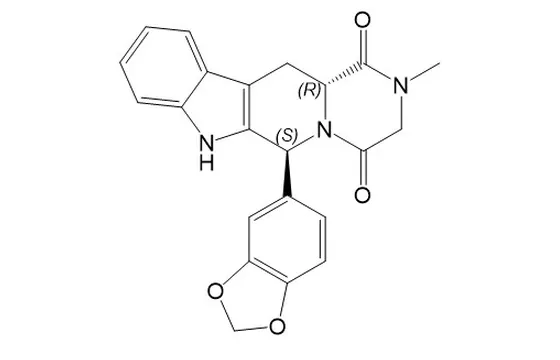
Where the mass ladder closes, and where it never does
The rest of the catalogue is arithmetically legible, and worth using. Entry 21 sits at 375.38, the parent less 14.03, one methyl, and it is named as the N-desmethyl compound, so name and mass agree. Entries 20, 111 and 115 sit at 405.41, plus 16.00. The 403.39 cluster is minus two hydrogens plus one oxygen. The 426.85 cluster is plus 37.44, formula C22H19ClN2O5, one nitrogen exchanged for a chlorine and an oxygen. The 350.37 cluster is minus 39.04, C20H18N2O4, six rows[1].
Every difference closes to within a hundredth of a mass unit, and that is the useful half of the technique: you can assign a composition to an unknown peak without a standard, and reject a proposed structure when the difference does not close. It is also the half that generates false confidence. Plus 16.00 says an oxygen was added; it does not say whether it went onto the indole nitrogen, the methylenedioxy methylene or the methylamine, and those are three impurities with three toxicological answers.
So the ladder handles the crowded part of the catalogue and stops where the same-formula cluster begins. That is the normal boundary of the technique, and the only way across it is chromatography shown to resolve the specific isomers.
The stereocentre is made in the first step and never revisited
Tadalafil is assembled by a Pictet-Spengler condensation between a tryptophan ester and piperonal. That one operation builds the tetrahydro-beta-carboline and sets both centres: the ring fusion and the carbon that will carry the benzodioxole. The condensation is not stereospecific at the fusion carbon; it gives a cis and a trans series, and the cis fraction is separated before the sequence continues. Everything downstream happens on a skeleton whose stereochemistry is already fixed: chloroacetylation, cyclisation to the diketopiperazine, displacement of the remaining chloride with methylamine[1].
There is no epimerisation step later and no crystallisation that inverts a wrong centre. If the trans series is not removed, it stays; if the wrong tryptophan enantiomer enters, it stays.
That is why the amino-acid entry matters more than its limit suggests. A tryptophan enantiomer appears as a numbered entry at C11H12N2O2, 204.23[5]. Whichever enantiomer the route consumes, the other one is the failure mode and it enters first. What comes out is not the drug plus a labelled intermediate; it is the drug plus its enantiomer, which puts the problem straight back on the chiral method.
The chloride that the release method cannot see
The diketopiperazine is closed with chloroacetyl chloride and the residual chloride displaced by methylamine. Their combination leaves 2-chloro-N-methylacetamide at C3H6ClNO, 107.54, in the catalogue as entry 120[4]. It is an alkyl chloride, a class 3 structural alert under M7, and it needs a control strategy whether or not anyone has measured it[6].
It also has no chromophore above roughly 210 nanometres and is volatile enough to be lost on prolonged drying. A reversed-phase method at 220 or 254 nanometres will not see it, and it will not appear in the area-percent purity on the certificate. The control has to sit upstream, on the intermediate and the raw material, by gas chromatography or mass spectrometric detection, with a limit justified by purge factor rather than by what the release method resolves.
This is the second place where two kinds of purity diverge. Chemical purity by area counts what the method detects, and a product can be 99.5 per cent pure by area while carrying a reagent-derived alkyl chloride above a toxicological threshold.
What the method has to demonstrate
The test set is not the parent. It is the same-formula cluster, and the question worth answering is how many members it resolves. The cis and trans diastereomers differ in shape, dipole and lipophilicity, so an octadecylsilane column with an acetonitrile gradient separates them without difficulty. The enantiomer has identical physical properties in an achiral environment and needs a chiral selector, typically a polysaccharide carbamate or benzoate phase, or derivatisation with a chiral reagent.
System suitability has to be built from a mixture. Injecting a trans diastereomer standard alone proves that it elutes, not that it is resolved from the drug, and the number that matters is the resolution between adjacent peaks in a combined injection. The minimum defensible setup is the drug plus one trans diastereomer plus the enantiomer, with a stated resolution for each adjacent pair[7].
Optical rotation is not a substitute: it distinguishes the enantiomer in a pure sample, tells you nothing in a mixture, and cannot see a diastereomer at all.
Limits at three doses
| Daily dose | Reporting, 0.05 per cent | Identification, 0.10 per cent | Qualification, 0.15 per cent | M7 default, 1.5 micrograms per day |
|---|---|---|---|---|
| 5 mg once daily | 2.5 micrograms | 5 micrograms | 7.5 micrograms | 0.03 per cent, 300 ppm |
| 10 mg | 5 micrograms | 10 micrograms | 15 micrograms | 0.015 per cent, 150 ppm |
| 20 mg single dose | 10 micrograms | 20 micrograms | 30 micrograms | 0.0075 per cent, 75 ppm |
Table note: thresholds from Q3A(R2), toxicological concern from M7(R2)[2,6]. At none of these doses does the 1.0 mg per day absolute branch apply; 0.15 per cent would have to reach 1.0 mg, which needs a 667 mg daily dose.
The consequence is single. At 20 mg the M7 default works out to 0.0075 per cent, thirteen times below the identification threshold and twenty times below the qualification threshold. For an impurity with a mutagenicity alert the Q3A columns are decoration; the limit comes from toxicology and is set long before the general threshold is relevant. For an impurity with no alert the reverse holds and the Q3A number governs. Both belong in the same specification.
The rest of the catalogue is a process fingerprint
Three entries sit at 150.13, 152.15 and 166.13: the methylenedioxybenzaldehyde that opens the condensation, its alcohol and its acid. Entry 1 is a tryptophan enantiomer at 204.23. Three entries cluster at C13H16N2O2, 232.28. Nine rows carry C20H18N2O4, several as hydrochloride pairs, because salt entries keep the free-base formula beside the salt mass[1].
None of those can be produced by stressing the finished drug. Light, heat, acid and peroxide do not synthesise a benzaldehyde that is not in the molecule. They are reagents, their over-oxidation products and their salts, which makes the list a map of the route: a forced-degradation programme designed from it hunts species that only a route change can create, while the ones light and oxygen actually make are the ordinary ladder at 405.41, 403.39 and 421.41.
What transfers to the rest of the family
Sildenafil has no stereogenic centre at all, so this entire problem disappears and its impurity work is about the piperazine, the sulfonamide and the ether. Avanafil has one centre, on the pyrrolidine ring, so it has an enantiomer but no cis-trans pair and no fused-ring diastereomers. Tadalafil has two fused centres created in one non-stereospecific step, which is the only reason five entries can sit on one formula.
The transferable lesson is an order of operations rather than a limit: assign the centres, decide which ones the route can get wrong, then count the entries that share a formula.
Standards for a five-entry problem
The catalogue holds 104 rows for tadalafil: the parent plus 103 numbered entries, highest number 192, with 97 numbers missing inside that range. The numbering is a shelf index, not a count of impurities. Within those rows, five numbered entries plus four pharmacopoeial letters cover the same-formula set, three cover the chloro series at 426.85, and five cover the double-oxidation set at 421.41.
A stereochemistry method can only be validated against the isomers it is meant to resolve, so the list has to name them: [see all tadalafil entries](tadalafil). Buy the drug, one trans diastereomer and the enantiomer first; the remaining same-formula entries can wait until a peak appears that those three do not explain.
Regulatory context: the CDE public database records 546 accepted filings for tadalafil from 215 applicants, a density that fits a product with this many strengths on file[8].
Frequently Asked Questions
Can liquid chromatography with mass spectrometry distinguish tadalafil from its stereoisomers?
Is EP Impurity A the enantiomer or a trans diastereomer?
Why does the certificate report 99.5 per cent when a stereoisomer is present?
Which column resolves the trans diastereomers, and which needs a chiral phase?
Is 2-chloro-N-methylacetamide a nitrosamine?
At 20 mg, which threshold governs an impurity with a mutagenicity alert?
Do I need both a diastereomer standard and an enantiomer standard?
Why does the tryptophan entry matter?
Related Substances and Reference Standards
- Tadalafil (103 impurity / derivative entries)
- Sildenafil (- impurity / derivative entries)
- Avanafil (133 impurity / derivative entries)
References and Sources
- PubChem, National Library of Medicine, Tadalafil, CAS 171596-29-5: molecular formula C22H19N3O4, molecular weight 389.4, and the two stereogenic centres at the ring fusion and the benzodioxole-bearing carbon, accessed 2026-11-23
- International Council for Harmonisation, ICH Q3A(R2), Impurities in new drug substances: reporting, identification and qualification thresholds, including the 1.0 mg per day absolute branch, accessed 2026-11-23
- International Council for Harmonisation, ICH Q6A, Specifications: test procedures and acceptance criteria, including the decision tree for chiral drug substances and the treatment of the enantiomer as a specified impurity, accessed 2026-11-23
- PubChem, National Library of Medicine, 2-Chloro-N-methylacetamide, CAS 96-30-0: molecular formula C3H6ClNO, molecular weight 107.5, the coupled byproduct of chloroacetyl chloride and methylamine, accessed 2026-11-23
- PubChem, National Library of Medicine, Tryptophan enantiomers, CAS 153-94-6 and 73-22-3: molecular formula C11H12N2O2, molecular weight 204.2, the amino acid that opens the tadalafil sequence, accessed 2026-11-23
- International Council for Harmonisation, ICH M7(R2), Assessment and control of DNA reactive (mutagenic) impurities: hazard classes and the 1.5 microgram per day threshold of toxicological concern, accessed 2026-11-23
- International Council for Harmonisation, ICH Q2(R2), Validation of analytical procedures: specificity, resolution and the demonstration that a method detects what it claims to detect, accessed 2026-11-23
- Center for Drug Evaluation, National Medical Products Administration, Accepted marketing applications listed in the public drug registration database, queried by product name on 23 November 2026, accessed 2026-11-23
This article was prepared by the CATO technical team. Regulatory, pharmacopoeial and published literature content cited above is attributed in the reference list. It is provided for technical exchange and search reference only and does not constitute a quality specification or regulatory advice. For any specific substance, the applicable test methods, limits and filing requirements are governed by the current regulations, pharmacopoeial monographs and official publications.
Product information on this site is provided for research search and selection reference only and is not a quality specification; technical data, purity and structural confirmation are governed by the shipped COA and our written confirmation. All products mentioned are for research use only, not for human or animal diagnostic or therapeutic use.