Tamoxifen Has No Chiral Center: The E Isomer, the Light, and the Phenanthrenes Behind It
Tamoxifen↗ citrate is C32H37NO8, 563.6, and the base is C26H29NO, 371.5. Look for a chiral center and there is none: the amine inverts, the methylenes are symmetric, and the entire stereochemistry of the molecule reduces to the geometry of one carbon-carbon double bond. Everything difficult about this substance follows from that. Its principal impurity is not a diastereomer or an enantiomer but the same molecule with one bond rotated, and the reagent that rotates it is light.
Note: product names shown in red (marked with ↗) are links - click through to the product page for structure, CAS number, purity and lead time.
A molecule with one element of stereochemistry, and it is not a chiral center
Key points
- Tamoxifen has no chiral center. Its only element of stereochemistry is a carbon-carbon double bond, so the drug and its geometric impurity are isomers of identical formula, C26H29NO, 371.5[1].
- Twenty milligrams of tamoxifen is 30.4 mg of the citrate salt, C32H37NO8, 563.6, and every percentage limit in the specification is applied to one of those two numbers[2].
- The ICH Q3A qualification threshold at the 20 mg dose is 0.15 percent, or 45.6 micrograms a day on the salt, and the committed E-isomer limit sits far below it[3].
- Light does not stop at the E isomer. Irradiation gives E, two phenanthrene derivatives and, with oxygen, a ketone, five products in one experiment[4].
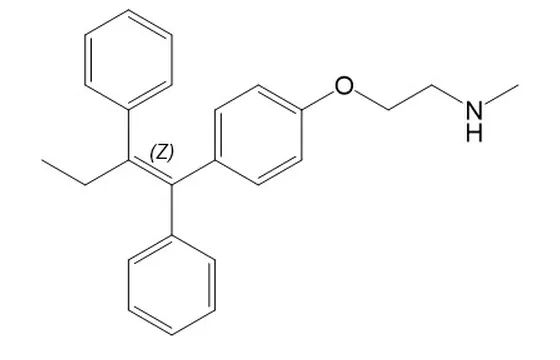
Tamoxifen is a triphenylethylene: two phenyl rings and a 4-(2-dimethylaminoethoxy)phenyl group on one carbon of a but-1-enyl double bond. The base is C26H29NO, 371.5[1]. Count the tetrahedral carbons with four different substituents and the answer is none. The amine nitrogen inverts. What is left is the geometry of that double bond, and the drug is the Z configuration.
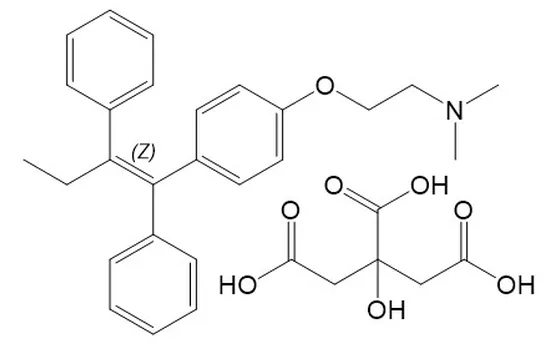
The tablet is the citrate. One molecule of citric acid per molecule of base gives C32H37NO8, 563.6, a 1:1 salt with no water of crystallization, and the label states the strength as tamoxifen base[2]. That salt factor is where most of the arithmetic errors in this file begin. A 20 mg dose is 20 mg of base and 30.4 mg of salt, so a limit written as a percentage of the salt is 1.52 times the same limit written on the base.
At 20 mg the difference is tens of micrograms, which sounds academic until the limits get small. The most interesting limit on this molecule is under two micrograms.
EP impurity A weighs exactly what the drug weighs
The European Pharmacopoeia designates the E isomer as impurity A. Its formula is C26H29NO and its molecular weight is 371.5, identical to the drug, because it is the drug with one bond rotated[1]. No mass spectrometer distinguishes them. No ultraviolet detector distinguishes them either: the chromophore is the same styrene-like system and the two spectra overlay.
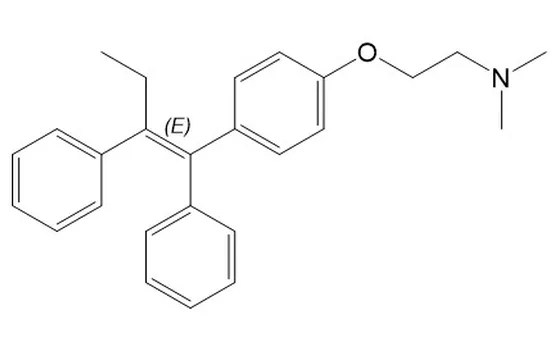
There is no diagnostic fragment ion, no shifted maximum, no derivatization that reacts with one and not the other. Identity is a retention time on a system that resolves them, and the only way to prove that the system resolves them is to inject a mixture and measure it.
The reference material set for this molecule therefore needs two items, not one. A pure E-isomer standard tells you where the peak should appear. A mixture of Z and E tells you whether the column separates them at the ratio you will actually meet, which is a few tenths of a percent of E under a large Z peak, not a fifty-fifty blend. System suitability built on a pure standard proves retention and nothing about resolution.
Light has a second and third product, not just the E isomer
The E isomer is the first thing irradiation makes, and the mistake is to assume it is the only thing. A photostability study of a tamoxifen oral liquid resolved the sequence: the native Z drug partially isomerizes to E, and on continued irradiation both isomers convert to their respective phenanthrene derivatives, with a photooxidation ketone appearing when oxygen is present. Five products from one experiment[4].
The chemistry is the classic stilbene photocyclization. Two aryl rings on the same side of a double bond close to a dihydrophenanthrene under light, and oxidation aromatizes it to a phenanthrene. Closure requires the cis arrangement, so the Z drug can go directly while the E isomer has to isomerize back first; irradiation drives both directions at once.
Two consequences follow, and both change how a forced degradation package should be read. First, an E-isomer limit does not bound the light liability, because the phenanthrenes are a separate pathway with a different chromophore and possibly a different response factor at the assay wavelength. Second, mass balance on a photostressed sample will not close against tamoxifen plus E isomer. If it appears to close, the integration is probably missing peaks.
The crystal form sets the rate of all of it
Tamoxifen citrate is polymorphic, and the two forms behave differently under light. A study of forms A and B irradiated with visible light, UVA at 320 to 400 nm and part of the UVB range found form A chemically unstable and form B stable. Both discolored from white to brown, but the color penetrated further into form A pellets than into form B[5].
This is the finding that stops a specification from being written as if the molecule were the only variable. Same API, same salt, same tablet, two crystal forms, two degradation rates. Photostability becomes partly a sourcing question: a form change at the supplier can move light sensitivity without moving a single retention time.
So characterize the crystal form of the lot used in the photostability study and state it in the dossier. A Q1B study on an uncharacterized lot answers a question about that lot.
Where 0.006 percent comes from, and why it is not an ICH number
The general thresholds do not produce a limit anywhere near that low. ICH Q3A sets a reporting threshold of 0.05 percent, an identification threshold of 0.10 percent or 1.0 mg per day whichever is lower, and a qualification threshold of 0.15 percent or 1.0 mg per day, for a maximum daily dose of 2 g or less[3]. At 20 mg of base, expressed on the salt, those are 15.2, 30.4 and 45.6 micrograms per day.
An E-isomer specification of 0.006 percent by weight is something else. It appears in a 2004 patent application claiming tamoxifen that contains not more than 0.006 percent of its geometric E isomer, for a medicament with a significantly reduced risk of causing endometrial hyperplasia[6]. The driver is not a qualification threshold. It is the estrogenic liability of the E isomer, which is why a geometric impurity on this molecule is treated as a safety-relevant species rather than a chromatographic nuisance.
| Limit | Source | Percent of base or salt | Micrograms per day at 20 mg base | What it controls |
|---|---|---|---|---|
| Reporting | ICH Q3A[3] | 0.05 | 15.2 as salt, 10.0 as base | What enters the table at all |
| Identification | ICH Q3A[3] | 0.10 | 30.4 as salt, 20.0 as base | Obligation to characterize the structure |
| Qualification | ICH Q3A[3] | 0.15 | 45.6 as salt, 30.0 as base | Toxicological cover for the level found |
| E isomer, committed | Patent claim[6] | 0.006 | 1.8 as salt, 1.2 as base | Estrogenic liability of the E isomer |
| Mutagenic TTC | ICH M7[7] | 0.0075 of base | 1.5 | Reference point, not a stated limit here |
Table note: thresholds from ICH Q3A(R2)[3]; the 0.006 percent figure is the claim of WO 2004/012723 A1[6]; conversions use 371.5 for the base and 563.6 for the citrate salt. The last row is arithmetic for comparison only and is not a limit applied to tamoxifen.
The last two rows deserve to sit side by side. At 20 mg, 0.006 percent is 1.2 micrograms of E isomer a day, and the default threshold of toxicological concern for a mutagenic impurity is 1.5 micrograms a day[7]. A limit chosen for an estrogenic effect has landed within a factor of 1.3 of the number you would derive by treating the impurity as genotoxic. That is not proof of intent, but it explains why the figure looks familiar to anyone who writes M7 assessments.
What the method has to prove, in order
Resolution first. The E and Z isomers differ in lipophilicity only slightly, and the standard approach is a C18 column with an acidic aqueous phase against acetonitrile. A published stability-indicating method for bulk drug and tablets used pH 2.0 phosphate buffer with acetonitrile and added N,N-dimethyloctylamine to the mobile phase to improve peak shape[8]. The amine additive matters: tamoxifen is a tertiary amine that interacts with residual silanols, and a tailing Z peak will swallow a small E peak sitting behind it.
Second, the system suitability standard. It should be the mixture, not the pure isomer, and the acceptance criterion should be resolution at a ratio close to the specification limit rather than at a convenient ratio. A resolution of 2.0 measured on a one-to-one blend says little about a 0.15 percent peak on the tail of a 99.8 percent peak.
Third, the forced degradation design. Light exposure per ICH Q1B option 2 is 1.2 million lux hours of visible light and 200 watt-hours per square meter of near ultraviolet[9]. Run the samples in clear and in ambered glass, because otherwise a thermal degradant and a photolytic degradant are reported as one number. And monitor the oxidative arm as separate peaks rather than assuming every new peak is the E isomer.
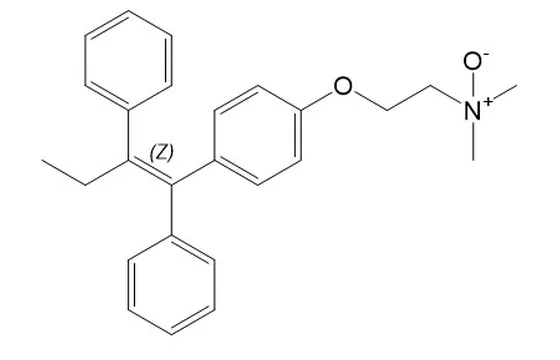
The N-oxide is the internal control for that arm. It is the drug plus one oxygen, it is also a known metabolite[10], and its retention is far from the Z and E pair, so its presence proves the stress condition did something even when the E isomer does not move.
Sample handling belongs in the method, not in a footnote
A photostability investigation of a commercial tamoxifen oral liquid tested two mitigations: an amber glass container as a physical light barrier, and ascorbic acid or quercetin as antioxidants[4]. They address different steps: the container blocks photons, the antioxidant intercepts the chain after absorption.
For tablets the container is the primary control, and the label reflects it: dispense in a tight, light-resistant container as defined in the USP[2]. What the label does not do is protect the sample between the bottle and the autosampler. If the sequence sits on a bench under a window for six hours, the E-isomer result will drift upward across the run, and the drift will look like a chromatography problem.
Treat sample preparation as a light-protected operation: amber glassware, foil over the autosampler tray, and a check of the same vial at the start and the end of the sequence. If the E-isomer area changes between injections of one vial, the method has told you something about the bench, not about the batch.
How much of the market shares this method
The Chinese filing record for tamoxifen citrate is small enough to read product by product, which matters when a limit this tight must be reproduced by laboratories that did not design the method. The count below is accepted filings, not approvals.
Read it as method-transfer risk, not market size. Every applicant running one geometry-sensitive assay is another chance to integrate a tailing peak differently, and the E isomer sits where integration is least stable.
What transfers to other double-bond drugs, and what does not
Two other substances in this catalog are also defined by a double-bond geometry. Terbinafine hydrochloride carries an E-configured enyne whose geometry is fixed by the allylic chloride used to build it, so the wrong isomer there is a process signature rather than a photochemical one. Vitamin A is the opposite case, a family of E and Z isomers that interconvert readily, and the compendial problem is assigning all-trans content in a mixture rather than excluding a single isomer.
The part that does not transfer is the photocyclization. A stilbene can close to a phenanthrene; an enyne cannot, and a retinol cannot. A light-stress package designed around a Z-to-E ratio is adequate for terbinafine and inadequate for tamoxifen, and the difference is structural rather than procedural.
A nearer analogy in failure mode, though not in chemistry, is anastrozole, whose same-mass impurity is a triazole regioisomer. Both need a standard to establish identity because mass spectrometry is silent, and neither can be controlled by a mass-based argument. The analogy breaks at the trigger: light moves tamoxifen, while one wrong nitrogen in a triazole ring makes the anastrozole impurity during synthesis.
Warfarin sodium is often grouped with tamoxifen because both are narrow-therapeutic-index oral drugs with one stereochemical feature. That grouping misleads: warfarin racemizes at a real chiral center, so its specification is about enantiomer ratio, while tamoxifen has none.
Five failures that recur on this molecule
One: reporting the E isomer against the base when the specification is written on the salt. The factor is 1.52 and it does not cancel.
Two: proving resolution with a pure E-isomer standard. That demonstrates retention, not separation.
Three: treating the E isomer as the only photoproduct. The phenanthrenes and the ketone are separate peaks with separate response factors[4].
Four: a photostability study on an uncharacterized crystal form. Forms A and B differ by a margin that decides the outcome[5].
Five: prepared solutions left on the bench. The drift is real, runs toward the impurity, and is easy to blame on the column.
Choosing standards for a two-item problem
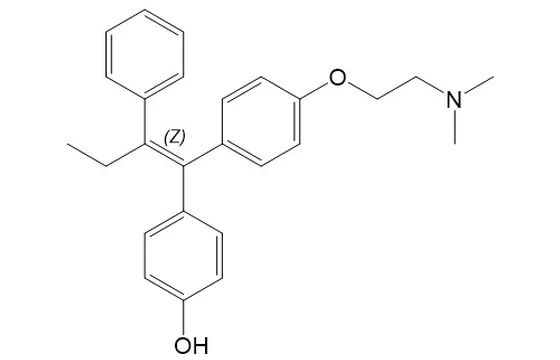
This catalog carries 33 entries under tamoxifen citrate, numbered to 38 with gaps, and the geometric family is covered more completely than that count suggests. The E isomer is available as the free base at CAS 13002-65-8 and as the hydrochloride at CAS 66584-36-9, and there is a mixed Z and E material at CAS 7728-73-6 that exists for the resolution experiment itself. The oxidative arm is covered by the N-oxide at CAS 75504-34-6 and by 4-hydroxytamoxifen at CAS 68047-06-3, and the demethylated series by N-desmethyltamoxifen at CAS 31750-48-8. The full list, with salt forms and formulae, sits on the variety page: Tamoxifen Citrate reference standards.
For method development the working set is four: the mixture for suitability, the pure E isomer for peak assignment, the N-oxide for the oxidative arm, and one hydroxylated standard to anchor the retention window.
Frequently Asked Questions
Does tamoxifen have any chiral center at all?
Why can the E isomer not be identified by mass spectrometry?
Is the E isomer a degradation product or a process impurity?
What is the practical significance of the 0.006 percent figure?
Should the limit be expressed on the base or on the salt?
Does a light-protected container remove the need for a photostability study?
Are the phenanthrene derivatives specified impurities?
How does crystal form enter the argument?
Related Substances and Reference Standards
- Tamoxifen Citrate (33 impurity / derivative entries)
- Terbinafine Hydrochloride (- impurity / derivative entries)
- Anastrozole (- impurity / derivative entries)
References and Sources
- PubChem, National Center for Biotechnology Information, Tamoxifen, CID 5376, C26H29NO, 371.5; (E)-tamoxifen, CAS 13002-65-8, CID 3032583, the same formula and the same molecular weight, accessed 2026-11-22
- DailyMed, US National Library of Medicine, Tamoxifen citrate tablets, prescribing information: strength expressed as tamoxifen base, and the direction to dispense in a tight, light-resistant container as defined in the USP, accessed 2026-11-22
- International Council for Harmonisation, ICH Q3A(R2), Impurities in New Drug Substances, Attachment 1: reporting 0.05 percent, identification 0.10 percent or 1.0 mg per day, qualification 0.15 percent or 1.0 mg per day at a maximum daily dose of 2 g or less, accessed 2026-11-22
- ACS Omega, American Chemical Society, Light-induced degradation of tamoxifen in liquid formulations: multivariate kinetic profiling, stabilization strategies and estrogen receptor binding, including the sequence from Z to E, two phenanthrene derivatives and a photooxidation ketone, accessed 2026-11-22
- International Journal of Pharmaceutics, Effect of spectroscopic properties on photostability of tamoxifen citrate polymorphs: form A chemically unstable and form B stable under visible light, UVA at 320 to 400 nm and part of the UVB range, accessed 2026-11-22
- WIPO, PCT publication WO 2004/012723 A1Tamoxifen containing not more than 0.006 percent by weight of its geometric E isomer, for a medicament with a significantly reduced risk of causing endometrial hyperplasia
- International Council for Harmonisation, ICH M7(R2), Assessment and Control of DNA Reactive (Mutagenic) Impurities in Pharmaceuticals: threshold of toxicological concern of 1.5 micrograms per day, accessed 2026-11-22
- Journal of Pharmaceutical SciencesSimultaneous determination of tamoxifen citrate and its E isomer impurity in bulk drug and tablets by high-performance liquid chromatography, using a C18 column, pH 2.0 phosphate buffer with acetonitrile, and N,N-dimethyloctylamine as a peak-shape additive
- International Council for Harmonisation, ICH Q1B, Photostability Testing of New Drug Substances and Products: option 2 exposure of 1.2 million lux hours of visible light and 200 Wh per square meter of near ultraviolet, accessed 2026-11-22
- PubChem, National Center for Biotechnology Information, Tamoxifen N-oxide, CAS 75504-34-6, CID 3033895, C26H29NO2, 387.5; 4-hydroxytamoxifen, CAS 68047-06-3, C26H29NO2, 387.5, accessed 2026-11-22
This article was prepared by the CATO technical team. Regulatory, pharmacopoeial and published literature content cited above is attributed in the reference list. It is provided for technical exchange and search reference only and does not constitute a quality specification or regulatory advice. For any specific substance, the applicable test methods, limits and filing requirements are governed by the current regulations, pharmacopoeial monographs and official publications.
Product information on this site is provided for research search and selection reference only and is not a quality specification; technical data, purity and structural confirmation are governed by the shipped COA and our written confirmation. All products mentioned are for research use only, not for human or animal diagnostic or therapeutic use.