Tamsulosin at 0.4 mg: Generous Limits, and a Method That Still Fails
Tamsulosin hydrochloride is dosed at 0.4 mg, small enough to invert the arithmetic that governs most genotoxic impurity work. A threshold of toxicological concern of 1.5 micrograms per day becomes 3750 ppm in the drug substance, so a batch that meets the pharmacopoeia is already well inside the mutagenicity budget. That does not make the file easy. It moves the difficulty from the limit to the purge, the enantiomer and the assay.
Note: product names shown in red (marked with ↗) are links - click through to the product page for structure, CAS number, purity and lead time.
One sulfonamide, one stereocenter, one secondary amine
Key points
- Tamsulosin hydrochloride is C20H29ClN2O5S, 445.0, CAS 106463-17-6, given at 0.4 mg once a day, with one stereocenter, one secondary amine and one sulfonamide.
- At 0.4 mg a day the ICH M7 threshold of 1.5 micrograms per day converts to 3750 ppm, two and a half times the 0.15 percent qualification threshold, so meeting the pharmacopoeia already keeps a batch inside the mutagenicity budget[1].
- The pharmacopoeial impurity letters bracket the alkylation step: impurity F is the amine half, impurity I is the alkyl bromide half, and impurity G is the enantiomer[2].
- The one limit that binds below the general thresholds is the nitrosamine, and only if the compound lands in the second potency category, where 100 ng per day is 250 ppm at this dose[3].
Tamsulosin is a selective alpha-1A antagonist used in benign prostatic hyperplasia, and the structure reads in one line: a 2-methoxybenzenesulfonamide carrying a 2-aminopropyl chain, which carries a 2-(2-ethoxyphenoxy)ethyl group on its nitrogen. Three elements decide what follows. The benzylic carbon of the aminopropyl chain is the single stereocenter and the drug is the R configuration. The amine is secondary, with one hydrogen available for nitrosation. The sulfonamide nitrogen is acylated by the sulfonyl group and is not a nitrosation site in the same sense.
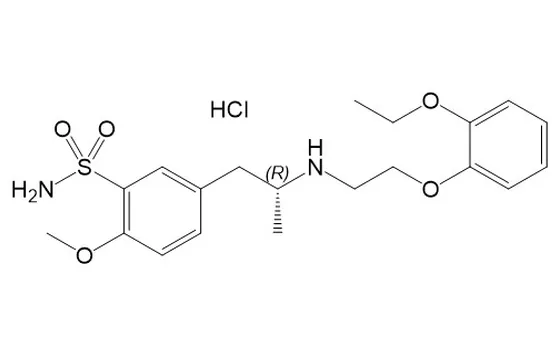
Four hundred micrograms once daily is one of the smallest chronic doses in the pharmacopoeia, and it decides which parts of the quality argument do the work. The tamsulosin page in our catalogue holds 65 rows, and they read less like a list of degradation products than like a photograph of the route.
The arithmetic that inverts the usual answer
Genotoxic impurity control usually opens with a number that is uncomfortably small. A threshold of toxicological concern of 1.5 micrograms per day divided by a daily dose of a gram or two gives parts per billion, below the reporting threshold of the related-substances method, which forces a dedicated assay with its own validation package[1].
At 0.4 mg the division runs the other way. 1.5 micrograms divided by 0.4 mg is 3750 ppm, or 0.375 percent. The qualification threshold for a drug substance under ICH Q3A(R2) is 0.15 percent, so a batch that passes the general specification is at most 40 percent of the way to the threshold of toxicological concern[4]. Nothing in the mutagenicity framework is binding.
| Drug | Maximum daily dose | 1.5 micrograms per day as a concentration |
|---|---|---|
| Metformin↗ hydrochloride | 1700 mg | 0.9 ppm |
| Allopurinol↗ | 300 mg | 5 ppm |
| Fluoxetine hydrochloride | 20 mg | 75 ppm |
| Ezetimibe↗ | 10 mg | 150 ppm |
| Tamsulosin hydrochloride | 0.4 mg | 3750 ppm |
Division of the ICH M7 threshold of toxicological concern by the maximum daily dose. Four orders of magnitude separate the first row from the last, with no change in the toxicological reference point.
The inversion also holds for the tablet. Under ICH Q3B(R2) a 0.4 mg product sits in the lowest dose band, where the identification threshold is 1.0 percent or 5 micrograms, whichever is lower[5]. One percent of 0.4 mg is 4 micrograms, so the percentage limb governs: the threshold is 1.0 percent of the tablet, or four micrograms per dose, a quantity a modern HPLC method handles without strain.
Put this first in a deficiency response, because it reframes the question. A reviewer who asks why there is no dedicated limit for the alkylating agent is not asking for more control; the reviewer is testing whether the applicant did the arithmetic. Entecavir at 0.5 mg runs the same calculation and reaches the same conclusion, which makes the pair a useful sanity check: dose, not hazard class, decides where the limit comes from.
What the Pharmacopoeia letters actually bracket
The impurity vocabulary is unusually legible. Read the rows in letter order and the last steps of the route appear: an amine, an aldehyde, an amine fragment, a bromide, and the mirror image of the drug.
| Entry | CAS | Formula | What it is |
|---|---|---|---|
| Impurity A | 2727060-83-3 | C30H41ClN2O7S | a hydrochloride of a species ten carbons larger than the drug |
| Impurity B | 112101-81-2 | C10H16N2O3S | the R amine intermediate, 5-(2-aminopropyl)-2-methoxybenzenesulfonamide |
| Impurity C | 2244986-82-9 | C18H24N2O4S | one ethyl group short of the drug |
| Impurity D | 1799280-05-9 | C19H26N2O5S | one carbon short of the drug |
| Impurity E | 105764-07-6 | C8H9NO4S | 5-formyl-2-methoxybenzenesulfonamide, the side chain oxidised and cleaved |
| Impurity F | 6781-17-5 | C10H15NO2 | 2-(2-ethoxyphenoxy)ethylamine, the amine half of the alkylation |
| Impurity G | 106138-88-9 | C20H28N2O5S | the S enantiomer of the drug |
| Impurity I | 3259-03-8 | C10H13BrO2 | 1-(2-bromoethoxy)-2-ethoxybenzene, the bromide half of the alkylation |
Formulae and CAS numbers from our catalogue, read on 9 November 2026, with structural assignments cross-checked against PubChem records. The letters in our index run A to I with no H.
Impurities F and I are the two halves of one reaction. The route starts from 2-ethoxyphenol, converts it to 2-(2-ethoxyphenoxy)ethanol and then to the bromide, and displaces the bromide with the R amine. Impurity I is the unreacted bromide; impurity F is the same bromide after displacement by ammonia instead of by the drug amine. Between them they record how much of the alkylating agent went to the wrong nucleophile.
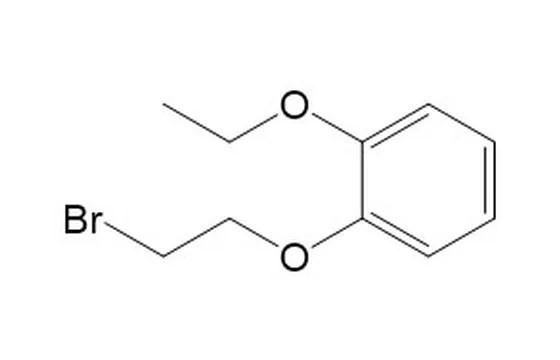
Three rows carry the formula of impurity I: the 2-ethoxy compound and its 3-ethoxy and 4-ethoxy positional isomers. They exist as standards to prove that the method separates the reagent actually used from isomers that would never be present, which is a selectivity argument rather than a control strategy.
The alkylating agent is a compendial impurity
It is unusual for a pharmacopoeia to name the alkylating reagent as an impurity, and instructive that this one does. 1-(2-Bromoethoxy)-2-ethoxybenzene is a primary alkyl bromide: the carbon bearing the bromine is unhindered, the leaving group is good, and the molecule will alkylate thiols and amines without activation. That is a direct-acting alkylator, the structural class genotoxicity testing was invented for.
Under ICH M7 the compound is an alerting structure without its own data, which places it in Class 3 by default; the options are control at the threshold of toxicological concern or a demonstration that the level is below the qualification threshold[1]. At 0.4 mg the first is 3750 ppm and the second is 1500 ppm, so the second is available and simpler. A batch at 0.15 percent is compliant without a dedicated limit.
What is not optional is the purge argument, because the reagent is charged in the last step and the specification therefore rests on the workup rather than on the chemistry. Three parts make it defensible. A spiking study, in which the bromide is added at a known multiple of its expected carry-over before the final isolation, with the level measured in the isolated drug across three consecutive batches. A fate analysis, showing where the bromide goes: into product, into the alcohol by hydrolysis, into the amine by displacement, or into aqueous waste. And a stability check, because a residual alkylator can keep reacting in the solid state or in a wet granulate.
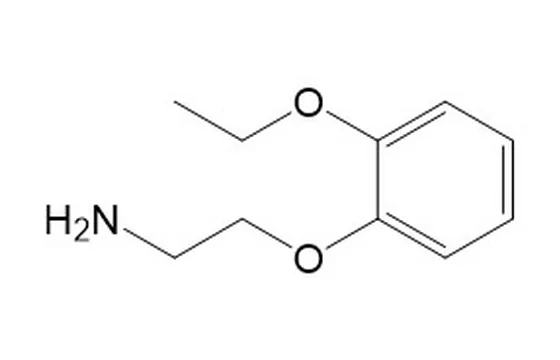
The fate analysis is easier when the alcohol and the amine are on the shelf. 2-(2-Ethoxyphenoxy)ethanol, C10H14O3, 182.2, CAS 3250-73-5, is both the bromination substrate and the hydrolysis product of the bromide. Quantifying all three in the mother liquor turns a narrative into data.
The enantiomer is the only impurity that can reach 50 percent
Everything else here sits at parts per thousand or less because the chemistry is inefficient. The enantiomer sits at whatever the resolution left behind, and if the resolution fails it sits at 50 percent. That asymmetry is why the chiral specification deserves more attention than its position in the monograph suggests.
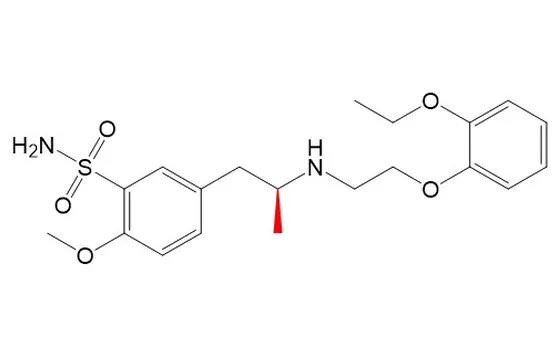
The two enantiomers are identical in mass, in ultraviolet spectrum and in everything an achiral method measures. Separation needs a chiral selector: a capillary electrophoresis method developed under quality-by-design principles for simultaneous chiral purity and impurity profiling, an amylose tris(3,5-dimethylphenylcarbamate) column in one HPLC study, a cellulose-based phase in another[6,7]. Three published chiral methods is a fair signal that none of them is routine.
Three points are worth preparing in advance. The standard, which must be the S enantiomer rather than the racemate, because a 50:50 mixture used as a resolution standard flatters the method. The resolution step itself, documented as a robust unit operation with a specified enantiomeric excess at isolation rather than a purge factor calculated from solubility. And the racemisation risk downstream, which for a benzylic amine is real but slow: any step generating a benzylic carbocation, or a long hold at elevated temperature in a polar protic solvent, erodes the enantiomeric excess, and the stability protocol should show that it does not happen.
The catalogue carries the racemate in both free base and hydrochloride form, useful for one purpose only: showing that the method resolves a 50:50 mixture into two peaks.
The nitrosamine sits where the limit does bind
The secondary amine is a genuine nitrosation substrate, and the catalogue already contains the product: N-nitroso-tamsulosin, C20H27N3O6S, 437.5, CAS 2892260-31-8, one nitrogen and one oxygen more than the drug and one hydrogen fewer, which is exactly what a nitroso group adds[2].
This is the one place where the low dose does not help, because the nitrosamine limit comes from an acceptable intake in nanograms rather than from the threshold of toxicological concern. At 100 ng per day, the second potency category, 0.4 mg gives 250 ppm, or 0.025 percent[3]. That is below the 0.05 percent reporting threshold, so the nitrosamine cannot be covered by the general specification however good the method is; it needs its own line, method and limit.
At 400 ng per day, the third category, the same division gives 1000 ppm, which coincides with the 0.10 percent identification threshold. The potency category therefore decides whether a dedicated control is unavoidable or merely prudent, and the assignment is a structural argument to be made explicitly rather than inherited. Nitrosamines built on an activated secondary amine are generally not placed in the least potent categories, and the burden of justifying a favourable assignment sits with the applicant.
Two negatives belong in the same section, because reviewers read them together. The sulfonamide nitrogen is not the site: it is acylated by the sulfonyl group, and N-nitroso sulfonamides are not stable enough to manage as a specification item. And the route introduces no nitrosating agent, so formation runs through the product and its excipients: nitrite in a wet granulation, in the water, or in a film coat, plus the acidic microclimate that the hydrochloride provides by itself. Metformin and cinacalcet are the comparison cases worth naming, the first because its nitrosamine is assembled from fragments and the second because it carries a secondary amine at doses two orders of magnitude higher, so the same acceptable intake converts to a limit two orders of magnitude tighter.
What a deficiency letter on a 0.4 mg product asks
Five questions recur at this dose, and each answer is shorter than the work behind it.
Why is there no dedicated limit for the alkyl bromide? Because the arithmetic does not require one: 3750 ppm from the threshold of toxicological concern against a 1500 ppm qualification threshold means the general specification is stricter, and the purge study shows actual carry-over far below both. Attach the spiking data, not the calculation alone.
How was the enantiomer method validated at the limit? With the S enantiomer as standard, a resolution criterion between the peaks, and a demonstrated absence of racemisation during sample preparation. If the diluent or the extraction temperature racemises the analyte, the method reports an enantiomeric excess the batch does not have.
Which nitrosatable nitrogens were considered? The secondary amine, with the product identified and a limit proposed; the sulfonamide nitrogen, dismissed on chemical grounds; and any secondary amine in the impurity list, ranked by level. The answer should be a numbered list with a conclusion per line.
Why is the specification where it is? Show the Q3A and Q3B arithmetic at 0.4 mg: 0.10 percent identification for the drug substance is 0.4 micrograms, while 1.0 percent for the tablet is 4 micrograms. Those two numbers explain why the API specification controls and why the product limits look generous.
Are the standards characterised for assay as well as identity? This matters more here than usual, because impurity I is a liquid. A liquid standard needs an assay value, a water content and a purity profile before it can be used quantitatively. The same applies to the S enantiomer, where the enantiomeric purity of the standard sets the floor of what the method can prove.
The block reports accepted filings and applicants, not approvals. The field is small enough that each applicant is visible, and the impurity package rather than the price tends to decide who is asked for supplements.
What to keep on the shelf
The routine set is four solids and one liquid: the drug substance, impurity B as the amine intermediate, impurity E as the oxidative marker of the side chain, impurity G as the enantiomer, and impurity I as the bromide, handled as a liquid standard with an assigned assay. Impurity F and the alcohol at CAS 3250-73-5 join the set when the purge argument is being built, because they are the two destinations of the bromide.
Beyond that, the positional isomers of the bromide are worth having for selectivity work, the racemate once, and N-nitroso-tamsulosin if the potency assignment requires a limit rather than a documented negative. The catalogue covers all of them, including eight of the nine letters: Tamsulosin hydrochloride reference standards and related entries.
Frequently Asked Questions
Does a 0.4 mg dose make genotoxic impurity control easier?
Is the alkyl bromide in the last step a Class 3 impurity?
Why is impurity I both an impurity and a reagent?
Can the enantiomer be controlled by the achiral related-substances method?
Which nitrogen carries the nitrosamine risk?
What limit does the nitrosamine need at this dose?
What is the weakest point in a typical file for this product?
Do the finished-product limits need to match the API limits?
Related Substances and Reference Standards
- Tamsulosin Hydrochloride (65 impurity / derivative entries)
- Cinacalcet Hydrochloride (105 impurity / derivative entries)
- Entecavir (59 impurity / derivative entries)
- Metformin Hydrochloride (83 impurity / derivative entries)
References and Sources
- International Council for Harmonisation, ICH M7(R2) Assessment and Control of DNA Reactive Impurities in Pharmaceuticals: hazard classes, the 1.5 microgram per day threshold of toxicological concern and control options for Class 3 impurities, accessed 2026-11-09
- National Library of Medicine, PubChem, Compound records for the pharmacopoeial impurities of tamsulosin hydrochloride, including 1-(2-bromoethoxy)-2-ethoxybenzene, 2-(2-ethoxyphenoxy)ethylamine, the S enantiomer and N-nitroso-tamsulosin, accessed 2026-11-09
- United States Food and Drug AdministrationRecommended acceptable intake limits for nitrosamine drug substance related impurities: carcinogenic potency categorization approach with potency categories and their ng per day limits
- International Council for Harmonisation, ICH Q3A(R2) Impurities in New Drug Substances: reporting, identification and qualification thresholds, accessed 2026-11-09
- International Council for Harmonisation, ICH Q3B(R2) Impurities in New Drug Products: thresholds for degradation products as a function of maximum daily dose, accessed 2026-11-09
- Journal of Separation Science, 2023Quality by design guided development of a capillary electrophoresis method for the simultaneous chiral purity determination and impurity profiling of tamsulosin
- Talanta, 2012, A new HPLC method for the chiral separation of tamsulosin enantiomers on an amylose tris(3,5-dimethylphenylcarbamate) stationary phase, accessed 2026-11-09
This article was prepared by the CATO technical team. Regulatory, pharmacopoeial and published literature content cited above is attributed in the reference list. It is provided for technical exchange and search reference only and does not constitute a quality specification or regulatory advice. For any specific substance, the applicable test methods, limits and filing requirements are governed by the current regulations, pharmacopoeial monographs and official publications.
Product information on this site is provided for research search and selection reference only and is not a quality specification; technical data, purity and structural confirmation are governed by the shipped COA and our written confirmation. All products mentioned are for research use only, not for human or animal diagnostic or therapeutic use.