Tenofovir Alafenamide: One Molecule, Three Formula Strings, and a 12 Percent Error Waiting to Happen
The label for tenofovir alafenamide tablets says each tablet contains 25 mg of the base, equivalent to 28 mg of the fumarate. Twenty-five over twenty-eight is 0.893, and that number is not a detail: it tells you the salt is a hemifumarate, and it tells you which of three catalogue entries will give you the right answer.
Note: product names shown in red (marked with ↗) are links - click through to the product page for structure, CAS number, purity and lead time.
Key points
Key points
- The tablet contains 25 mg of tenofovir alafenamide, equivalent to 28 mg of the fumarate, which fixes the salt as a hemifumarate rather than a 1:1 fumarate[1].
- Three entries exist for one molecule: free base at 476.47, monofumarate at 592.5 and the 2:1 species at 1069.0. Using the wrong one shifts an assay by 12 to 24 percent[2,3,4].
- Our catalogue carries five free-base entries and five fumarate entries with the same impurity numbers, so a purchase order that names only the number can deliver either form[2,3].
- Phosphorus is a stereocentre here. The diastereomer is isobaric with the drug, and the published route work treats its separation as a dedicated problem rather than a chromatography detail[5].
Three formula strings for one molecule
Tenofovir↗ alafenamide is a phosphonamidate prodrug of tenofovir. The free base is C21H29N6O5P at 476.47, and it carries a stereogenic phosphorus: the phosphonamidate centre has four different substituents, so the molecule exists as two diastereomers, and the drug is one of them[2]. That single structural fact generates most of the analytical difficulty discussed below.
The catalogue carries the substance under three different formula strings. The free base, CAS 379270-37-8, C21H29N6O5P, 476.47[2]. The monofumarate, CAS 379270-38-9, C25H33N6O9P, 592.5, which is one molecule of base plus one molecule of fumaric acid at 116.07[3]. And a third entry, CAS 1392275-56-7, C46H62N12O14P2, 1069.0, which is two molecules of base plus one of fumaric acid — a hemifumarate written out as a dimer[4].
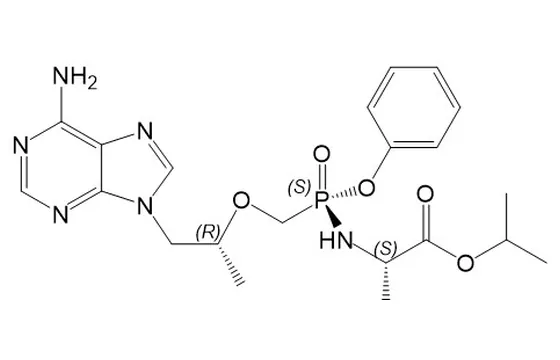
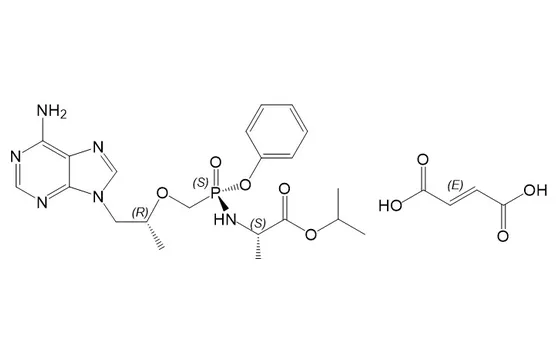
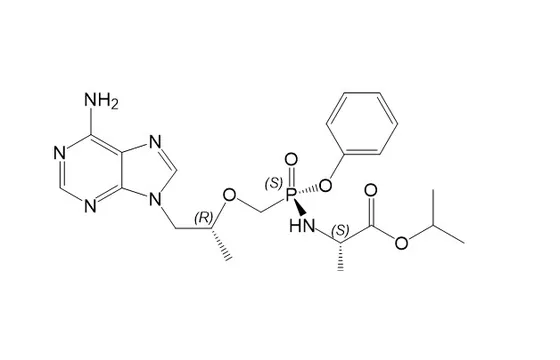
Three entries, one active moiety. The 476.47 and the 592.5 differ by exactly the mass of fumaric acid, and 1069.0 is twice 476.47 plus 116.07 to within rounding. Anyone who has weighed a standard and typed a molecular weight into a spreadsheet has already made the choice between them, whether or not they noticed making it.
What the label settles, and what it leaves open
The prescribing information contains one sentence that resolves the stoichiometry: each tablet contains 25 mg of tenofovir alafenamide, equivalent to 28 mg of tenofovir alafenamide fumarate[1]. Divide 25 by 28 and you get 0.893. The base fraction of the monofumarate is 476.47 divided by 592.54, which is 0.804. The base fraction of the hemifumarate is 476.47 divided by 534.51, which is 0.891. The label's 0.893 matches the hemifumarate and not the 1:1 salt[4,3].
That is worth pausing on, because the same acid appears in the other tenofovir prodrug at a different ratio. Tenofovir disoproxil fumarate is the 1:1 salt: 519.4 for the base plus 116.07 for the acid gives 635.5, which is the listed molecular weight[6]. Two prodrugs, one counterion, two stoichiometries, and a naming convention that uses the same three words for both. A dossier that copies the salt factor from one to the other is wrong by eleven percent and will not fail any validation parameter.
The label also fixes the dose: 25 mg once daily, with food[1]. Twenty-five milligrams is small enough that the absolute caps in the ICH tables sit far away, so every percentage threshold applies directly, and the mutagenic limit lands at 60 ppm — 1.5 micrograms divided by 25 mg[7]. The tablet has its own Q3B bands for degradation products, and they are looser[8].
The arithmetic of weighing basis
Here is the calculation that decides whether a certificate is usable. Suppose a laboratory prepares a 0.10 percent spike of an impurity at the 25 mg dose and reports the result against the wrong form of the standard. The consequences are not subtle.
| Form | Formula and mass | Base fraction | Error if treated as base |
|---|---|---|---|
| Free base | C21H29N6O5P, 476.47 | 1.000 | None |
| Hemifumarate, 2:1 | C46H62N12O14P2, 1069.0 | 0.891 | Plus 12.2 percent high |
| Monofumarate, 1:1 | C25H33N6O9P, 592.5 | 0.804 | Plus 24.4 percent high |
Table note: base fractions calculated from the stated molecular weights; fumaric acid taken as 116.07. The label ratio of 25 to 28 corresponds to 0.893, the hemifumarate row[1,4].
An assay that reads 24 percent high does not look like an error in the standard. It looks like an unusually potent batch, or a dissolution result that is suspiciously good. Both get investigated in the wrong direction, and the investigation costs more than the standard would have.
Five pairs, and why the number is not enough
Our catalogue carries 40 numbered entries beside the API for this substance. Five impurity numbers appear twice: once as a free base and once as a fumarate. Impurity 13 exists as CAS 383365-04-6 and as CAS 1422343-76-7; the first is the base, the second the salt. Impurity 16, impurity 30, impurity 94 and impurity 96 repeat the pattern. The parent itself repeats it at 379270-37-8 and 379270-38-9[2,3].
The pattern is not a catalogue defect. It is what a supplier does when a customer asks for the salt form of an impurity that was originally sold as the free base, and it is the correct thing to do. The failure mode is on the buyer's side: an order written as "impurity 16" with no formula string can legitimately be filled from either shelf, and both will pass incoming identity testing, because the identity test for an impurity is usually a retention time and a mass.
The scale of the problem is visible in the filing record. CDE acceptance data for this substance, counted on 25 November 2026:
Acceptance records and applicants, not approvals, and no statement about salt form.
The fix is procedural rather than analytical. Write the CAS number and the formula string on the specification, and state the weighing basis on the method: as-is, anhydrous, or salt-free. For a hemifumarate that also carries water, all three bases differ, and only one of them matches the number the specification quotes.
The phosphorus that is also a stereocentre
Phosphonamidate phosphorus with four different substituents is stereogenic, and the drug is a single diastereomer. The other diastereomer is isobaric: same C21H29N6O5P, same 476.47, same fragments in most product-ion scans, because the connectivity is identical and only the geometry at phosphorus differs. Our catalogue indexes CAS 383365-04-6 as a diastereomer of tenofovir alafenamide at the same formula, which is the entry that exists to make this point[2].
Route chemistry confirms the scale of the problem. Published work on this molecule describes a dedicated enzymatic strategy for the diastereoselective isolation of the drug from its phosphorus epimer, which is a strong statement about how separable the pair is by ordinary means[5]. When a synthesis needs an enzymatic resolution step, the chromatographic separation is not trivial, and a generic reversed-phase gradient that happens to show a shoulder at 1.05 relative retention has not demonstrated anything.
Practical consequence for method validation: the diastereomer standard is not optional. Specificity against a spiked sample of the epimer, at the reporting threshold, is the only evidence that the main peak is not hiding it. Ultraviolet detection at the adenine band will see both equally, so the chromatogram gives no warning.
The hydrolysis ladder and the phenyl that goes missing
Both tenofovir prodrugs converge on tenofovir, C9H14N5O4P at 287.21[9]. The interesting part is what leaves on the way. Tenofovir alafenamide is a phenyl ester as well as an alanine isopropyl ester, so hydrolysis has two arms: the phosphonamidate cleaves to release the amino acid ester, and the phenyl ester cleaves to release phenol. The parent-minus-phenyl fragment is in the catalogue as C15H25N6O5P at 400.37, which is 476.47 minus 76.10, the mass of a phenylene unit[2].
That 400.37 entry is easy to misclassify. It looks like a truncated molecule and is easy to file as a process intermediate, but it is also what you get if the phenyl group is never installed or is lost early, and the two possibilities imply different specifications. A process impurity needs a purge argument; a degradant needs a stability argument. The formula alone does not tell you which, and the route does.
The phenol itself deserves a mention because it is small, volatile and ultraviolet-active at the same wavelengths as the analyte. Any method that quantitates phenol without checking for it in the blank will find it, and any method that does not look will not.
Comparisons that mislead
Tenofovir alafenamide invites comparison with sofosbuvir, and the phosphorus analogy is real: both are P-chiral prodrugs, both are dosed as single diastereomers, and both have an isobaric epimer that a mass spectrometer will not resolve. What does not transfer is the salt chemistry. Sofosbuvir↗ is not a salt, so the weighing-basis problem that dominates this article simply does not exist there, and a method transfer between the two carries the P-epimer lesson without the stoichiometry lesson.
The other comparison is with the older prodrug, and it is the one that catches people. Tenofovir disoproxil fumarate is a 1:1 fumarate at 635.5[6]. Same acid, different ratio, and the two are frequently handled by the same analysts in the same laboratory. If a worksheet template is copied from one to the other, the salt factor travels with it and nobody notices, because the number looks plausible.
What transfers usefully from the whole nucleotide family is the expectation that the impurity file will be dominated by hydrolysis products rather than by oxidation products. There is no benzylic position to oxidize and no thioether to over-oxidize; the chemistry that matters is ester and amide cleavage, and it happens in water at neutral pH whether or not anyone stresses the sample.
Common pitfalls
- Quoting a molecular weight without the stoichiometry. 476.5, 592.5 and 1069.0 all belong to this drug. Two of the three will give a wrong answer[2,3,4].
- Assuming the fumarate is 1:1 because the other prodrug's is. The label ratio of 25 to 28 settles it at 0.893, which is the hemifumarate[1].
- Ordering an impurity by number. Five numbers exist in both free-base and fumarate form. Put the CAS and the formula string on the order.
- Validating specificity without the phosphorus diastereomer. It is isobaric, it absorbs at the same wavelength, and it will not announce itself as a shoulder.
- Filing the 400.37 fragment as a degradant without checking the route. The same formula arises from an uninstalled phenyl group and from ester hydrolysis, and the two need different arguments[2].
Standards where the salt factor is the specification
Our catalogue carries 40 numbered entries beside the API here, including five impurity numbers that exist in both free-base and fumarate form and a hemifumarate entry that states the 2:1 stoichiometry explicitly. If the method has to be traceable, start with the full entry list and pick by CAS and formula rather than by number.
The closing point is about certificates. For this substance, the certificate's most important line is not the purity; it is the molecular weight and the stated basis. A 98.5 percent pure standard weighed against a molecular weight from the wrong salt form is a 98.5 percent pure standard used incorrectly, and the error is invisible in every validation table except the one nobody fills in.
Frequently Asked Questions
Is tenofovir alafenamide fumarate a 1:1 salt or a hemifumarate?
Why does the catalogue carry three molecular weights for one drug?
How large is the error if I use the wrong entry?
Does the drug have a stereocentre beyond the sugar-like backbone?
Why would a synthesis need an enzymatic step for a phosphorus diastereomer?
What is the 400.37 fragment in the catalogue?
What limits apply at 25 mg a day?
Should the same salt factor be used for tenofovir disoproxil fumarate?
Related Substances and Reference Standards
- Tenofovir Alafenamide Fumarate (41 impurity / derivative entries)
- Tenofovir (1 impurity / derivative entries)
- Sofosbuvir (82 impurity / derivative entries)
References and Sources
- DailyMed, U.S. National Library of Medicine, VEMLIDY (tenofovir alafenamide) tablets, prescribing information: 25 mg of tenofovir alafenamide equivalent to 28 mg of the fumarate, once daily with food, accessed 2026-11-25
- PubChem, U.S. National Library of Medicine, Tenofovir alafenamide, CAS 379270-37-8: free base C21H29N6O5P at 476.47 with a stereogenic phosphorus, accessed 2026-11-25
- PubChem, U.S. National Library of Medicine, Tenofovir alafenamide monofumarate, CAS 379270-38-9: C25H33N6O9P at 592.5, one fumaric acid per molecule, accessed 2026-11-25
- PubChem, U.S. National Library of Medicine, Tenofovir alafenamide fumarate, CAS 1392275-56-7: C46H62N12O14P2 at 1069.0, two bases per fumaric acid, accessed 2026-11-25
- Molecules, 2026, An efficient enzymatic strategy for the diastereoselective isolation of tenofovir alafenamide, accessed 2026-11-25
- PubChem, U.S. National Library of Medicine, Tenofovir disoproxil fumarate, CAS 202138-50-9: C23H34N5O14P at 635.5, a 1:1 salt of a different prodrug, accessed 2026-11-25
- International Council for Harmonisation, ICH Q3A(R2), Impurities in new drug substances: reporting, identification and qualification thresholds, accessed 2026-11-25
- International Council for Harmonisation, ICH Q3B(R2), Impurities in new drug products: degradation product thresholds across daily dose bands, accessed 2026-11-25
- PubChem, U.S. National Library of Medicine, Tenofovir, CAS 147127-20-6: C9H14N5O4P at 287.21, the hydrolysis product shared by both prodrugs, accessed 2026-11-25
This article was prepared by the CATO technical team. Regulatory, pharmacopoeial and published literature content cited above is attributed in the reference list. It is provided for technical exchange and search reference only and does not constitute a quality specification or regulatory advice. For any specific substance, the applicable test methods, limits and filing requirements are governed by the current regulations, pharmacopoeial monographs and official publications.
Product information on this site is provided for research search and selection reference only and is not a quality specification; technical data, purity and structural confirmation are governed by the shipped COA and our written confirmation. All products mentioned are for research use only, not for human or animal diagnostic or therapeutic use.