Ticagrelor: Two N-Nitroso Entries, One Secondary Amine, and the 0.1 ppm Question
Ticagrelor↗ has exactly one nitrogen that can carry a nitroso group and stay stable, and the catalogue holds two N-nitroso entries for it: 551.6 on the drug and 591.6 on the acetonide. Those two numbers say something a risk assessment should not miss. Nitrosation of the finished drug is a downstream event that a good manufacturing step can prevent; nitrosation of the protected intermediate happens upstream, where the amine is unprotected, the solvent is organic and nobody is looking. And the limit that applies is not 8.3 ppm by default: at 180 mg a day, the potency category decides whether the number is 8.3, 2.2, 0.56 or 0.1 ppm.
Note: product names shown in red (marked with ↗) are links - click through to the product page for structure, CAS number, purity and lead time.
Key points
Key points
- Ticagrelor is C23H28F2N6O4S at 522.6, dosed at 90 mg twice daily, so the daily intake used for limit arithmetic is 180 mg[1].
- The molecule has one secondary amine: the nitrogen that joins the difluorophenyl-cyclopropyl group to C7 of the triazolopyrimidine. The triazole nitrogens are ring atoms and the tertiary N3 cannot form a stable N-nitroso compound[1].
- Two N-nitroso entries exist: 2476859-55-7 at 551.6 and 2476859-56-8 at 591.6. Both are 29 mass units above their parent, which is the signature of N=O replacing N-H[2,3].
- The 591.6 entry is the nitroso derivative of the acetonide at 562.6, a protected intermediate. That places a nitrosation risk upstream of the last step rather than only in the finished API[4].
- At 180 mg a day, 1.5 micrograms gives 8.3 ppm, 400 ng gives 2.2 ppm, 100 ng gives 0.56 ppm and 18 ng gives 0.1 ppm. Which of those applies is decided by the potency category, not by the method[5,6].
- The catalogue holds 199 numbered entries for this variety spread over a range to 400 with 219 numbers missing, plus pharmacopoeial letters A to E, so the two nitroso rows sit inside a much larger, route-driven impurity set[1].
The only N-H in the molecule
Read the systematic name slowly: (1S,2S,3R,5S)-3-[7-[[(1R,2S)-2-(3,4-difluorophenyl)cyclopropyl]amino]-5-propylsulfanyltriazolo[4,5-d]pyrimidin-3-yl]-5-(2-hydroxyethoxy)cyclopentane-1,2-diol. Six stereocentres, a propylthio group, a hydroxyethoxy chain, and one amino link[1].
That amino link is the whole nitrosamine story. It is a nitrogen bonded to C7 of the triazolopyrimidine and to the cyclopropyl carbon, with one hydrogen left over. Secondary amine, one N-H, and secondary amines are the ones that give stable N-nitroso compounds when they meet nitrous acid.
The other nitrogens do not compete. N1 and N2 of the triazole are ring atoms with no hydrogen; N3 carries the cyclopentane and is therefore tertiary. Nitrosation of a tertiary amine does not give a stable N-nitroso product, it gives an unstable ammonium species that falls apart by dealkylation, which is a degradation pathway rather than an impurity you can buy a standard for[7].
So the chemistry is unusually clean to reason about. One site, one product, two mass units of arithmetic, and a limit that depends on how bad that one product is.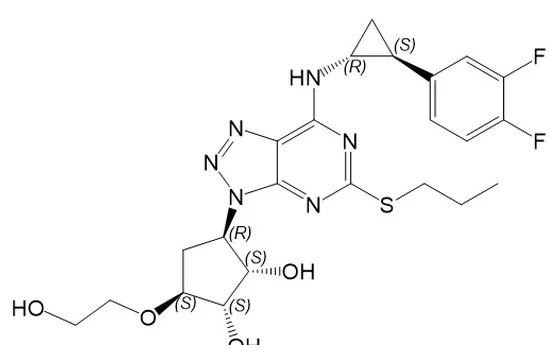
Two entries, one increment of 29
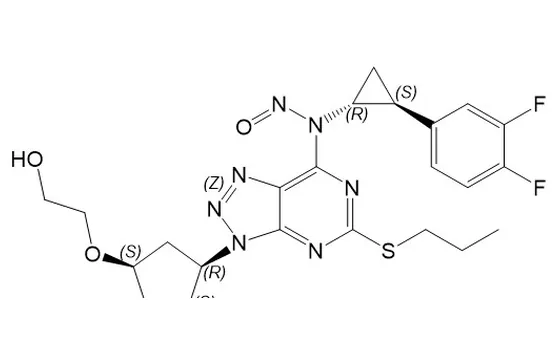
N-nitrosation replaces the amine hydrogen with an NO group. Add 30 for NO, remove 1 for the hydrogen, and the product is 29 units heavier than its parent. That single number separates real entries from catalogue noise more reliably than any name.
522.6 plus 29 gives 551.6, which is the N-nitroso derivative of the drug. 562.6 plus 29 gives 591.6, and 562.6 is the acetonide: C26H32F2N6O4S, with the 2,3-diol protected as a 2,2-dimethyl-1,3-dioxolane[4]. Both entries are in the catalogue, both have structures that can be checked, and both are worth having on the shelf if nitrosamine work is on the agenda.
The acetonide is not an exotic artefact. It is the protected form of the diol, which means it is an intermediate on the route rather than a degradant of the finished drug, and its presence in the catalogue as a numbered impurity is the normal consequence of a supplier building rows from a process rather than from a specification.
Why the intermediate's nitrosamine matters more than the drug's
A risk assessment written around the finished API asks one question: can nitrite reach the amine in the last steps, in water, at acidic pH, in the presence of a nitrosating agent. That is a real question and it usually has a reassuring answer, because the final steps are often recrystallisations from alcoholic or ketonic solvents with no nitrite source.
The acetonide changes the geography of the risk. At that stage the amine is already present, unprotected, and the molecule is lipophilic enough to partition into the organic phase where nitrosating species concentrate. Nitrosation is fast in the pH 3 to 4 window and does not need much nitrite; a nitrite level measured in the parts per million of an excipient is irrelevant here, because the reacting nitrite is whatever the solvent, the water or the headspace delivers, and the amine is not competing with anything else in the vessel.
There is a second reason to look upstream: deprotection does not remove an N-nitroso group. Hydrolysis of the acetonide opens the dioxolane and leaves the nitroso amine untouched, so a nitrosamine formed at the acetonide stage arrives in the API at full strength, minus whatever purge the crystallisation achieves. That is why the 591.6 entry is more than a catalogue curiosity: it is evidence that the risk exists at a stage a finished-product assessment never inspects.
There is also an upside hidden in the same structure. The amine at C7 starts life as a primary aromatic amine, the 7-amino group on the triazolopyrimidine, which is a mutagenic alert under ICH M7 in its own right. Installing the cyclopropyl removes that alert by converting the primary amine into a secondary one, and simultaneously creates the nitrosatable site. One step solves one problem and creates the other, which is the normal arithmetic of route design and the reason both the free amine fragment and the two nitroso entries are useful reference points.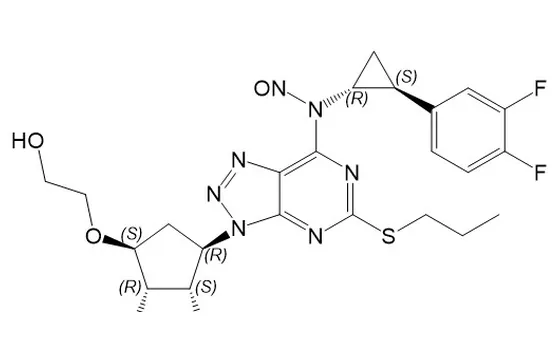
The limit ladder at 180 mg a day
The ICH M7 default acceptable intake for an impurity with an unknown potency is 1.5 micrograms per day. Divide by the daily dose and convert to parts per million: 1.5 micrograms in 180 mg is 8.3 ppm.
That number is a ceiling, not an answer. The carcinogenic potency categorisation approach assigns a category from structure, and each category carries its own acceptable intake. The arithmetic at a fixed 180 mg dose then looks like this.
Two hundred and forty times separates the top of that table from the bottom, and nothing in the laboratory changes between the rows: same standard, same column, same instrument. What changes is an argument about the structure, and that argument is where a nitrosamine project is usually won or lost[5,6].
The practical consequence is that the method has to be designed for the bottom row or the project runs the whole assessment twice. A limit of 0.10 ppm on the API at a 1 mg per mL sample concentration is 0.1 nanograms per millilitre, and five microlitres injected is half a picogram on column. That is achievable on a modern triple quadrupole, but only just, and not with a standard whose purity is quoted to the nearest per cent.
Where the nitrite actually comes from
Nitrosamine investigations that fail usually fail here, because the team looks for a nitrite number in a certificate of analysis and stops when it finds a small one.
Nitrite enters a solid dosage form through several doors that a single specification cannot close. Excipients carry it as an impurity, and the levels vary by supplier, by lot and by the water used in manufacture. Water itself carries nitrite and can carry nitrate, which is reduced to nitrite by the very conditions that also catalyse nitrosation. The environment contributes nitrogen oxides, which is why a tray left open in a plant is different from a sealed dryer. And the process contributes: any step that uses nitrous acid, or that mixes an amine with a nitrite salt, or that mills an amine-containing API together with a nitrite-releasing lubricant, converts a theoretical risk into a batch result.
The chemistry has an optimum. Nitrosation of a secondary amine by nitrous acid proceeds fastest at pH 3 to 4, because that is where the nitrosating species is in equilibrium with the protonated amine. Formulations that create a locally acidic microenvironment inside a tablet, and enteric or gastric-fluid exposure afterwards, sit right in that window. This is why the same API can be clean in one formulation and out of specification in another without anything changing in the API specification.
For ticagrelor specifically, the low basicity of the C7 amine works in the opposite direction. An amine adjacent to an electron-poor pyrimidine is a weak base, so it is less protonated at a given pH and the nitrosation optimum shifts. That is a small comfort, not a control strategy, and it should be described as a mechanistic argument rather than used as a reason to skip the confirmatory data.
Running a method at 0.1 ppm
Three practical points, in the order they cause trouble.
Mobile phase and system history. No nitrite or nitrate buffers, no diethylamine, no dimethylamine: an ion-pair reagent that contains a secondary amine is a nitrosamine generator sitting in the mobile-phase bottle. And do not run the nitrosamine method behind a method that used nitrite-containing buffers, because carryover in a shared system shows up as a peak in the blank and gets blamed on the sample.
Carryover is structural, not accidental. Nitrosamines stick to stainless steel and to the injector; a big calibration point followed by a blank will show a peak that is often mistaken for contamination in the lab. The fix is a wash programme and a blank between the top standard and the sample, not a longer equilibration.
Ionisation choice. These are large, polar, non-volatile molecules, so the choice is between electrospray and atmospheric-pressure chemical ionisation with the source tuned for the nitrosamine rather than for the parent drug. Tuning on the parent and assuming the nitrosamine will ionise the same way is the most common way to lose a factor of ten in response and conclude the method is not sensitive enough[8].
One more: the standard. A nitrosamine reference material at 95 per cent purity contributes 5 per cent uncertainty before any weighing error, and at 0.1 ppm that is the difference between passing and failing. Where the material is a research-grade item rather than a certified reference standard, the purity has to be established for the purpose, and the certificate has to say how.
248 records, 105 generic filings, 99 applicants
The numbers are large enough to make the point on their own. Two hundred and forty-eight acceptance records, ninety-nine applicants, and a hundred and five of the records filed as generics, against thirty-seven new-drug and fourteen import records.
A generic wave of that size means a hundred and five different routes to the same molecule, and nitrosamine risk is route-specific. One applicant may carry the amine through an acetonide; another may use a different protecting group; a third may assemble the triazolopyrimidine at a different point, so that the free aromatic amine exists for one step or for six. The impurity profile of the finished drug is similar across all of them, which is exactly why a shared specification cannot carry the nitrosamine argument: the control point that matters differs by applicant, and the only document that knows which is the route description.
For a laboratory supporting these filings, that is also the commercial shape of the demand. The two N-nitroso entries plus the amine fragment are a small set that many projects need, rather than a large set that one project needs.
The antiplatelet neighbours fail differently
Clopidogrel↗ has 8 numbered entries in the catalogue and no nitrosamine row of its own; its nitrosamine questions are about the thiophene and the ester, not about an amine link. Prasugrel has 80 and a similar absence. Cangrelor↗ has 14 and is flagged for nitrosamine in the same metadata, because its adenine-like ring system carries aromatic amines. Ticagrelor sits between them with 199 entries, letters A to E, and two N-nitroso rows. The lesson from the comparison is not that ticagrelor is worse; it is that the nitrosamine question follows the nitrogen, and the nitrogen sits in a different place in each molecule. Copying a control strategy across the P2Y12 class produces a document that describes the wrong reaction.
What the control strategy has to contain
A defensible package for this molecule has four layers, and they answer different questions.
The API specification carries the limit and the method. That is the last line of defence and the least useful one, because it catches the problem rather than preventing it.
The route and process description names every step where a secondary amine and a nitrite source could meet, including the acetonide stage, and states what is done about it: a nitrite-free solvent list, a wash, a purge factor measured on spiked batches rather than asserted.
The excipient and packaging specification covers nitrite in the materials that touch the drug, and the packaging is part of it because a blister with a nitrite-containing adhesive is a slow-release source over a two-year shelf life.
The confirmatory testing is what regulators actually read: three batches at the commercial process, at the commercial scale, with the commercial excipient sources, tested at the limit rather than at the reporting threshold. When the limit is 0.1 ppm and the reporting threshold in the pharmacopoeial general method is higher than the limit, the confirmatory method has to be the nitrosamine-specific one from the start.
Four questions before you buy a standard
Is it the drug's nitroso or the acetonide's? They differ by 40 mass units and by which question they answer. A project that buys only the 551.6 entry can measure the finished product and cannot investigate the step where the risk was created.
What is the purity basis? At 0.1 ppm the standard's purity is a term in the result, not a footnote. Ask for the assay method and the uncertainty, not just a percentage.
Is the structure confirmed by NMR? A nitroso group on a secondary amine is easy to draw and easy to misassign, particularly when the parent has six stereocentres and the NMR spectrum is crowded. A certificate that quotes only the mass is quoting 1 per cent of the evidence.
Can it be stored? Nitrosamines are not especially unstable, but the standards are used at low levels and small decomposition shows up as a large relative error. Amber glass, a desiccator and a re-assay date are cheap.
Frequently Asked Questions
How many nitrosatable sites does ticagrelor have?
Why is the limit 8.3 ppm and not 0.1 ppm?
Does the acetonide nitrosamine really reach the finished drug?
Can nitrosation happen in the solid state?
What concentration does 0.1 ppm correspond to?
Is the free amine fragment an impurity or an intermediate?
Do all P2Y12 inhibitors carry the same nitrosamine risk?
Why does the catalogue hold 199 numbered entries for one molecule?
Related Substances and Reference Standards
- Ticagrelor (199 impurity / derivative entries)
- Prasugrel (80 impurity / derivative entries)
- Cangrelor (14 impurity / derivative entries)
- Clopidogrel (8 impurity / derivative entries)
References and Sources
- PubChem, National Library of Medicine, Ticagrelor, CAS 274693-27-5: molecular formula C23H28F2N6O4S, molecular weight 522.6, and the systematic name showing the single secondary amine at C7 of the triazolopyrimidine, accessed 2026-11-24
- PubChem, National Library of Medicine, N-Nitroso ticagrelor, CAS 2476859-55-7: molecular formula C23H27F2N7O5S, molecular weight 551.6, 29 mass units above the parent, accessed 2026-11-24
- PubChem, National Library of Medicine, N-Nitroso derivative of the ticagrelor acetonide, CAS 2476859-56-8: molecular formula C26H31F2N7O5S, molecular weight 591.6, accessed 2026-11-24
- PubChem, National Library of Medicine, Ticagrelor acetonide, CAS 274693-26-4: molecular formula C26H32F2N6O4S, molecular weight 562.6, the 2,2-dimethyl-1,3-dioxolane protecting the 2,3-diol, accessed 2026-11-24
- International Council for Harmonisation, ICH M7, Assessment and control of DNA reactive (mutagenic) impurities: the 1.5 microgram per day default acceptable intake and the treatment of nitrosamine impurities, accessed 2026-11-24
- Regulatory Toxicology and Pharmacology, 2024, Determining recommended acceptable intake limits for N-nitrosamine impurities in pharmaceuticals: development of the carcinogenic potency categorisation approach, accessed 2026-11-24
- Regulatory Toxicology and Pharmacology, 2024, N-Nitrosamine drug substance related impurities (NDSRIs): a proposal for the addition of subcategories to the carcinogenic potency categorisation approach, accessed 2026-11-24
- Journal of Pharmaceutical and Biomedical Analysis, 2015, Identification of the major degradation pathways of ticagrelor, including the behaviour of the triazolopyrimidine and cyclopentane moieties under stress, accessed 2026-11-24
This article was prepared by the CATO technical team. Regulatory, pharmacopoeial and published literature content cited above is attributed in the reference list. It is provided for technical exchange and search reference only and does not constitute a quality specification or regulatory advice. For any specific substance, the applicable test methods, limits and filing requirements are governed by the current regulations, pharmacopoeial monographs and official publications.
Product information on this site is provided for research search and selection reference only and is not a quality specification; technical data, purity and structural confirmation are governed by the shipped COA and our written confirmation. All products mentioned are for research use only, not for human or animal diagnostic or therapeutic use.