One Secondary Amine, Three Nitroso Entries: Where Varenicline's Nitrosamine Risk Actually Sits
Varenicline↗ is a small tricyclic amine, C13H13N3, 211.26, given as the tartrate at 0.5 and 1 mg. Read the structure and the nitrosamine question looks closed: one secondary amine, two substituted nitrogens, one place for nitrous acid to go. Then you open the impurity series and count three N-nitroso entries. The explanation is that nitrosation does not only happen to the drug. It happens to whatever secondary amine shares the reactor, including intermediates that never finished the route.
Note: product names shown in red (marked with ↗) are links - click through to the product page for structure, CAS number, purity and lead time.
The scaffold offers a nitrosating agent exactly one site
Key points
- Varenicline tartrate is a 1:1 salt: 0.5 mg of base is 0.85 mg of tartrate and 1 mg is 1.71 mg, and the film-coated tablet contains no nitrite-bearing excipient on paper[1].
- The series carries three N-nitroso entries, not one: the drug at C13H12N4O, 240.26, a nitroso derivative of a dinitro intermediate at C11H10N4O5, 278.22, and a nitroso derivative of an 11-carbon fragment at C11H14N4O, 218.26[2,3,4].
- On stability the nitrite per tablet falls while the nitroso rises, but the molar arithmetic misses by a factor of five, so nitrite is a leading indicator and not a mass-balance partner[5].
- N-Formyl varenicline reaches 5530 ng per tablet against 31 ng for the nitroso, which puts the formamide above the 0.5 per cent identification threshold at a 2 mg daily dose[6].
Varenicline is C13H13N3, 211.26: a pyrazine ring fused to a benzene ring and closed by a two-carbon bridge, which forms a seven-membered azepine [7]. Of the three nitrogens, two are fully substituted and one carries a hydrogen. That single N–H is the only place where nitrous acid can run the textbook reaction. Everything else is a spectator.
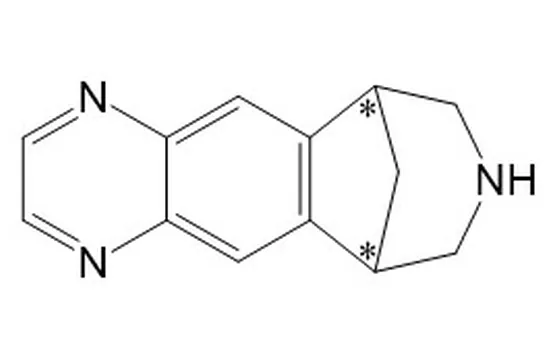
The tablet is the tartrate, a 1:1 salt: 0.5 mg of base is 0.85 mg of varenicline tartrate and the 1 mg tablet holds 1.71 mg [1]. That salt factor is not a rounding detail. It sets the assay calculation and the denominator of every percentage limit, and it explains most 70 per cent discrepancies between a certificate of analysis and a specification when neither states its basis.
The inactive ingredients are microcrystalline cellulose, anhydrous dibasic calcium phosphate, croscarmellose sodium, colloidal silicon dioxide, magnesium stearate and an Opadry film [1]. Not one is a nitrite salt, and that is the point. The nitrite is there anyway: 9.3 to 31.0 ng per tablet at release across four approved products [5]. At that level it is a trace contaminant of excipients and granulation water, invisible to any supplier specification that does not ask for it.
Three N-nitroso entries in a series numbered to 87
The catalogue for this substance carries 37 entries and the numbering runs from 8 to 87 with gaps. A gap is information, not missing data: an innovator impurity number is assigned once and inherited, so an absent number marks a compound that exists in the development history but is not sold as a standard. Reading the sequence is reading the route.
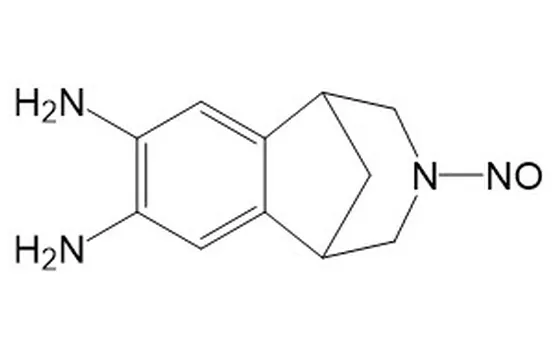
Impurity 37 is N-nitroso varenicline, C13H12N4O, 240.26 [2]. Impurity 67 is recorded as the N-nitroso derivative of impurity 42, C11H10N4O5, 278.22, a formula with two nitro groups in addition to the nitroso group [3]. Impurity 76 is recorded as the N-nitroso derivative of impurity 75, C11H14N4O, 218.26, a fragment that keeps a ring nitrogen and the nitroso group but not the skeleton [4].
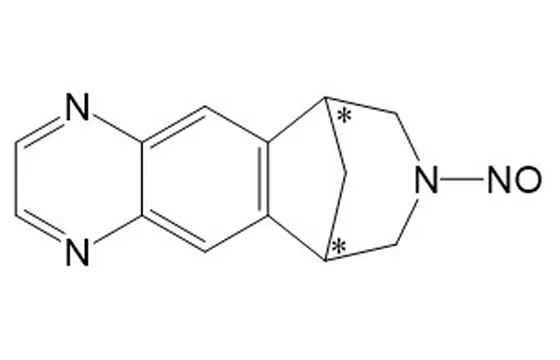
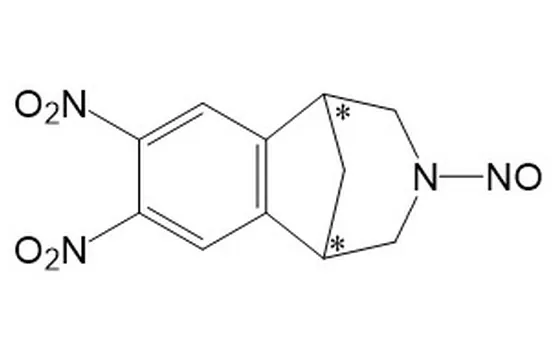
The naming convention is the useful part: a compound called the N-nitroso derivative of X says that X is a secondary amine somewhere in the process and that its nitrosation was studied. An assessment that inventories only the drug substance answers a narrower question.
| Catalogue entry | Identity | Formula | Mass | Relation to the drug |
|---|---|---|---|---|
| Impurity 37 | N-nitroso varenicline, CAS 2755871-02-2 | C13H12N4O | 240.26 | parent plus NO minus H, a gain of 29.00 |
| Impurity 67 | N-nitroso derivative of impurity 42, CAS 2803960-63-4 | C11H10N4O5 | 278.22 | nitroso plus two aromatic nitro groups |
| Impurity 76 | N-nitroso derivative of impurity 75, CAS 2803960-64-5 | C11H14N4O | 218.26 | nitroso on a truncated ring system |
Table 1. The three N-nitroso entries in the varenicline tartrate series, with the mass each one represents against the parent at 211.26 [2,3,4]. Only the first is derived from the drug substance itself.
Nitrite falls, the nitroso rises, and the arithmetic does not close
Four approved products were stored at 30 °C/75% RH and 40 °C/75% RH and tested for nitrite, N-nitroso varenicline, N-formyl varenicline and N-methyl varenicline [5]. The direction of travel is what the mechanism predicts. Nitrite fell from 9.3 ± 2.3 to 31.0 ± 9.3 ng per tablet at release to 1.7 ± 0.3 to 8.1 ± 5.4 ng after six months at 40 °C/75% RH, while the nitroso rose from zero to 31.0 ± 11 ng.
The temptation is to read those numbers as a pair. They are not. Thirty-one nanograms of nitrite is 0.674 nmol; thirty-one nanograms of N-nitroso varenicline is 0.129 nmol. The nitrite that disappeared could have made five times the nitroso that appeared, and at the extreme point only about a fifth of the nitrosating capacity is accounted for. The rest went to nitrate, to other amines, or into the film.
So nitrite is a leading indicator with a reliable direction, not a mass-balance partner: a nitrite limit cannot be derived by dividing a nitroso limit by the stoichiometry.
| Measure | Release, ng per tablet | Six months at 40 °C/75% RH, ng per tablet | Per cent of a 1 mg tablet | Intake at 2 mg per day |
|---|---|---|---|---|
| Nitrite | 9.3 ± 2.3 to 31.0 ± 9.3 | 1.7 ± 0.3 to 8.1 ± 5.4 | 0.0031 | 62 ng |
| N-Nitroso varenicline | 0 to 31.0 ± 11 | 31.0 ± 11 | 0.0031 | 62 ng |
| N-Methyl varenicline | 7.0 ± 0.3 to 1633.2 ± 55.8 | 1633.2 ± 55.8 | 0.163 | 3.27 µg |
| N-Formyl varenicline | 75 ± 9.1 to 5530 | 5530 | 0.553 | 11.06 µg |
Table 2. Ranges reported for four approved products [5], converted to per cent of label claim on a 1 mg tablet and to daily intake at the maximum dose of 2 mg. Nitrite and nitroso share a per cent column because they share a nanogram value, not because they are related by stoichiometry.
The degradant that owns the specification is a formamide
N-Formyl varenicline reached 5530 ng per tablet and N-methyl varenicline 1633 ng, against 31 ng for the nitroso [5]. The ranking is not close. The largest amine-derived degradant in a stored tablet is a formamide, larger than the nitrosamine by a factor of about 180.
In the units a specification uses: on a 1 mg tablet, 5530 ng is 0.553 per cent of label claim, N-methyl is 0.163 per cent, and the nitroso is 0.0031 per cent. At 2 mg per day the intakes are 11.06 µg, 3.27 µg and 62 ng.
Now apply the product thresholds. For a maximum daily dose between 1 and 10 mg, ICH Q3B(R2) sets identification at 0.5 per cent or 20 µg per day and qualification at 1.0 per cent or 50 µg per day, whichever is lower [6]. The absolute branch never binds here, because 11.06 µg sits under 20 µg. The percentage branch does. At 0.553 per cent the formamide is above identification and below qualification, so a tablet held six months under accelerated conditions lands between the two tiers on a peak that no nitrosamine workflow looks at.
A formamide needs a one-carbon electrophile, and in a tablet the plausible sources are the organic excipients and the film, not the drug. That is an excipient compatibility question, and it is the study usually scoped too narrowly.
At 2 mg a day, 62 ng is small and that is the trap
Sixty-two nanograms per day is 4.1 per cent of the 1.5 µg per day threshold of toxicological concern that ICH M7(R2) applies to a DNA-reactive impurity of unknown potency [8]. That reads as a comfortable margin and it is the number that will be quoted in a response. It is also the wrong number to lean on.
Nitrosamine drug substance-related impurities are not controlled at the TTC. Regulators assign an acceptable intake in nanograms per day from the structural category, and for most categories that value sits well below 1500 ng per day. A measured 62 ng per day has to be compared with the compound-specific value. Until that value is agreed the margin is unknown rather than comfortable.
Second, the percentage column is stricter than the absolute cap by more than an order of magnitude: at 2 mg per day, 0.10 per cent is 2 µg per day. The nitrosamine line will be the only one in the specification expressed in nanograms.
China is where the filing arithmetic is easiest to check, because the acceptance record is public:
That count matters commercially: a nitrosamine limit only one supplier can meet is a market position, not a scientific one.
Two peaks one dalton apart, and a wavelength that flatters both
N-Nitroso varenicline is 240.26 and N-formyl varenicline is 239.27. One dalton apart, and both elute in the same window. On a unit-resolution instrument an extraction window wide enough to capture the nitroso captures part of the formamide, and the error runs in the direction that inflates the nitrosamine, which produces a recall rather than a false negative.
A published stability-indicating method for varenicline tartrate used a C18 column of 250 by 4.6 mm with 5 µm particles, 0.02 M ammonium acetate brought to pH 4 with trifluoroacetic acid against acetonitrile in a gradient, 237 nm and 40 °C [9]. That is a sound starting point for the parent, but 237 nm is not a nitrosamine wavelength. The n to pi star absorption is weak, and the response of the nitroso there is a small fraction of the parent response at equal concentration. Quantitation belongs on tandem mass spectrometry, with the confirmatory transition established against a standard rather than predicted, because fragment ions of N-nitroso heterocycles do not transfer between ring systems.
Nitrite needs its own test. Ion chromatography with conductivity detection, reported in nanograms per tablet rather than parts per million of a blend, is the form that can be compared with stability data. A colour reaction screens acceptably, but its yield depends on pH and matrix and it does not separate nitrite from nitrate without a reduction step.
What a deficiency letter asks, and which answers survive
The questions are predictable. Which secondary and tertiary amines exist in the route, at which step, and what the nitrite concentration is in each excipient and in the water. Whether nitrosamine chemistry was studied on the drug substance only or also on the intermediates that carry a secondary amine. Whether each excipient specification includes a nitrite limit, and what batch data support it.
Answers sit in a hierarchy. The strongest is a route that keeps the amine away from nitrite, or a nitrite limit on every input with data behind it. The next is a demonstrated purge, with the purge factor calculated rather than asserted. The weakest is a limit without data, which invites the question of why the limit sits where it does.
The confirmation also has to carry the two impurity-derived entries. A reviewer who has seen the series will ask about impurity 67 and impurity 76 by number, and an answer covering only N-nitroso varenicline reads as incomplete even when both measured values are below the limit of detection. The catalogue makes the point neatly: it lists impurity 42 and its nitroso, but for the C11 fragment it lists the nitroso and not the parent amine. An inventory built from what is commercially available inherits exactly that gap, and the same gap runs through the methyl-substituted secondary amines behind the sitagliptin and fluoxetine cases.
What this molecule does not share with the familiar NDSRI cases
The amine sits inside a fused seven-membered ring and the nitrosation product is a stable, isolable, chromatographable solid. Compare ranitidine, where dimethylamine is released by cleavage of a Mannich base before it is nitrosated, and where the nitrosamine is absent from the impurity profile because it is not a structural relative of the drug. Compare metformin, where the same logic applies to a different leaving group. In both cases the analytical target lives outside the related-substances method. Here it lives in the same chromatogram, one dalton from a much larger peak.
The aromatic amine chemistry of the sartans is a different problem again, and so is the dihydropyridine N–H of amlodipine, where nitrosation competes with oxidation of the ring. Neither framework transfers. A risk assessment copied from a sartan template asks the right questions and points at the wrong control points.
What transfers is the arithmetic: nanograms per tablet to nanograms per day, then to a fraction of an acceptable intake in the same units. Doing that before the stability data arrive is the difference between a limit that survives review and one that is rewritten twice.
Five failures that recur on this molecule
- Reporting N-nitroso varenicline as a percentage of the tartrate while the acceptable intake is in nanograms per day: two units, one line, no conversion.
- Using the nitrite of a blend as a proxy for the nitroso, when the two differ fivefold in molar terms.
- Validating a 237 nm method for the nitroso and quoting a limit of quantification never demonstrated with a nitroso standard.
- Leaving N-formyl varenicline as an unspecified impurity at 0.2 per cent when accelerated data put it above 0.5 per cent.
- Treating the three nitroso entries as alternatives rather than as three molecules, one of which sits on a dinitro intermediate.
Reading the series before writing the specification
The sequence is short: count the secondary amines in the route rather than in the drug, measure nitrite in every input, treat the nitroso and the formamide as two targets one dalton apart with separate standards, then write the limits in the units the reviewer will use.
This catalogue carries 37 entries for the substance, including N-nitroso varenicline, both impurity-derived nitroso compounds and the parent amine of one of them, which is what an assessment needs in order to test the drug and the route as separate questions. The list, with its gaps visible, is on the varenicline tartrate page.
Frequently Asked Questions
Does varenicline have a secondary amine that nitrous acid can reach?
Why are there three N-nitroso entries when the drug has only one N–H bond?
Can I predict N-nitroso varenicline from the nitrite content of the tablets?
Which impurity actually limits shelf life under accelerated conditions?
Is 31 ng per tablet of N-nitroso varenicline acceptable?
Does the tartrate counter-ion contribute to nitrosamine formation?
Should each nitroso entry get its own specification line?
Why not quantify the nitroso with the 237 nm related-substances method?
Related Substances and Reference Standards
- Varenicline Tartrate (37 impurity / derivative entries)
- Ranitidine Hydrochloride (- impurity / derivative entries)
- Metformin Hydrochloride (- impurity / derivative entries)
References and Sources
- DailyMed, US National Library of Medicine, CHANTIX (varenicline tartrate) tablets, prescribing information: 0.5 mg and 1 mg strengths, 0.85 mg and 1.71 mg of tartrate per tablet, dosing to 1 mg twice daily, and the full inactive ingredient list, accessed 2026-11-21
- PubChem, National Center for Biotechnology Information, N-Nitroso varenicline, CAS 2755871-02-2, C13H12N4O, 240.26, accessed 2026-11-21
- PubChem, National Center for Biotechnology Information, N-Nitroso derivative of varenicline impurity 42, CAS 2803960-63-4, C11H10N4O5, 278.22, carrying two aromatic nitro groups, accessed 2026-11-21
- PubChem, National Center for Biotechnology Information, N-Nitroso derivative of varenicline impurity 75, CAS 2803960-64-5, C11H14N4O, 218.26, accessed 2026-11-21
- AAPS PharmSciTech, Springer, Hassan et al., Stability assessment of FDA approved varenicline tartrate products for critical quality attributes: N-nitroso varenicline, solid form and dissolution, 27(3):174, 2026. Nitrite 9.3 to 31.0 ng per tablet falling to 1.7 to 8.1 ng, N-nitroso up to 31.0 ng, N-formyl up to 5530 ng, N-methyl up to 1633 ng, accessed 2026-11-21
- International Council for Harmonisation, ICH Q3B(R2), Impurities in new drug products, Attachment 1: for a maximum daily dose of 1 to 10 mg, identification at 0.5 per cent or 20 µg per day and qualification at 1.0 per cent or 50 µg per day, whichever is lower, accessed 2026-11-21
- PubChem, National Center for Biotechnology Information, Varenicline, C13H13N3, 211.26, used here for the skeleton and for every mass difference in Table 1, accessed 2026-11-21
- International Council for Harmonisation, ICH M7(R2), Assessment and control of DNA reactive impurities: threshold of toxicological concern of 1.5 µg per day, and the compound-specific approach applied to nitrosamines, accessed 2026-11-21
- Scientia Pharmaceutica, Pujeri, Khader and Seetharamappa, Stress degradation studies on varenicline tartrate and development of a validated stability-indicating HPLC method, 80(1):115-126, 2012: C18 250 by 4.6 mm, 5 µm, 0.02 M ammonium acetate at pH 4 with trifluoroacetic acid, acetonitrile gradient, 237 nm, 40 °C, accessed 2026-11-21
This article was prepared by the CATO technical team. Regulatory, pharmacopoeial and published literature content cited above is attributed in the reference list. It is provided for technical exchange and search reference only and does not constitute a quality specification or regulatory advice. For any specific substance, the applicable test methods, limits and filing requirements are governed by the current regulations, pharmacopoeial monographs and official publications.
Product information on this site is provided for research search and selection reference only and is not a quality specification; technical data, purity and structural confirmation are governed by the shipped COA and our written confirmation. All products mentioned are for research use only, not for human or animal diagnostic or therapeutic use.