Vemurafenib: 1.92 g a Day, Four Photoactive Handles, and a 0.052 Per Cent Threshold
Two numbers decide how vemurafenib impurities are judged, and neither of them comes from a pharmacopoeia: 1.92 grams of drug substance per day, and a qualification threshold written as 0.10 per cent or 1.0 mg per day, whichever is lower. At this dose the second branch wins and the real threshold is 0.052 per cent. Put that together with a molecule that absorbs UVA and produces a photoproduct which itself absorbs UVA, and the specification has to answer a question that an ordinary shelf-life study does not ask.
Note: product names shown in red (marked with ↗) are links - click through to the product page for structure, CAS number, purity and lead time.
Key points
Key points
- Vemurafenib↗ is C23H18ClF2N3O3S at 489.9, dosed at 960 mg twice daily, so a patient takes 1.92 g of drug substance a day[1].
- ICH Q3A(R2) sets the qualification threshold above 2 g/day at 0.10 per cent or 1.0 mg per day, whichever is lower. One milligram inside 1,920 mg is 0.052 per cent, so 0.052 per cent is the number that governs this product, not 0.10 per cent[2].
- The molecule carries four photoactive handles: an aryl ketone, an aryl chloride, an N-S sulfonamide bond and an azaindole N-H[1].
- Published photochemistry shows that UVA, not UVB, drives the reaction, and that irradiation produces a photoproduct which absorbs UVA in its own right[3,4,5].
- ICH Q1B asks for 1.2 million lux hours plus 200 W h per square metre of near UV, a dark control and a sample in the immediate pack. The near-UV part is the part that matters here[6].
- The catalogue holds 146 numbered entries running from 4 to 149 with no missing number. That is a supplier numbering block, not a degradation map, and only about four of those entries are plausible light-driven products[1].
One molecule, four places where light can act
The systematic name reads N-[3-[5-(4-chlorophenyl)-1H-pyrrolo[2,3-b]pyridine-3-carbonyl]-2,4-difluorophenyl]propane-1-sulfonamide. Strip the name back to its parts and the photochemistry becomes obvious: a 7-azaindole core, a 4-chlorophenyl on C5, a carbonyl at C3 that joins the core to a 2,4-difluorophenyl ring, and a propane-1-sulfonamide sitting on that same ring[1].
Four of those parts absorb ultraviolet light, and each fails in a different way.
The aryl ketone is the strongest candidate. Aryl ketones have an n to pi-star transition that lands around 320 to 350 nm, inside the UVA window, and the excited carbonyl is a hydrogen abstractor. In a solid the nearest hydrogen donors are the sulfonamide N-H and the azaindole N-H; in solution the solvent competes. Abstraction followed by disproportionation gives the benzhydrol-type alcohol, two hydrogens heavier than the drug, at 491.9.
The aryl chloride is the second. Carbon-chlorine bonds on aromatic rings homolyse under UVA, and the resulting aryl radical abstracts a hydrogen to give the dechlorinated product at 455.4, thirty-four mass units below the parent. The useful side effect is diagnostic: the parent carries a 3 to 1 M to M+2 isotope pattern from chlorine, and any peak that has lost that pattern has lost the chlorine[5].
The sulfonamide is the third. The N-S bond is the weak point of the group, and its photolysis produces a sulfonamide radical pair that either recombines elsewhere or loses the group entirely. The azaindole N-H is the fourth: photooxidation gives the N-oxide at 505.9, sixteen units above the parent, and radical coupling gives dimers near 978.
Which of the four dominates is not a question a textbook answers. It is a question a light-stress experiment answers, and the answer changes with the matrix, because a tablet is not a solution.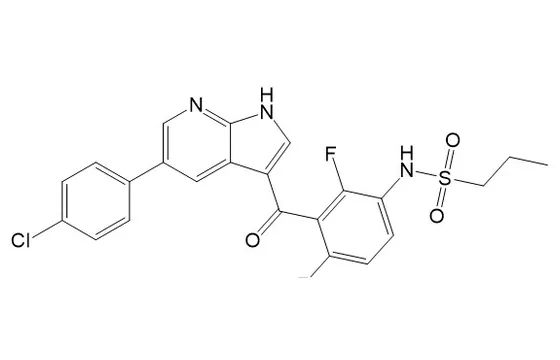
The dose sets the threshold before the chemistry does
Most impurity discussions start with the chromatogram. This one starts with arithmetic, because the arithmetic decides how much of the chromatogram anyone has to care about.
The clause that does the work is whichever is lower. A tenth of a per cent of 1,920 mg is 1.92 mg, which is nearly twice the absolute cap. So the absolute cap wins, and 1.0 mg in 1,920 mg works out to 0.052 per cent[2].
The consequence is not academic. A photoproduct sitting at 0.06 per cent of area is above the qualification threshold for this product, which means it needs a qualification package: a toxicological argument, a literature argument or a study. The same 0.06 per cent in a 10 mg tablet would be a reportable unknown and nothing more. Templates copied between projects carry the 0.10 per cent figure and quietly lose the absolute branch, which is how a photodegradant passes a review that should have stopped it.
Two further arithmetic notes. First, the calculation uses the maximum labelled daily dose, which is 960 mg twice daily, not the 240 mg strength of a single tablet. Second, if the label ever adds a higher dose or a combination regimen, the divisors move and the threshold has to be recomputed rather than copied forward.
What the photochemistry literature actually establishes
Three findings are well supported and worth stating precisely, because each one changes what a specification should say.
The first is that the action spectrum is UVA. Phototesting in patients shows that the 320 to 400 nm range triggers both the immediate burning sensation with oedematous erythema and the delayed sunburn-type reaction, and in vitro work on cell models shows the phototoxic effect is produced by UVA irradiation rather than by UVB[3].
The second is that irradiation produces a photoproduct, and that this photoproduct absorbs UVA. Photochemical studies on the compound itself support the formation of a UVA-absorbing species, which is a more uncomfortable statement than it first appears: a photodegradant that absorbs where the drug absorbs is a second photosensitiser generated by the first one[3,4].
The third is the mechanism downstream of absorption. Work in keratinocytes links the UVA response to reactive oxygen species, singlet oxygen, membrane lipid peroxidation and photoproduct formation, with the photoproduct and the peroxidation acting together rather than as alternatives[5].
None of these papers hands over a validated impurity list. What they hand over is a ranking: the light-driven pathway is not a minor line in the degradation scheme of this molecule, it is the pathway the clinical label is about. A dossier that qualifies a hydrolytic degradant at 0.08 per cent while ignoring a light-driven one at the same level has optimised the wrong axis.
Q1B is an experiment with two options, not a checkbox
ICH Q1B offers two exposure options. Option 1 is 1.2 million lux hours of visible light plus 200 W h per square metre of near UV; option 2 is 6 million lux hours plus the same 200 W h per square metre. Both require a dark control, both require the sample to be tested in the immediate pack as well as exposed, and both are one-batch exercises unless the results say otherwise[6].
For a compound whose action spectrum is UVA, the visible-light number is close to decoration and the near-UV number is the experiment. Two failures are common. The first is a light cabinet whose fluorescent tubes emit almost nothing below 400 nm: the lux-hour target is met, the near-UV target is not, and the study reports no change. The second is running the study on the drug substance, reporting that the API is stable, and never testing the tablet, even though the tablet contains titanium dioxide, a film coat and a blister material that together decide how much light reaches the crystals.
Solid versus solution matters for a different reason. In solution the ketone finds hydrogen donors everywhere and the photochemistry runs quickly; that is exactly what you want when the job is to identify products. In the solid the reaction is limited by crystal packing and by how much light penetrates the compact, so the solid study tells you what the patient is exposed to but is a poor way to discover what the products are. Run the solution study to find the peaks, then the solid and in-pack study to decide whether they matter.
Reading a light-stress chromatogram
Four masses organise the search: 491.9 (ketone reduced to alcohol), 455.4 (chlorine lost), 505.9 (azaindole N-oxide) and about 978 (dimer). Anything else in a light-stressed sample is worth a second look but is unlikely to be a first-generation photoproduct.
The isotope pattern does more work than the mass. The parent contains one chlorine, so it shows M and M+2 in roughly 3 to 1 ratio. The reduced ketone keeps the chlorine and keeps that pattern. The dechlorinated product loses it. Looking at the pattern before looking at the mass is faster than the reverse, and it survives the situation where a small peak sits inside the tail of a large one.
Two traps. A peak two units below the parent can be a dehydrogenation or the alcohol at 491.9 seen through a mass calibration that is drifting; on a unit-resolution instrument those are the same number, and only accurate mass or an authentic standard separates them. And a photoproduct will not necessarily share the parent's response factor: the dechlorinated aryl ketone has a different chromophore and therefore a different molar absorptivity, so area per cent is not mass per cent and a relative response factor has to be established rather than assumed[7].
The cheapest improvement to any photostability method is to put a light-stressed sample into system suitability. If the method cannot separate the alcohol at 491.9 from the parent, the validation has proved that the method runs, not that it can see the degradant the study exists to find.
146 numbers, four that matter
The catalogue holds 147 rows for this variety: the parent plus 146 numbered entries. The numbers run from 4 to 149 with no missing value anywhere in that range, and the metadata records no pharmacopoeial letter set for the compound at all.
A contiguous block is a signature. Degradation chemistry produces gaps, because a numbering scheme follows the peaks a development programme actually found. A run with no gaps at all looks like a batch assignment made in one pass, and it means the label on an entry, impurity 87 say, tells you nothing about its structure, its origin or its mass. Compare the two neighbours in this catalogue: ticagrelor has 199 numbered entries spread over a range to 400 with 219 numbers missing, and esomeprazole sodium has 147 distinct numbers up to 228 with 81 missing. Those gaps are where the chemistry lives.
For photostability work the practical consequence is a short shopping list. You need the reduced ketone, the dechlorinated product, the N-oxide and, if dimers appear, one dimer. The other 142 entries are process and route impurities that a light-stress study will never generate, and buying them because they exist is how a photostability project turns into an inventory project.
Twelve acceptance records in fourteen years, one applicant group
Twelve records, seven applicants, and every one of the named applicants belongs to the originator group: Roche Registration, Delpharm Milano as the manufacturer, Roche Pharma (Schweiz), Roche S.p.A. Six of the twelve are supplementary applications, four are imports and two are import re-registrations. There is not a single generic filing in the set.
That profile explains something that otherwise looks like an omission. There is no domestic generic wave to generate a local impurity vocabulary for this molecule, so there is no local convention for which numbered entry corresponds to which degradant, and no ANDA-style precedent to copy. When a laboratory asks for the pharmacopoeial impurities of vemurafenib, the honest answer is that there is no letter set in this catalogue to map, and the impurity language of the product comes from the originator dossier and from the literature on the photochemistry.
What belongs in the specification
Four items, in order of how much trouble they cause when missing.
First, a photostability statement that names the packaging. The Q1B result applies to the product in the pack that will be marketed; a change from aluminium blister to a white opaque PVC/PVDC changes the light dose at the crystal and therefore reopens the question rather than closing it.
Second, a limit for the light-driven degradant that is consistent with 0.052 per cent, not with the 0.10 per cent that appears in most templates. If the specified limit is written as 0.10 per cent, the specification is above the qualification threshold and the number cannot be defended without a qualification package that says so.
Third, a mass balance statement that includes the alcohol and the dechlorinated product explicitly. A mass balance built only from peaks that elute in the main window will close to 99 per cent while the missing material sits on the column or in the void.
Fourth, a confirmatory light-stress study rather than a one-off. For a drug whose label carries a photosensitivity warning, the light question recurs with every packaging, formulation and scale change; treating Q1B as a single experiment performed once at development is how a known photolabile compound ends up with a specification that has forgotten it.
The BRAF neighbours are not interchangeable
The catalogue holds 13 numbered entries for dabrafenib, 23 for trametinib, 10 for encorafenib and 12 for selumetinib, against 146 for vemurafenib. Read carelessly, that looks like vemurafenib being an order of magnitude harder to control. It is not. The difference is catalogue coverage, not chemistry: the originator's development programme for vemurafenib simply documented far more numbered impurities, and the supplier built rows to match.
The chemistry points the other way. Dabrafenib↗ is a thiazole-aminopyrimidine with a sulfonamide but no aryl ketone; trametinib is a cyclopropyl-amide with no aryl chloride. Neither carries the combination of chromophores that makes vemurafenib photolabile, and neither has a photosensitivity warning of the same character. Porting vemurafenib photostability conclusions across the class, in either direction, produces a specification that is wrong for both molecules.
Four questions before you buy a standard
Which photoproduct does the method actually resolve? Ask for the retention time relative to the parent, not just the catalogue number. The alcohol at 491.9 and the parent differ by two hydrogens; on a short run they can be one peak.
Is the assigned structure confirmed or inherited? For a compound with 146 contiguous numbered entries, the numbering cannot be evidence of structure. Ask for the certificate plus the characterisation behind it, at least for the four entries that will be used in a light-stress study.
What is the response factor? A standard supplied as a salt, a hydrate or a solvate has to be corrected before it can be compared with an area per cent from the drug. This matters more than usual when the degradant has lost its chlorine.
Is the standard itself photostable? A photoproduct standard stored on a bench in a clear vial is a standard that degrades while it waits. Amber glass, dark storage and a re-assay date are not formalities for this class of compound.
Frequently Asked Questions
Does vemurafenib need a photostability study if the tablet is already in an opaque blister?
Is the qualification threshold 0.10 per cent or 0.052 per cent?
Can a degradation product be more phototoxic than the parent drug?
Why does this compound have no EP or USP impurity letters in the catalogue?
Should the threshold be calculated on the salt or the base?
How useful is the chlorine isotope pattern in practice?
Is a solution-phase forced degradation enough for a tablet?
Why are there 146 numbered entries with no gaps?
Related Substances and Reference Standards
- Vemurafenib (146 impurity / derivative entries)
- Dabrafenib (13 impurity / derivative entries)
- Trametinib (23 impurity / derivative entries)
References and Sources
- PubChem, National Library of Medicine, Vemurafenib, CAS 918504-65-1: molecular formula C23H18ClF2N3O3S, molecular weight 489.9, and the systematic name locating the 7-azaindole core, the 4-chlorophenyl, the 2,4-difluorobenzoyl group and the propane-1-sulfonamide, accessed 2026-11-24
- International Council for Harmonisation, ICH Q3A(R2), Impurities in new drug substances: reporting, identification and qualification thresholds, including the 0.10 per cent or 1.0 mg per day branch for doses above 2 g per day, accessed 2026-11-24
- Journal der Deutschen Dermatologischen Gesellschaft, 2020, Vemurafenib-related photosensitivity: UVA 320 to 400 nm triggers both the immediate and the delayed reaction, and photochemical studies suggest a UVA-absorbing photoproduct, accessed 2026-11-24
- Photochemical and Photobiological Sciences, 2015, A molecular insight into the phototoxic reactions observed with vemurafenib, a first-line drug against metastatic melanoma, accessed 2026-11-24
- Toxicological Sciences, 2016, Interplay between membrane lipid peroxidation and photoproduct formation in the ultraviolet A-induced photocytotoxicity of vemurafenib in keratinocytes, accessed 2026-11-24
- International Council for Harmonisation, ICH Q1B, Photostability testing of new drug substances and products: the two exposure options, the dark control, and the 200 W h per square metre near-UV requirement, accessed 2026-11-24
- International Council for Harmonisation, ICH Q2(R2), Validation of analytical procedures: specificity, relative response factors and the treatment of impurities without an available standard, accessed 2026-11-24
- Center for Drug Evaluation, NMPA, Public drug acceptance records used for the acceptance counts cited in this article; counts are acceptance records, not approvals, accessed 2026-11-24
This article was prepared by the CATO technical team. Regulatory, pharmacopoeial and published literature content cited above is attributed in the reference list. It is provided for technical exchange and search reference only and does not constitute a quality specification or regulatory advice. For any specific substance, the applicable test methods, limits and filing requirements are governed by the current regulations, pharmacopoeial monographs and official publications.
Product information on this site is provided for research search and selection reference only and is not a quality specification; technical data, purity and structural confirmation are governed by the shipped COA and our written confirmation. All products mentioned are for research use only, not for human or animal diagnostic or therapeutic use.