Ambroxol: One Secondary Amine, Four Impurities, and No Way to Design the Amine Out
Ambroxol↗ is a small molecule with an unusually dense set of functional groups: a dibromoaniline, a secondary benzylamine, and a cyclohexanol whose stereochemistry decides whether the molecule is the drug or an impurity. Four of its catalogued impurities are reactions of those groups rather than of the manufacturing process, which is why the control strategy looks different from the one used for a molecule that can be re-routed.
Note: product names shown in red (marked with ↗) are links - click through to the product page for structure, CAS number, purity and lead time.
One aliphatic N-H, and four impurities that all depend on it
Key points
- Ambroxol is C13H18Br2N2O, 378.10, CAS 18683-91-5, and the hydrochloride is 414.56; the molecule is a 2-amino-3,5-dibromobenzyl group on a trans-4-aminocyclohexanol, so it carries one aromatic amine, one secondary aliphatic amine and two bromines[1].
- The only secondary amine is the benzylamine nitrogen, and it is the pharmacophore as well as the nitrosation site, so it cannot be designed out of the molecule.
- EP impurity B, C14H18Br2N2O at 390.11, is exactly ambroxol plus formaldehyde minus water: 378.10 + 30.03 - 18.02 = 390.11. It is a cyclic aminal closed across both nitrogens.
- Ambroxol is the N-demethyl metabolite of bromhexine[2], which means the secondary amine that carries the nitrosamine risk is also the active species.
Ambroxol is a small molecule with an unusual amount of functionality packed into it. A benzene ring carries an amino group at C2 and bromines at C3 and C5. Off C1 sits a methylene, then a secondary amine, then a trans-1,4-disubstituted cyclohexane ending in a hydroxyl. C13H18Br2N2O, 378.10, CAS 18683-91-5; the hydrochloride is C13H19Br2ClN2O, 414.56[1].
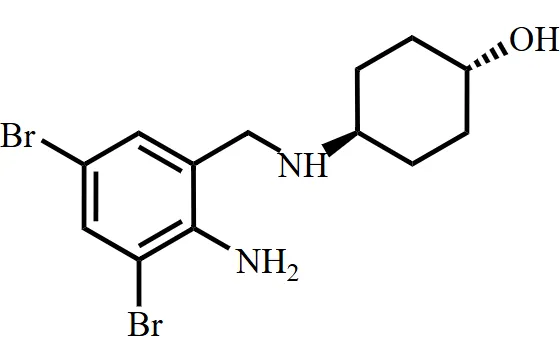
The aromatic amine is an aniline and belongs to a structural class that always attracts a mutagenicity question. The secondary amine is the one bond in the molecule that is both a nucleophile and a nitrosatable N-H. The two bromines are heavy, lipophilic and introduce their own elemental and dehalogenation questions. Most expectorants have none of this.
What makes ambroxol worth a separate article is that these features are not independent. Three of the four impurities that a stability or route review has to explain are reactions of the same nitrogen, and the fourth comes from the stereochemistry of the cyclohexanol. Read the impurity list as four answers to one question and it stops looking like a random collection.
The route is a reductive amination, and the imine is on the shelf
The commercial route condenses 2-amino-3,5-dibromobenzaldehyde with trans-4-aminocyclohexanol, reduces the imine, and isolates the hydrochloride. Both ends of that condensation appear in this catalogue: the aldehyde as EP impurity E at 50910-55-9, C7H5Br2NO, 278.93, and the benzyl alcohol as EP impurity A at 50739-76-9, C7H7Br2NO, 280.94. The presence of both is informative. A route that starts from the aldehyde will also carry the alcohol, because the alcohol is the reduced aldehyde and any borohydride or hydrogenation step that sees the aldehyde before the amine does will make it.
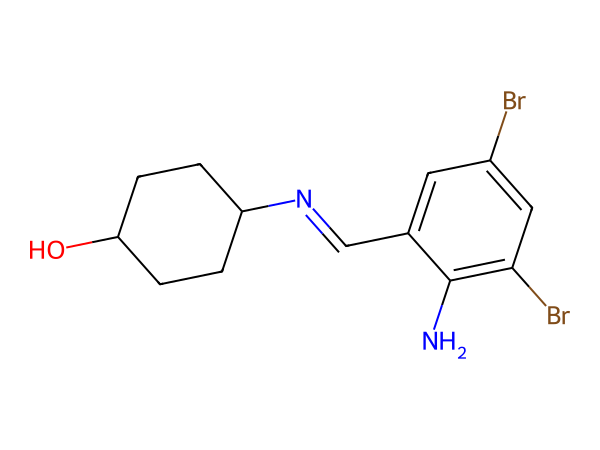
The imine itself is catalogued at 50910-53-7, C13H16Br2N2O, 376.09, as EP impurity C. That is the most useful entry in the whole set, because it is the only impurity that tells you the reduction was incomplete rather than that something degraded. Two daltons separate it from ambroxol, and the difference between incomplete reduction and over-reduction is a single catalytic cycle.
There is a practical consequence for specifications. An imine is hydrolytically labile: in aqueous acid it reverts to the aldehyde and the amine. A sample prepared for a related-substances injection therefore contains an equilibrium mixture, and an imine result read from an aqueous diluent at low pH understates what was in the solid.
Formaldehyde closes a ring across both nitrogens
EP impurity B is the entry that repays arithmetic. The catalogue gives it as C14H18Br2N2O, 390.11, CAS 18683-95-9. Ambroxol is C13H18Br2N2O at 378.10. The difference is one carbon and one oxygen in, one water out: 378.10 + 30.03 - 18.02 = 390.11, which is the tabulated mass to two decimals.
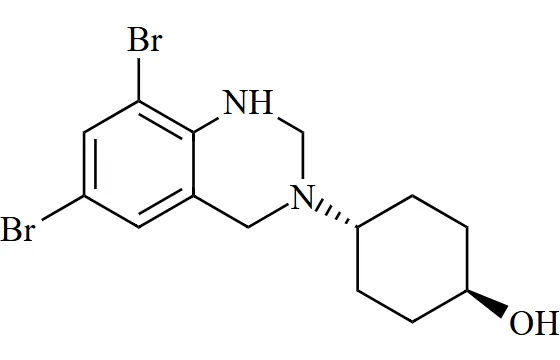
That mass balance describes a specific reaction. Formaldehyde adds to the aniline nitrogen, the resulting hemiaminal condenses with the secondary amine, water leaves, and a six-membered dihydroquinazoline ring closes using both nitrogens and one new carbon. The product is not a dimer and not an oxidation product. It is a formaldehyde adduct, and the arithmetic says so before any structure is drawn.
This matters because formaldehyde is everywhere a pharmaceutical is not supposed to have it: in some polymeric excipients, in certain packaging adhesives, in cleaning residues, and in the laboratory atmosphere around a formaldehyde-based fixative. A molecule that scavenges formaldehyde will find it. Once formed, EP B is a stable aromatic amine with a closed ring, so it accumulates rather than reverting, which is the opposite of the imine's behaviour.
| Species | Formula and mass | Relationship to ambroxol | Reverts on storage |
|---|---|---|---|
| Ambroxol | C13H18Br2N2O, 378.10 | parent | not applicable |
| EP impurity C, imine | C13H16Br2N2O, 376.09 | two hydrogens removed | yes, by hydrolysis |
| EP impurity B, cyclic aminal | C14H18Br2N2O, 390.11 | plus formaldehyde minus water | no |
| EP impurity A, benzyl alcohol | C7H7Br2NO, 280.94 | side chain cleaved, alcohol retained | no |
| EP impurity E, aldehyde | C7H5Br2NO, 278.93 | side chain cleaved, aldehyde | oxidises onward |
| EP impurity D, cis isomer | C13H18Br2N2O, 378.10 | same formula, opposite ring geometry | no |
Table note: formulas and masses from this catalogue and PubChem records[1]; the relationship column is derived from those formulas.
Two rows share 378.10. The parent and EP impurity D are stereoisomers, not homologues, and no mass-based method will tell them apart.
The same nitrogen is the nitrosation site, and the arithmetic is unforgiving
Nitrosation needs a secondary amine and a nitrosating species. Ambroxol supplies the first in a favourable position: a benzylamine is more nucleophilic than a plain alkylamine because the benzyl group stabilises the developing positive charge, and the nitrogen is unhindered on one face. Nitrite from an excipient, from water, or from nitrous acid generated in situ supplies the second.
The product, N-nitroso ambroxol, has no published acceptable intake, so the default framework applies: 1.5 micrograms per day under ICH M7(R2) unless a compound-specific limit is derived[3]. That number is easy to state and hard to use, because it has to be converted to a concentration before a method can be judged against it. The conversion is 100 nanograms divided by the daily dose in grams, which gives parts per million directly.
| Daily dose used in the calculation | 100 ng per day expressed as a concentration | 1.5 micrograms per day expressed as a concentration |
|---|---|---|
| 100 mg | 1 ppm | 15 ppm |
| 300 mg | 0.33 ppm | 5 ppm |
| 1 g | 0.1 ppm | 1.5 ppm |
Table note: arithmetic only, from the definition of a concentration limit for a stated daily dose; the dose rows are worked examples and not a posology statement.
At the low end of that table, the limit sits at a concentration where a UV method has no chance and an LC-MS/MS method has to be built around it. At the high end it is still an order of magnitude below the 0.05 per cent reporting threshold. In both cases the method, not the chemistry, sets the achievable control.
One further point from the literature: simulation work on NDSRIs derived from secondary-amine impurities shows that the formation risk is not only about the intact API but about the secondary-amine impurities that sit alongside it[4]. For ambroxol that means the demethylated or partially reduced species in the impurity profile are themselves nitrosatable, and a risk assessment that models only the parent will understate the total.
The exposure range is also wider than the mucolytic label suggests, because high-dose ambroxol is used outside that indication[5]. A limit expressed in parts per million therefore has to be computed at the top of the dose range, not at the bottom, and the two answers differ by an order of magnitude.
Why the amine cannot be engineered away
In most molecules with a nitrosamine finding there is a route fix. Change the alkylating agent, remove the dimethylamine, replace the solvent. None of those apply here, and that changes the entire control strategy from prevention at source to prevention in the package.
The benzylamine nitrogen is the pharmacologically active group. Removing the N-H by methylation gives a tertiary amine that is a different molecule with different properties, and in fact that molecule already exists: it is bromhexine. The dibromoaniline is also structural. Remove a bromine and the lipophilicity and the mucolytic activity change together. Both alerts are inside the pharmacophore, so a route that avoids them does not produce ambroxol.
That leaves three levers, all downstream. Control nitrite in excipients and in water, which means a specification on the raw materials rather than on the drug. Control the package, because a nitrosation reaction in the solid state needs a mobile nitrosating species and moisture is what mobilises it. And control the environment, since a formaldehyde source and a nitrite source in the same blister are a reaction waiting for a humidity cycle.
Bromhexine hydrochloride is the instructive comparison. Its nitrogen is tertiary, so nitrosation requires demethylation first, and demethylation is exactly the metabolic step that produces ambroxol. The parent drug therefore has a two-step path to a nitrosamine and the metabolite has a one-step path, which is the reverse of what a casual reading of the structures suggests.
cis and trans: the impurity that comes in with the raw material
The cyclohexane ring carries a 1,4 relationship between the amine nitrogen and the hydroxyl. Trans is the drug. Cis is a different molecule with the same formula, the same mass and different geometry, catalogued at 107814-37-9 as EP impurity D with the formula C13H18Br2N2O and the mass 378.10[1].
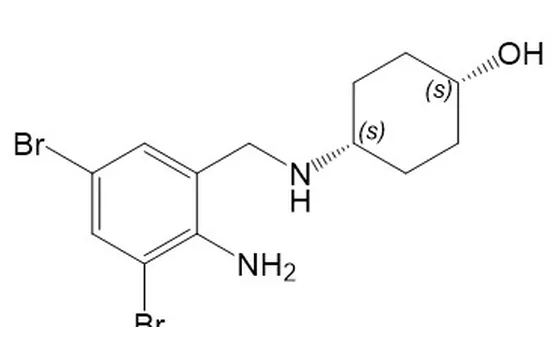
This is a configurational difference, not a conformational one. A cyclohexane chair flip interconverts axial and equatorial positions but never converts cis into trans, so no amount of heating, milling or storage will move the ratio. Whatever cis content is in the batch came in with the trans-4-aminocyclohexanol, and the only control is a specification on that starting material.
For the analyst the consequence is a separation problem, not a stability problem. Two compounds with the same formula and the same fragmentation differ only in shape, so the selectivity has to come from the stationary phase and the mobile phase, and it is usually small. A method developed on the parent alone will report a single peak for a batch that contains several per cent of the cis isomer.
Where the four mechanisms meet in one batch record
Put the four together and a batch record reads differently. The aldehyde and the alcohol are process entries from the reductive amination. The imine is the incomplete version of the same step. The cis isomer is an entry from the raw material. EP B is the only one that is unambiguously a reaction of the finished molecule with something in its environment, and it is the one that a stability programme is most likely to miss, because a formaldehyde adduct forms slowly and does not track with temperature in the way an hydrolysis product does.
Two analytical notes follow. The dibromoaniline chromophore absorbs in the middle ultraviolet but not strongly, so the aldehyde and the alcohol respond better than the aliphatic amine, and a single-wavelength method will quantitate the aromatic impurities more honestly than the aliphatic ones. And the imine, the aldehyde and formaldehyde itself are all reactive species that will react with the diluent, the column and each other; a sample preparation that takes an hour is measuring a different mixture from the one that was manufactured.
For the nitrosamine, nothing in a conventional related-substances method will see it. N-nitroso ambroxol has no chromophore beyond the aniline, elutes late because it is more lipophilic than the parent, and has to be measured by LC-MS/MS with its own standard. That is a separate method, a separate validation and a separate specification line.
What transfers to other brominated expectorants and what does not
Ambroxol and bromhexine share the dibromoaniline and the benzylamine skeleton, so the aromatic-amine question and the formaldehyde chemistry transfer directly. The nitrosation chemistry does not, because the nitrogen substitution differs by one methyl, and that methyl is the difference between a one-step and a two-step nitrosation pathway.
Acetylcysteine is the counter-example that keeps appearing in this class. Its reactive group is a free thiol, its impurities are disulfides and thioethers, and its nitrosamine risk sits on an amide nitrogen rather than on an amine. Nothing about ambroxol's nitrogen chemistry applies, and a control strategy copied across would test for the wrong things.
Carbocisteine and Erdosteine are thioether and thiolactone chemistry respectively, with sulfur oxidation as the dominant degradation route. The lesson across the mucolytic class is that the excipient compatibility work has to be built around the specific reactive group, and for ambroxol that group is an amine that reacts with both formaldehyde and nitrous acid.
Reference standards for a four-mechanism molecule
This catalogue holds 72 ambroxol entries and 40 in the hydrochloride set. The four that carry the argument are the parent at 18683-91-5, the imine at 50910-53-7, the cyclic aminal at 18683-95-9 and the cis isomer at 107814-37-9; the aldehyde at 50910-55-9 and the alcohol at 50739-76-9 complete the route picture. [See every ambroxol entry](Ambroxol)
One handling note. The imine and the aldehyde are both moisture-sensitive and both react with primary amines, so they should be weighed and dissolved separately rather than combined into a mixed working standard. A mixed standard left overnight will contain EP B, formed in the vial, and the injection will show an impurity the batch never had.
give the scale of the filing base, which is the practical reason a defensible impurity map matters more here than the size of the catalogue.Frequently Asked Questions
Is ambroxol's aromatic amine a genotoxic impurity?
How can EP impurity B be distinguished from a dimer?
Does the nitrate or nitrite come from the drug substance or the product?
Can the cis isomer form during storage?
Why is the imine unstable in the sample diluent?
Is N-nitroso ambroxol commercially available?
Does the hydrochloride change any of this?
What is the first experiment for a new peak at high retention?
Related Substances and Reference Standards
- Ambroxol (72 impurity / derivative entries)
- Bromhexine Hydrochloride (52 impurity / derivative entries)
- Acetylcysteine (310 impurity / derivative entries)
- Carbocisteine (36 impurity / derivative entries)
References and Sources
- U.S. National Library of Medicine, PubChem, Ambroxol, CAS 18683-91-5, C13H18Br2N2O, 378.10; ambroxol hydrochloride, CAS 23828-92-4, C13H19Br2ClN2O, 414.56; 2-amino-3,5-dibromobenzenemethanol, CAS 50739-76-9, C7H7Br2NO, 280.94; 2-amino-3,5-dibromobenzaldehyde, CAS 50910-55-9, C7H5Br2NO, 278.93; the imine, CAS 50910-53-7, C13H16Br2N2O, 376.09; ambroxol EP impurity B, CAS 18683-95-9, C14H18Br2N2O, 390.11; rac-cis-ambroxol EP impurity D, CAS 107814-37-9, C13H18Br2N2O, 378.10, accessed 2026-11-12
- Annales Pharmaceutiques Francaises, Facile approaches for determination of bromhexine hydrochloride and its active metabolite ambroxol hydrochloride using eosin Y complex formation, accessed 2026-11-12
- International Council for Harmonisation, ICH M7(R2), Assessment and control of DNA reactive (mutagenic) impurities in pharmaceuticals to limit potential carcinogenic risk: the 1.5 microgram per day total threshold of concern and the options for compound-specific limits, accessed 2026-11-12
- Journal of Pharmaceutical Sciences, Simulation of nitrosamine drug substance-related impurities from secondary amine-related impurities in approved human drugs, accessed 2026-11-12
- Pharmacology Research and Perspectives, via Europe PMC, Non-pulmonary mechanisms of action of ambroxol in in vivo experimental models: a systematic review, documenting the high-dose use of ambroxol beyond the mucolytic indication, accessed 2026-11-12
This article was prepared by the CATO technical team. Regulatory, pharmacopoeial and published literature content cited above is attributed in the reference list. It is provided for technical exchange and search reference only and does not constitute a quality specification or regulatory advice. For any specific substance, the applicable test methods, limits and filing requirements are governed by the current regulations, pharmacopoeial monographs and official publications.
Product information on this site is provided for research search and selection reference only and is not a quality specification; technical data, purity and structural confirmation are governed by the shipped COA and our written confirmation. All products mentioned are for research use only, not for human or animal diagnostic or therapeutic use.