Nine EP Impurities, One Carbon: Anastrozole Is a Leaving-Group Story at 1 mg
Anastrozole↗ is C17H19N5, 293.4, a 1 mg tablet, and a molecule with almost no chemistry available to it. The two quaternary carbons carry no hydrogen, the nitriles are inert, the ring is deactivated. What is left is a benzylic methylene holding a triazole, and one bond. Read the nine EP impurities with that in mind and they stop being a list: six of them are that carbon carrying the wrong atom, one is the wrong nitrogen, and two are what happens when the triazole reacts a second time.
Note: product names shown in red (marked with ↗) are links - click through to the product page for structure, CAS number, purity and lead time.
The molecule is one benzylic carbon with fittings
Key points
- Anastrozole is C17H19N5, 293.4, dosed at 1 mg once daily, and it is assembled by one displacement at a benzylic carbon[1,2].
- Six of the nine EP impurities are that carbon in another state: bromide, chloride, alcohol, methyl, dibromide, and the sulfonic acid left over from activating it[3,4].
- Their masses form a ladder of exactly 44.45, 18.44 and 16.00 units, which is Br minus Cl, Cl minus OH, and O minus H2. Nothing about that ladder needs a spectrometer to confirm.
- At 1 mg a day, 0.15 percent is 1.5 micrograms, which is exactly the mutagenic threshold of toxicological concern. The general limit is already as strict as M7, so M7 adds nothing here[5,6].
Anastrozole is 2,2-[5-(1H-1,2,4-triazol-1-ylmethyl)-1,3-phenylene]bis(2-methylpropanenitrile): a benzene ring carrying two quaternary centers, each with two methyls and a nitrile, and a methylene that holds a 1,2,4-triazole[2]. Formula C17H19N5, 293.4. The tablet is 1 mg, stored at controlled room temperature, and the label does not ask for light protection[1].
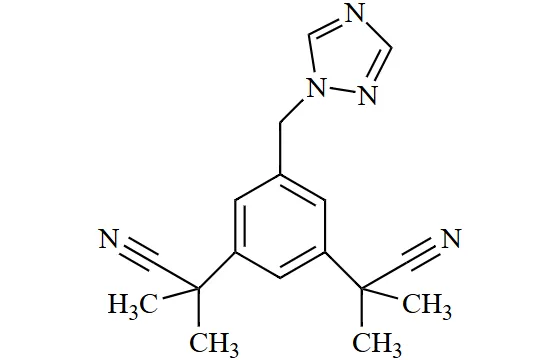
Sit with that structure for a moment. Two quaternary carbons with no hydrogen on them cannot be oxidized, halogenated or eliminated. The nitriles are stable. The aromatic ring is deactivated. What is left is one CH2 with a triazole on it, and one bond between that CH2 and the triazole nitrogen.
Every API is assembled at some bond; this one is unusual in how completely the specification records it. The nine EP impurities are, with two exceptions, a catalog of what happens to that methylene when the displacement goes wrong.
Sorting the EP list by what the methylene did
| EP impurity | Formula | MW | What it is |
|---|---|---|---|
| C | C15H17BrN2 | 305.21 | The benzyl bromide, unreacted alkylating agent |
| I | C15H17ClN2 | 260.76 | The benzyl chloride, halide exchange |
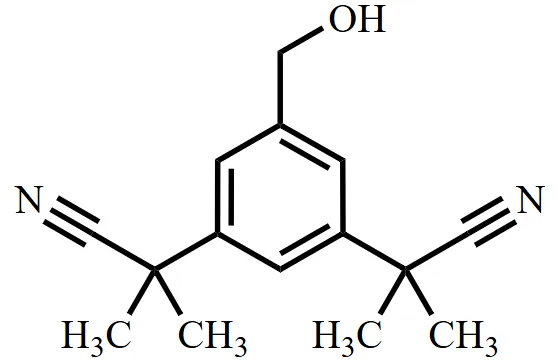
| E | C15H18N2O | 242.32 | The benzyl alcohol, the unactivated precursor |
| H | C15H18N2 | 226.32 | The 5-methyl analogue, bromide reduced to a methyl |
| D | C15H16Br2N2 | 384.11 | The dibromomethyl analogue, over-bromination |
| F | C7H10O4S | 190.22 | p-Toluenesulfonic acid monohydrate |
| G | C17H19N5 | 293.4 | The N4-triazole regioisomer, same formula as the drug |
| B | C30H31N9 | 517.6 | A dimer from a second alkylation event |
| A | C16H17N5 | 279.35 | One CH2 fewer than the drug |
Table note: formulae and molecular weights from the catalog entries and the corresponding PubChem records. The two exceptions mentioned in the text are G, which is a connectivity isomer, and A, which is a homolog.
Six rows are one carbon. The bromide, chloride, alcohol and methyl are the same benzylic position carrying a different atom; the dibromide carries two. The sulfonic acid belongs with them: it is what remains of the leaving group if the alcohol was activated as a sulfonate rather than a halide.
That is a specific diagnosis. A specification built from this list is not saying the molecule is unstable. It is saying that one displacement step leaks, and that the leaks were characterized well enough to be sold as standards.
A mass ladder that does not need a mass spectrometer
Line the four benzylic species up by weight and the differences are exactly the differences between the substituents. The bromide at 305.21 minus the chloride at 260.76 is 44.45, which is bromine minus chlorine, 79.90 minus 35.45. The chloride minus the alcohol at 242.32 is 18.44, which is chlorine minus hydroxyl, 35.45 minus 17.01. The alcohol minus the methyl at 226.32 is 16.00, which is oxygen minus two hydrogens.
Three differences, three substituent swaps, no speculation. This is the cheapest kind of structure confirmation available: if a new peak appears with a mass 44.45 below the bromide and it co-elutes with the chloride standard, the assignment is settled before any fragmentation study is designed.
The ladder also explains why recrystallization does not fix the profile. These are not degradants accumulating in a vial but the reactant, the halide, the hydrolysis product and the reduction product of one step; reducing them means changing the water content, the halide source and the reducing environment of that step.
The regioisomer no mass spectrometer can see
EP impurity G is C17H19N5 at 293.4, the same formula and the same mass as the drug, and it is not a degradant. It is the product of alkylating the wrong nitrogen of the triazole[7].
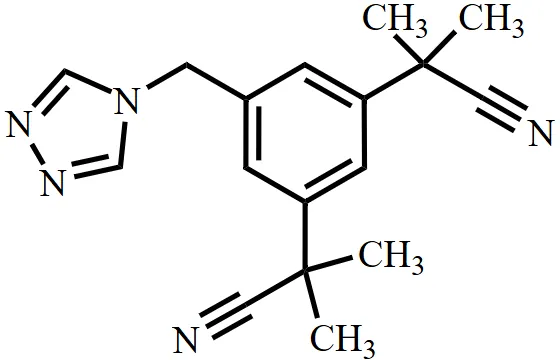
The parent ring is 1H-1,2,4-triazole. One nitrogen carries the hydrogen and is the nucleophile in the neutral ring; the other two are pyridine-like and nucleophilic only as the anion. In the drug, the benzyl group sits on N1. In EP impurity G it sits on N4, giving the 4H-1,2,4-triazol-4-yl arrangement, in which the two ring carbons are equivalent by symmetry. Same atoms, same mass, different connectivity, different retention.
Two consequences follow. Identity needs a standard and a spiked sample, because the product ion spectra of both isomers are dominated by the same benzylic cleavage and the same triazole fragments. And a peak at the drug retention time carrying the drug mass is not automatically an unknown degradant: check it against the regioisomer standard before opening an investigation.
The control lever is not chromatographic. It is the base, the solvent and the temperature of the alkylation, which decide which nitrogen is the better nucleophile. A hotter, more basic process makes more of G, and no column chemistry changes that.
What happens when the triazole reacts twice
EP impurity B is a dimer at C30H31N9, 517.6[8]. The number is worth pausing on: twice the drug is 586.8, and the difference is 69.2, close to C4H7N. So the dimer is not two intact molecules joined end to end. Something was lost on the way, which is consistent with a second alkylation at the triazole followed by elimination or fragmentation rather than a simple coupling.
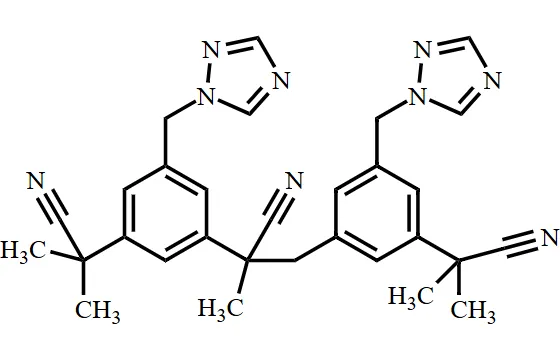
The mechanism need not be settled to draw the operational conclusion. A 1,2,4-triazole has more than one basic nitrogen, so in a reactor with excess benzyl halide the second alkylation is a question of stoichiometry and addition order. Add the halide slowly, keep it near stoichiometric, and the dimer becomes a small number.
What a dimer limit really tests is whether the process was characterized. A specification that carries a limit for a two-molecule species and no limit for the monoalkylated triazolium intermediate has drawn the line at the wrong place, because the intermediate is the precursor and the dimer is what it becomes.
What the chromatogram has to resolve at 1 mg
A published stability-indicating method for anastrozole used a 100 by 4.6 mm column with 3 micrometer particles, an isocratic 60:40 mixture of 10 mM ammonium formate and acetonitrile, 0.5 mL per minute, and detection at 215 nm, and it identified two degradation products not previously reported under thermal, photolytic, oxidative and base stress[9].
The conditions suit a 1 mg product. A 3 micrometer particle at half a milliliter per minute is a sensitivity choice: the injected mass is small, the triazole and nitriles absorb weakly, and 215 nm is where the nitrile and the aromatic ring give enough signal to see a 0.05 percent peak at all.
That wavelength is also where the mobile phase absorbs. Ammonium formate at 10 mM is transparent enough at 215 nm, which is presumably why it was chosen over phosphate; but the margin is thin, and a different formic acid supplier shows up as baseline drift that looks like a late-eluting impurity.
The resolution that matters is not the API from the dimer. It is G from the API, because they differ by a nitrogen position and nothing else, and any method that resolves them at one-to-one will still be asked to prove it at 0.1 percent.
At 1 mg a day the percentage limit arrives first
Here the arithmetic reverses the usual intuition. ICH Q3A sets identification at 0.10 percent or 1.0 mg per day and qualification at 0.15 percent or 1.0 mg per day for a maximum daily dose of 2 g or less[5]. At 1 mg those percentages are 1.0 and 1.5 micrograms per day, and the absolute ceilings of 1.0 mg never come close to binding.
Now compare the second number with the mutagenic threshold. The default threshold of toxicological concern is 1.5 micrograms per day[6]. The Q3A qualification threshold at this dose is also 1.5 micrograms per day, to three significant figures. For anastrozole, the general impurity framework is already as strict as the mutagenic one, and an M7 assessment that concludes the TTC is satisfied has said nothing that Q3A had not already required.
| Daily dose | 0.10 percent, in micrograms per day | Does the 1.5 microgram TTC bind? | Which limit controls |
|---|---|---|---|
| 1 mg | 1.0 | No, the percentage is stricter | ICH Q3A identification and qualification |
| 5 mg | 5.0 | Yes | TTC, by a factor of 3.3 |
| 10 mg | 10.0 | Yes | TTC, by a factor of 6.7 |
| 100 mg | 100 | Yes | TTC, by a factor of 67 |
| 1000 mg | 1000 | Yes | TTC, by a factor of 667 |
Table note: 0.10 percent converted at each dose and compared with the 1.5 micrograms per day threshold of toxicological concern[6]. The crossover sits at 1.5 mg per day, where 0.10 percent equals 1.5 micrograms.
The crossover is at 1.5 mg per day. Below it, percentage limits are the binding constraint and a mutagenic impurity is controlled more tightly than M7 asks. Above it, the TTC takes over and the general identification threshold becomes irrelevant for any impurity that is mutagenic. Anastrozole, at 1 mg, sits on the strict side of that line, and so does any other microgram-dose drug.
The deficiency questions this list invites
The first is about purge. Saying the benzyl bromide is not detected at the reporting threshold restates the result rather than answering the question. What a reviewer wants is a spiking experiment: add the bromide at a known level before the crystallization, measure what comes out, and report the clearance factor.
The second is about EP impurity F. A free base whose impurity list includes p-toluenesulfonic acid monohydrate is telling you how the benzylic carbon was activated[10]. If the alcohol becomes a sulfonate ester before displacement, the tosylate is a reactor intermediate, and the follow-up question is whether the ester itself was looked for. If the process uses the bromide, the acid should not be there at all.
The third is about the triazole. Which nitrogen, and what evidence. The answer is a standard of G, a spiked sample, and a number for G in three batches, not a statement that the triazole is attached at N1.
The fourth is about the dimer. A limit for B without a control strategy for the second alkylation reads as a limit chosen because the peak was there, and reviewers have learned to ask for the batch data behind it.
How many dossiers carry this list
Anastrozole is a mature product with a crowded filing history, which matters for a specification whose limits are set by arithmetic rather than by toxicology: every applicant has to reproduce the same 0.10 and 0.15 percent thresholds on a 1 mg tablet.
The figures are accepted filings, not approvals. Read them as the number of dossiers that had to explain a triazole regioisomer carrying the mass of the drug.
What transfers to other triazoles, and what does not
Letrozole carries a 1,2,4-triazole on a methine carbon bearing two 4-cyanophenyl groups. The N1 versus N4 question transfers intact, because the same ring is alkylated. The halide ladder does not: with no benzylic methylene to halogenate, a purge argument imported from anastrozole is meaningless.
Fluconazole has two triazoles on adjacent carbons, which multiplies the regioisomer problem rather than repeating it: each ring can attach through a different nitrogen, and the combinations are not degenerate.
Itraconazole and its relatives are a reminder of what dominates when a molecule has several stereocenters: the triazole connectivity is a minor question next to the diastereomer set, and the analytical effort goes there.
Tamoxifen citrate is the closest parallel in failure mode and the furthest in chemistry. Its same-mass impurity is a geometric isomer rather than a connectivity isomer, and light rather than a wrong nitrogen produces it. Both cases end at the same place: a standard, a spiked sample, and a resolution criterion that holds at the specification limit.
Five failures that recur on this molecule
One: calling the regioisomer an unknown degradant. It has the drug mass because it is the drug formula, not because it came from the drug[7].
Two: trying to remove the benzylic family by recrystallization. Bromide, chloride, alcohol and methyl are a step problem, and the step is upstream.
Three: quoting the TTC as an additional safeguard at 1 mg, where 0.15 percent is already 1.5 micrograms[5,6].
Four: integrating at 215 nm without checking mobile phase absorbance batch to batch. The baseline drift looks like a late peak.
Five: carrying a dimer limit and no precursor limit for the second alkylation[8].
Standards that match the ladder
This catalog carries 43 entries under anastrozole, numbered to 39 across two series, and the benzylic family is complete enough to build a method around. EP impurity C, the bromide, is at CAS 120511-84-4 with a standard for the alcohol at 120511-88-8 and the chloride at 120511-91-3. The reduced methyl analogue is at 120511-72-0, the N4 regioisomer at 120511-92-4, and the dimer at 1216898-82-6. The sulfonic acid entry is at 6192-52-5, which is the monohydrate. The full list with formulae is on the variety page: Anastrozole reference standards.
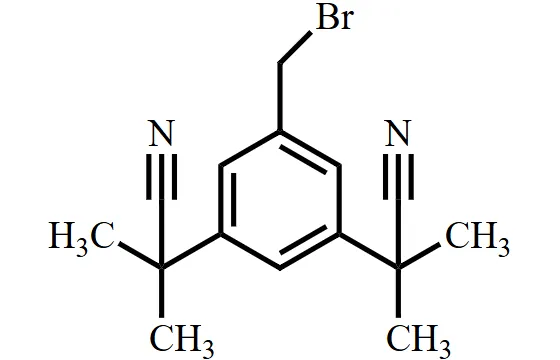
The working set is five: the bromide, the alcohol, the regioisomer, the dimer and one rung of the halide pair. That covers the purge argument, the activation residue, the identity problem and the second alkylation, and it costs less than a full EP collection.
Frequently Asked Questions
Why is anastrozole dosed at 1 mg, and why does that matter for impurities?
Is EP impurity G a degradation product?
What are the six benzylic impurities in the EP list?
How can a free base have p-toluenesulfonic acid in its impurity list?
Does the dimer limit control the second alkylation?
Why is the assay run at 215 nm?
Do the anastrozole impurity lessons apply to letrozole?
Is there a photostability concern?
Related Substances and Reference Standards
- Anastrozole (43 impurity / derivative entries)
- Letrozole (- impurity / derivative entries)
- Fluconazole (- impurity / derivative entries)
References and Sources
- DailyMed, US National Library of Medicine, Anastrozole tablets, prescribing information: 1 mg strength and storage at 20 to 25 degrees Celsius under USP controlled room temperature, without a light-protection direction, accessed 2026-11-22
- PubChem, National Center for Biotechnology Information, Anastrozole, CID 2187, C17H19N5, 293.4, with the 1,2,4-triazol-1-ylmethyl group on a benzylic carbon between two 2-cyanopropan-2-yl substituents, accessed 2026-11-22
- PubChem, National Center for Biotechnology Information, 2,2-(5-Bromomethyl-1,3-phenylene)di(2-methylpropiononitrile), CAS 120511-84-4, CID 11522359, C15H17BrN2, 305.21, the alkylating agent recorded as EP impurity C, accessed 2026-11-22
- PubChem, National Center for Biotechnology Information, 5-(Hydroxymethyl)-alpha,alpha,alpha,alpha-tetramethyl-1,3-benzenediacetonitrile, CAS 120511-88-8, CID 19349398, C15H18N2O, 242.32, EP impurity E, accessed 2026-11-22
- International Council for Harmonisation, ICH Q3A(R2), Impurities in New Drug Substances, Attachment 1: identification 0.10 percent or 1.0 mg per day and qualification 0.15 percent or 1.0 mg per day, whichever is lower, for a maximum daily dose of 2 g or less, accessed 2026-11-22
- International Council for Harmonisation, ICH M7(R2), Assessment and Control of DNA Reactive (Mutagenic) Impurities in Pharmaceuticals: threshold of toxicological concern of 1.5 micrograms per day, accessed 2026-11-22
- PubChem, National Center for Biotechnology Information, The 4H-1,2,4-triazol-4-yl regioisomer of anastrozole, CAS 120511-92-4, CID 23046242, C17H19N5, 293.4, EP impurity G, accessed 2026-11-22
- PubChem, National Center for Biotechnology Information, Anastrozole dimer impurity, CAS 1216898-82-6, CID 57369231, C30H31N9, 517.6, EP impurity B, accessed 2026-11-22
- Journal of Pharmaceutical and Biomedical Analysis, Determination and characterization of degradation products of anastrozole by LC-MS/MS and NMR spectroscopy: Oyster ODS-3 column 100 by 4.6 mm, 3 micrometer particles, 10 mM ammonium formate with acetonitrile 60:40, 0.5 mL per minute, 215 nm, and two previously unreported degradation products, accessed 2026-11-22
- PubChem, National Center for Biotechnology Information, p-Toluenesulfonic acid monohydrate, CAS 6192-52-5, CID 521998, C7H10O4S, 190.22, recorded in the catalog as anastrozole EP impurity F, accessed 2026-11-22
This article was prepared by the CATO technical team. Regulatory, pharmacopoeial and published literature content cited above is attributed in the reference list. It is provided for technical exchange and search reference only and does not constitute a quality specification or regulatory advice. For any specific substance, the applicable test methods, limits and filing requirements are governed by the current regulations, pharmacopoeial monographs and official publications.
Product information on this site is provided for research search and selection reference only and is not a quality specification; technical data, purity and structural confirmation are governed by the shipped COA and our written confirmation. All products mentioned are for research use only, not for human or animal diagnostic or therapeutic use.