Captopril: Ten Lettered Impurities, One Route, and a Disulfide With Two Origins
Captopril↗ carries ten lettered impurities, and most are not degradation products at all: they are the four steps of its synthesis, each left behind with a mass and a name. The one true degradant is the disulfide, and its rate is second order in copper, which changes what a stability programme should control.
Note: product names shown in red (marked with ↗) are links - click through to the product page for structure, CAS number, purity and lead time.
A thiol at one end, an amide at the other, and a route in between
Key points
- Captopril is C9H15NO3S, 217.29, CAS 62571-86-2: an L-proline amide of 3-mercapto-2-methylpropanoic acid, with two stereocenters and one free thiol[1].
- Most lettered EP impurities in this catalogue are intermediates of one four-step route rather than products of degradation, which is why the letters run to N.
- EP impurity J, C11H17NO4S at 259.32, is the acetyl-protected drug: 259.32 minus 42.04 is 217.28, captopril to two decimals, and it is the clearest marker of incomplete deprotection[1].
- In water the disulfide is the only degradation product, and the rate is first order in oxygen pressure but second order in copper in the zero-order regime[2].
Captopril was the first orally active angiotensin-converting enzyme inhibitor, and its chemistry is a generation older than the molecules that followed. The drug is an L-proline amide of 3-mercapto-2-methylpropanoic acid: C9H15NO3S, 217.29, CAS 62571-86-2, with a free thiol at one end and a carboxylic acid at the other[1].
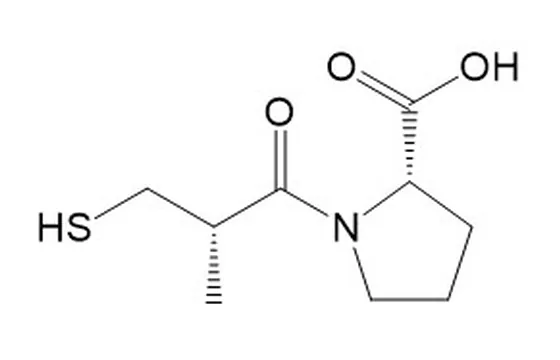
Two features decide everything here. The thiol is the pharmacophore, the oxidation site and the reason the bottle smells of sulfur. And the amide bond joins proline to a side chain that was assembled before the bond was made, so every intermediate in that assembly has a mass and a name.
That is why the profile looks unlike a modern drug's. Lettered impurities are usually degradation products somebody had to discover; on captopril most letters are steps of the synthesis, catalogued because they were the obvious things to look for. The maximum daily dose is 450 mg[3], high enough that percentage limits govern and no cap binds.
Four steps, seven intermediates, and a table that reads like a batch record
The route runs from 3-bromo-2-methylpropanoic acid through a thioacetate to the protected amide: brominate or buy the bromo acid, displace the bromine with thioacetate, activate and acylate L-proline, then remove the acetyl to expose the thiol. Each operation leaves a species behind, and each species has an entry.
| Step | Species | CAS and formula | What its presence proves |
|---|---|---|---|
| Acylating agent | EP D, 3-bromo-2-methylpropanoic acid | 56970-78-6, C4H7BrO2, 167.00 | reagent carried through |
| Thioacetate | EP G, 3-acetylthio-2-methylpropanoic acid | 33325-40-5, C6H10O3S, 162.21 | the protected acid, before or after coupling |
| Coupling, wrong order | EP B, the bromo amide | 80629-35-2, C9H14BrNO3, 264.12 | proline acylated before the bromine left |
| Deprotection, incomplete | EP J, the acetyl-protected drug | 64838-55-7, C11H17NO4S, 259.32 | acetyl still on the sulfur |
| Amide hydrolysis | EP C, 3-mercapto-2-methylpropanoic acid | 26473-47-2, C4H8O2S, 120.17 | the amide broke; proline is the other half |
| Desulfurisation | EP E, isobutyrylproline | 23500-15-4, C9H15NO3, 185.22 | sulfur was lost, not merely unreacted |
| Oxidation | EP A, captopril disulfide | 64806-05-9, C18H28N2O6S2, 432.6 | two thiols met an oxidant |
Table note: CAS numbers, formulas and masses from the PubChem records for each substance[1]; the left-hand column is the route logic each species reports on, not a published process description.
Read as a route, the table is a diagnostic instrument. A batch with EP D and EP G but no EP J had a clean coupling and deprotection, and its problem is upstream reagent quality. A batch with EP J alone failed at one step. One with EP C and EP E has lost sulfur two ways, which is why they carry separate letters.
The deprotection that did not finish: 259.32 minus 42.04
The deprotection deserves its own section because the arithmetic is exact. EP impurity J is captopril with an acetyl group still on the sulfur: C11H17NO4S, 259.32, CAS 64838-55-7.
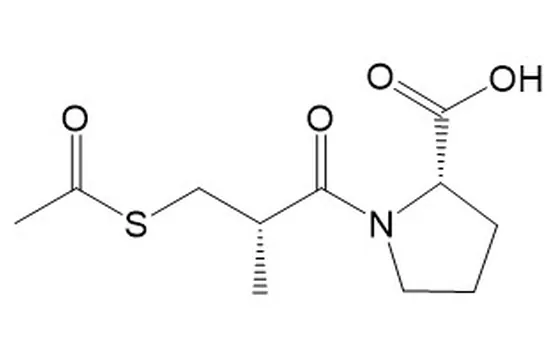
Subtract the acetyl group as ketene, C2H2O at 42.04, and 259.32 becomes 217.28, which is captopril at 217.29 to two decimals. Nothing else in the profile has that relationship. A difference of 42 is also what acetylation of the drug would give, so direction matters: EP J is not captopril acetylated on storage but protected captopril never deprotected.
That decides the investigation. If EP J is present at release and rises with time, the batch was under-deprotected. If it is absent at release and at twelve months, the step is robust. No plausible storage pathway installs an acetyl group on a thiol in a tablet, so EP J is always a manufacturing finding.
The same logic explains why EP G is not simply unreacted reagent. The acetylthio acid is both a reagent and a hydrolysis product of EP J, so it can appear at release from incomplete reaction and at stability from slow deprotection of residual EP J. Two origins, one peak, and only the release value separates them.
Two ways to lose sulfur, and only one of them is a loss
Two impurities describe the loss of sulfur, and they are different events.
EP impurity C is 3-mercapto-2-methylpropanoic acid, C4H8O2S at 120.17, and it is what remains of the side chain when the amide hydrolyses. The mass balance closes on the other half: 217.29 plus 18.02 is 235.31, and 120.17 plus proline at 115.13 is 235.30. So EP C kept its sulfur and lost the proline.
EP impurity E is the opposite. Isobutyrylproline, C9H15NO3 at 185.22, is captopril minus sulfur: 217.29 minus 32.06 is 185.23. The proline is intact, the side chain is intact, the thiol is gone. That can come from reductive desulfurisation, which is a real risk wherever catalytic hydrogenation runs near a thiol, or from using the des-thio acid as acylating agent in the first place.
The two therefore sit at opposite ends of the polarity range. The acid at 120.17 is small, polar and elutes near the injection front; the des-thio amide at 185.22 elutes inside the main window. A short run with a late gradient start sees one and misses the other, and the one it misses is the one that indicates sulfur loss.
The epimer is on the chain, not on the proline ring
Captopril has two stereocenters, the proline alpha carbon and the carbon bearing the side-chain methyl, and both are S in the drug. The catalogue carries the side-chain epimer as EP impurity F, epicaptopril, C9H15NO3S at 217.29, CAS 63250-36-2, with the same formula and mass as the drug[1].
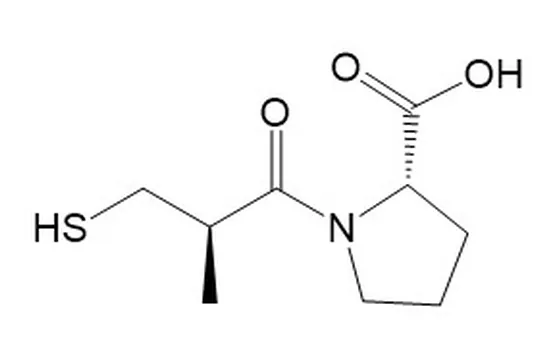
Which center inverts first is not a matter of symmetry. The side-chain carbon is alpha to a carbonyl that becomes a thioester and then a thiol, and it is the more acidic position in the basic medium used for deprotection. The proline center is alpha to a carboxylate and a nitrogen, and inverting it means breaking a ring geometry rather than rotating a methyl. So the epimer that accumulates first is the one on the chain, which is why EP F exists as a lettered single epimer while the proline epimer does not appear here.
For the analyst this is one more pair at the same mass. They differ by a methyl orientation on a flexible chain, so retention differs little and the ultraviolet spectra are identical. Derivatisation of the thiol, or detection that does not rely on absorbance, is often the only way to see them at the levels a 450 mg dose demands.
One degradant, and copper that enters the rate law squared
In solution the picture simplifies to one reaction. A controlled study at 32 degrees Celsius between pH 6.6 and 8.0, with oxygen pressure held between 90 and 760 millimetres of mercury and cupric ion added or omitted, found captopril disulfide to be the sole degradation product[2]. Not the main one. The only one.
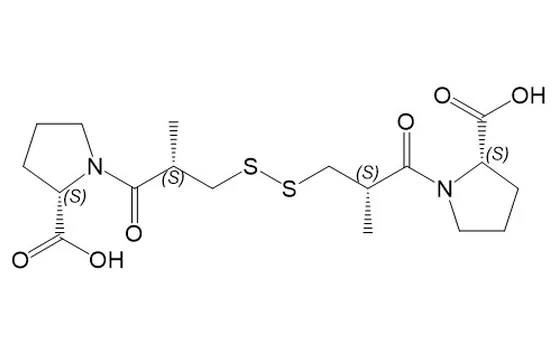
The kinetics matter more than the identity. The reaction is first order in captopril until the concentration falls, then switches to zero order, and the switch point depends on pH, oxygen pressure and copper. In the first-order regime the rate constant is first order in oxygen and first order in copper; in the zero-order regime it is first order in oxygen but second order in copper[2].
Second order in copper is the finding with consequences. At high copper the rate grows with the square of the metal concentration, so halving trace copper cuts the rate four-fold while halving oxygen pressure only halves it. A process that sparges nitrogen but leaves a copper source in the water or in a metal-contact part has optimised the smaller term. Chelation, or removal of the metal, is the higher-leverage control and it is cheap.
The pH dependence points the same way. The species that reacts with oxygen is the thiolate anion, so the rate rises from pH 6.6 to 8.0, which is the range where a captopril solution is buffered. A formulation at pH 7.8 is not worse than one at 6.8 by accident; the thiolate fraction is larger.
One peak, two origins, and no chromatogram that separates them
The disulfide has two origins and one structure, and no chromatogram separates them. That is the central practical difficulty of this molecule.
It forms in the plant during deprotection, when two thiols meet oxygen or a trace oxidant in the same vessel, and it forms in the package over two years. Both routes give the same 432.6 peak at the same retention time. The release result therefore has to be read against the stability trend: a release value at 0.05 per cent that stays at 0.05 per cent for twenty-four months is a process residue, while one at 0.02 per cent that reaches 0.15 per cent is a storage phenomenon, and the two need different corrective actions.
What makes this disulfide unusual is that its limit is not driven by toxicity. It is reduced back to captopril in vivo: an oral dose of the dimer in the rat produced plasma captopril at about a fifth of the peak seen with the same dose of monomer, while disulfide species persisted far longer[4]. Chemical reduction points the same way, with the captopril dimer reduced almost quantitatively by tributylphosphine and by glutathione two to three orders of magnitude faster than the penicillamine disulfide[5].
So the disulfide is a potency problem, not a safety problem: a batch at 95.0 per cent assay carrying 1.5 per cent disulfide has lost more activity than the assay suggests. That argument belongs in the specification rationale.
Limits at 450 mg, where every absolute cap is idle
Captopril is dosed up to 450 mg per day, in tablets of 12.5, 25, 50 and 100 mg[3]. At that intake the ICH Q3A identification threshold of 0.10 per cent or 1.0 mg per day resolves to 0.10 per cent, because 0.45 mg is below 1.0 mg[6]. Qualification at 0.15 per cent is 0.68 mg, also below 1.5 mg. Every absolute cap is idle, so this is a pure percentage drug.
| Daily intake | 0.10 per cent as mass | 0.15 per cent as mass | Absolute caps |
|---|---|---|---|
| 12.5 mg | 12.5 micrograms | 18.8 micrograms | idle |
| 50 mg | 50 micrograms | 75 micrograms | idle |
| 150 mg | 150 micrograms | 225 micrograms | idle |
| 450 mg | 450 micrograms | 675 micrograms | idle |
Table note: arithmetic from the ICH Q3A(R2) thresholds[6] applied to the maximum labelled dose[3]; the caps are idle because neither percentage reaches 1.0 mg or 1.5 mg at any of these intakes.
One consequence is easy to miss. Because no cap binds, 0.10 per cent means the same on a 12.5 mg tablet and on a 100 mg tablet, though exposure differs eight-fold. The percentage is defensible only if the qualification package covers the highest strength.
Because neither the drug nor its impurities carry a useful chromophore, quantitation often depends on derivatisation or on a separation with a different detector; a capillary electrophoresis method with a CTAB-modified buffer has been validated for captopril and its degradation products[7]. The arithmetic also explains the lettered structure: with a thiol this reactive and a route this leaky, one unspecified limit would absorb half the profile under a single number.
What transfers from lisinopril, acetylcysteine and ramipril
Three comparisons show where the logic stops.
Lisinopril is the nearest relative and a completely different set of failures. It has no thiol, so oxidation is not the dominant pathway; its characteristic impurity is a diketopiperazine from intramolecular ring closure, a condensation rather than a redox reaction. None of the copper kinetics above applies.
Acetylcysteine shares the free thiol and therefore the disulfide chemistry, and the two behave alike in solution. What differs is everything else: acetylcysteine has no amide to hydrolyse and no stereocenter, so its profile has one axis where captopril has four. Penicillamine is the redox contrast, because its disulfide is far harder to reduce, which changes what a disulfide limit means for exposure[5].
Ramipril and Fosinopril sodium are prodrug esters whose impurities come from hydrolysis and cyclisation, and whose stability programmes are built around water activity rather than oxygen. A captopril-style nitrogen sparge would treat the wrong variable.
On a thiol drug the oxidation state of sulfur is the first thing to specify. Everything else in the profile is route bookkeeping.
Reference standards for a molecule with ten letters
This catalogue holds 35 captopril entries as of November 2026, ten of which carry EP letters: A, B, C, D, E, F, G, H, J and N. The five that carry this argument are the drug at 62571-86-2, the disulfide at 64806-05-9, the acetyl-protected drug at 64838-55-7, epicaptopril at 63250-36-2 and the acetylthio acid at 33325-40-5. [See every captopril entry](Captopril)
Two handling notes. Sample preparation has to exclude oxygen and metal at the same time; a stainless steel filter and an aerated diluent will make the disulfide during the preparation, and the analyst will then investigate a degradation that happened in a syringe. And EP C at 120.17 should be injected deliberately in system suitability, because it elutes near the solvent front and a method that never sees it has no evidence it can.
Frequently Asked Questions
Is captopril disulfide a genotoxic impurity?
Why does EP impurity J matter more than the other letters?
Is EP impurity C a degradation product or a process impurity?
Can the epimer and the drug be separated on an ordinary C18 column?
Why does copper matter more than oxygen for captopril stability?
Does the 0.10 per cent limit mean the same thing on every tablet strength?
Which impurity proves sulfur was lost rather than left unreacted?
Related Substances and Reference Standards
- Captopril (34 impurity / derivative entries)
- Lisinopril (97 impurity / derivative entries)
- Acetylcysteine (310 impurity / derivative entries)
- Ramipril (34 impurity / derivative entries)
References and Sources
- U.S. National Library of Medicine, PubChem, Captopril, CAS 62571-86-2, C9H15NO3S, 217.29; captopril disulfide, CAS 64806-05-9, C18H28N2O6S2, 432.6; EP impurity B bromo analogue, CAS 80629-35-2, C9H14BrNO3, 264.12; EP impurity C, CAS 26473-47-2, C4H8O2S, 120.17; EP impurity D, CAS 56970-78-6, C4H7BrO2, 167.00; EP impurity E, CAS 23500-15-4, C9H15NO3, 185.22; epicaptopril EP impurity F, CAS 63250-36-2, C9H15NO3S, 217.29; EP impurity G, CAS 33325-40-5, C6H10O3S, 162.21; EP impurity J, CAS 64838-55-7, C11H17NO4S, 259.32; EP impurity N, CAS 65134-74-9, C8H14O4S2, 238.3, accessed 2026-11-13
- Pharmaceutical Research, Kinetics and mechanism of captopril oxidation in aqueous solution under controlled oxygen partial pressure: captopril disulfide as the sole degradation product, the first-order to zero-order transition, and the dependence of the rate on oxygen pressure and cupric ion, accessed 2026-11-13
- U.S. National Library of Medicine, DailyMed, Captopril tablets, prescribing information: tablet strengths of 12.5, 25, 50 and 100 mg, maximum recommended human dose 450 mg per day, aqueous solubility approximately 160 mg per mL, accessed 2026-11-13
- Biochemical Pharmacology, Captopril disulfide conjugates may act as prodrugs: disposition of the disulfide dimer of captopril in the rat, with plasma captopril after the dimer well below the level after the monomer, accessed 2026-11-13
- Biochemical Pharmacology, Reversibility of disulfide formation: comparison of chemical and enzyme-mediated reduction of penicillamine and captopril disulfides, and the far greater ease of reducing the captopril dimer, accessed 2026-11-13
- International Council for Harmonisation, ICH Q3A(R2), Impurities in new drug substances: reporting, identification and qualification thresholds of 0.05, 0.10 and 0.15 per cent, and the 1.0 mg and 1.5 mg per day alternatives, accessed 2026-11-13
- Journal of Pharmaceutical and Biomedical Analysis, Determination of captopril and its degradation products by capillary electrophoresis, using a CTAB-modified phosphate buffer and an internal standard for purity control of the raw material, accessed 2026-11-13
This article was prepared by the CATO technical team. Regulatory, pharmacopoeial and published literature content cited above is attributed in the reference list. It is provided for technical exchange and search reference only and does not constitute a quality specification or regulatory advice. For any specific substance, the applicable test methods, limits and filing requirements are governed by the current regulations, pharmacopoeial monographs and official publications.
Product information on this site is provided for research search and selection reference only and is not a quality specification; technical data, purity and structural confirmation are governed by the shipped COA and our written confirmation. All products mentioned are for research use only, not for human or animal diagnostic or therapeutic use.