Colchicine Photolyses Into Two Isomers That Weigh Exactly What Colchicine Weighs
Colchicine is C22H25NO6, 399.44, and it is dosed at 0.6 mg. Two of the pharmacopoeial impurities carried for it are isomers of the parent, produced by light, with the same formula and the same nominal mass. A low dose and an isomerising degradant decide the specification and the method at the same time, and they decide them in opposite directions: the limits become purely relative, while the analysis becomes a question of identity rather than of sensitivity.
A 0.6 mg dose decides which column of the threshold table applies
Key points
- Colchicine is C22H25NO6, 399.44, dosed at 0.6 mg twice daily and up to 2.4 mg per day in familial Mediterranean fever, so the percentage column of every threshold table binds and the 1.0 mg absolute branch never does[1].
- Two of the five European Pharmacopoeia impurities carried for this substance are lumicolchicines: C22H25NO6, 399.44, the same formula and the same nominal mass as the parent[2,3].
- Light closes a ring rather than oxidising the molecule, so the photoproducts are isomers, not fragments; mass spectrometry cannot tell them from the drug, and neither can an assay that integrates one peak[4,5].
- The photolysis runs under visible light as well as ultraviolet, and the product is roughly four times less cytotoxic than colchicine, so the change is a loss of potency rather than a gain in toxicity[6].
Colchicine is a tricyclic alkaloid of the tropolone class, C22H25NO6, 399.44, with an acetamide on the seven-membered ring and four methoxy groups, one of them on the tropolone oxygen that gives the molecule its colour and its ultraviolet spectrum [7]. The tablet is 0.6 mg of the free base, film coated, and the label allows 0.6 mg once or twice daily for prophylaxis of gout flares, a 1.2 mg loading dose followed by 0.6 mg for treatment, and 1.2 to 2.4 mg per day in familial Mediterranean fever [1].
That dose range does something unusual to the impurity thresholds. ICH Q3A(R2) sets reporting at 0.05 per cent, identification at 0.10 per cent or 1.0 mg per day and qualification at 0.15 per cent or 1.0 mg per day, whichever is lower, for any daily dose up to 2 g [8]. At 0.6 mg per day, 1.0 mg is 167 per cent of the dose. The absolute branch cannot bind even in principle. The percentage branch binds at 0.30, 0.60 and 0.90 µg per day respectively.
This is the mirror image of the high-dose problem. At 4 g per day the absolute cap collapses the two-tier table into one tier. Here the percentage column is the only column, so every limit is a relative number with no toxicological anchor in absolute mass, and the whole set could be halved or doubled without moving a microgram into or out of the patient.
| Maximum daily dose | 0.05 per cent, reporting | 0.10 per cent, identification | 0.15 per cent, qualification | Absolute branch of 1.0 mg per day |
|---|---|---|---|---|
| 0.6 mg | 0.30 µg | 0.60 µg | 0.90 µg | 167 per cent of the dose, cannot bind |
| 1.2 mg | 0.60 µg | 1.20 µg | 1.80 µg | 83 per cent of the dose, cannot bind |
| 2.4 mg | 1.20 µg | 2.40 µg | 3.60 µg | 42 per cent of the dose, cannot bind |
Table 1. ICH Q3A(R2) thresholds at the three daily doses the label permits [1,8]. The absolute branch is shown as a fraction of the dose to demonstrate that it is unreachable.
Thirteen entries fall into two formula clusters
The catalogue carries 13 entries, five of them with a European Pharmacopoeia letter: impurity 1 is EP A, 3 is EP C, 5 is EP E, 6 is EP F and 7 is EP G [7]. Numbers and letters do not run in parallel, and B and D are absent. In a series this short that is worth asking about rather than assuming.
Sort the 13 by formula and the structure of the problem appears. Five entries share C22H25NO6 at 399.44 with the parent: two of them are the lumicolchicines recorded as EP impurities C and G [2,3]. Three share C21H23NO6 at 385.42: EP A, EP E and EP F, each one methyl short of the drug, each missing it from a different place [9,10,11]. One entry is demecolcine at C21H25NO5, 371.43, which is 28.01 mass units lighter, exactly the mass of a carbonyl [12]. One is cornigerine at C21H21NO6, 383.42, a natural congener rather than a degradation product.
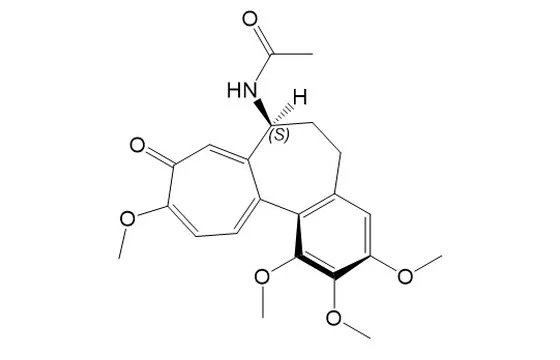
| Entry | Identity | Formula | Mass | Difference from colchicine |
|---|---|---|---|---|
| Impurity 1, EP A | N-deacetyl-N-formylcolchicine, CAS 7411-12-3 | C21H23NO6 | 385.42 | minus 14.02, acetyl shortened to formyl |
| Impurity 3, EP C | Lumicolchicine, CAS 6901-13-9 | C22H25NO6 | 399.44 | none, it is an isomer |
| Impurity 5, EP E | 3-Demethylcolchicine, CAS 7336-33-6 | C21H23NO6 | 385.42 | minus 14.02, aromatic methoxy lost |
| Impurity 6, EP F | Colchiceine, CAS 477-27-0 | C21H23NO6 | 385.42 | minus 14.02, methyl position not given by the name |
| Impurity 7, EP G | Second lumicolchicine, CAS 6901-14-0 | C22H25NO6 | 399.44 | none, it is the other isomer |
| Impurity 10 | Demecolcine, CAS 477-30-5 | C21H25NO5 | 371.43 | minus 28.01, acetyl replaced by methyl |
Table 2. The formula clusters in a 13-entry series [7,2,3,9,10,11,12]. Two entries are indistinguishable from the parent by mass, and three are indistinguishable from each other.
The minus fourteen that means three different things
A loss of 14.02 is a loss of CH2, and in this molecule that unit can come from four places: the N-acetyl, one of the three aromatic methoxy groups, or the methoxy on the tropolone ring. Three of those four possibilities are represented in the catalogue, and they are not equivalent chemically even though they are identical by mass.
EP A shortens the acetyl to a formyl, an event on the amide that leaves the chromophore intact. EP E removes an aromatic methyl and leaves a phenol, so the compound moves in the chromatogram without moving the spectrum. EP F is also one methyl short, with no position given in its name, and the position is what decides whether the spectrum shifts: the methyl on the tropolone oxygen is conjugated with the carbonyl that produces the visible absorption.
The practical consequence is that a single-wavelength method cannot distinguish the three: two of them carry essentially the parent spectrum at the detection wavelength and only the third does not. A photodiode array does, and a ratio of two absorbances is a free identity test once the spectra are collected.
What light does: a ring closes, it does not oxidise
Colchicine is not oxidised by light in the way a dihydropyridine is. The tropolone ring undergoes a disrotatory cyclisation onto the adjacent double bond, forming a new sigma bond and a strained four-membered ring fused to the seven-membered one. The reaction has been mapped computationally: the first excited state lies at about 3.6 eV, the two cis-fused products sit roughly 15 kcal per mole above colchicine, and the trans-fused alternatives are more than 60 kcal per mole higher, which is why they are not observed [4].
Two products come out, beta and gamma, differing only in the geometry of that new ring fusion. The ratio between them is not a constant of nature. A solvent study found that the partitioning of the excited singlet depends on solvent polarity, that oxygen does not change either the quantum yield or the ratio, and that triplet sensitisers fail to drive the reaction at all, which argues against a triplet intermediate [5]. Read that result carefully: the beta to gamma ratio is a fingerprint of the irradiation conditions, not a fixed stoichiometry, so a limit written on one isomer and an unspecified limit on the other is a limit written on the wrong variable.
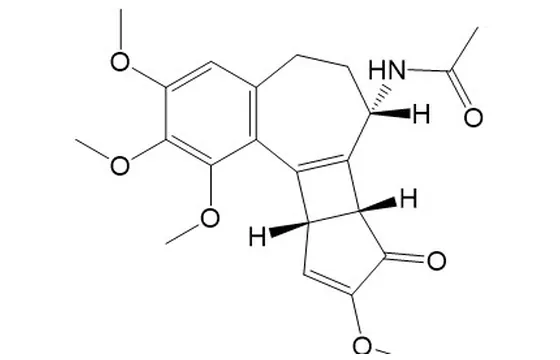
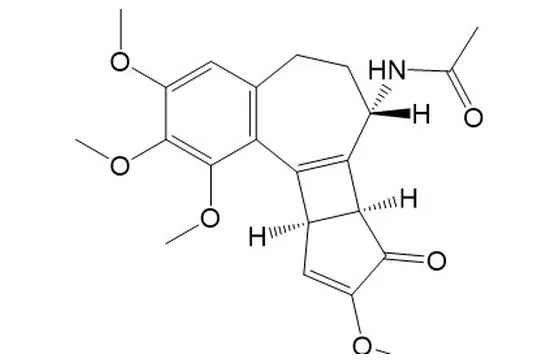
Visible light is enough. A photolysis study on colchicine in solution found that both ultraviolet and visible irradiation degrade it, that the reaction is first order with a rate constant of 0.5862 per hour in ethanol under ultraviolet light, and that the product under those conditions is a deacetamido-lumicolchicine rather than the intact isomer [6]. Cytotoxicity moved the other way: the IC50 against BRL 3A cells rose from 0.48 to 2.1 µg per mL. The photoproduct is less active than the drug, which makes photodegradation a content problem first and a safety problem second.
The mass balance that stays at one hundred per cent while the product degrades
An isomeric degradant breaks the usual sanity checks. If 2 per cent of the colchicine in a tablet becomes lumicolchicine, the assay falls by 2 per cent, the impurity method gains a 2 per cent peak, and the sum is still 100 per cent. Mass balance is satisfied and nothing looks inconsistent, yet the product has lost 2 per cent of its active content, in a molecule whose label carries a warning about fatal toxicity at excessive doses.
A mass balance calculation is therefore evidence of accounting, not of stability. The check that matters is the individual photoproduct peak, and the second is whether the two lumicolchicines are resolved from each other, because a method that reports them as one peak cannot see the ratio change that signals a change in light exposure.
A second trap sits in the integration window. If the assay window includes the leading edge of the lumicolchicine, the assay reads high by an amount that depends on the resolution of the column that day. The failure is not random: it is worse on a column with a few hundred injections behind it, which is the column in the stability laboratory at the end of the study.
Light is a formulation variable, not only an analytical one
The tablet is film coated with hypromellose, polyethylene glycol, titanium dioxide, triacetin, carnauba wax and two aluminium lake dyes [1]. Titanium dioxide scatters ultraviolet light and is the reason a white coat protects anything at all. The dyes do not filter, and the coat is thin enough that protection is partial. The packaging does the rest, and in practice the choice between an aluminium blister and a high-density polyethylene bottle is a photostability decision that is often made by marketing before it is made by development.
ICH Q1B option 2 asks for at least 1.2 million lux hours of visible light and 200 W·h per square metre of ultraviolet, applied to the product in its pack and unprotected [13]. The unprotected arm is the informative one here: the question is not whether the pack protects the tablet but how much margin it has, and a product that fails unprotected while passing in the blister has a shelf life that depends on a supplier not changing the film.
Forced degradation should be designed with the same distinction. A solution study in water and acetonitrile will give a different beta to gamma ratio from a solid-state study, because the ratio depends on solvent polarity [5]. Neither is wrong. They answer different questions, and a specification cannot be built on the solution ratio and then verified against a solid sample.
Reading a colchicine chromatogram
Start with the wavelength. The tropolone system absorbs strongly near 350 nm, clear of the 210 to 220 nm region where the mobile phase and the excipients contribute most of their noise [7]. The higher wavelength costs nothing in sensitivity for the parent or the two lumicolchicines and removes most of the interference a low-wavelength method would have to resolve.
Then check the injection load. A 0.6 mg tablet in 1 mL gives 0.6 mg per mL, a 10 µL injection puts 6 µg on column, and the 0.05 per cent reporting threshold is 3 ng on column, well within reach of a modern ultraviolet detector. The low dose does not make the analysis difficult; it makes the limits devoid of toxicological meaning, which a better detector cannot fix.
Then calibrate identity rather than retention. A photodiode array ratio plus a retention time against each standard is the only way to say which peak is which, and in this series a wrong assignment is not a small error: it moves a peak between an unspecified limit and a 0.10 per cent individual limit.
Five traps in the specification
- Assigning EP letters by catalogue number. The series runs impurity 1, 3, 5, 6, 7 for EP A, C, E, F, G, and the letters B and D are absent, so any automatic mapping is wrong by construction.
- Reporting area per cent for the lumicolchicines. Their chromophore is not the parent chromophore, so equal areas do not mean equal mass, and the correction is a measured relative response rather than an assumption.
- Running the photostability study on the drug substance only. The coat, the dye and the pack are part of the protection, and the substance in a clear vial is not the product.
- Treating a demecolcine peak as a degradant. Demecolcine is a marketed substance in its own right, so a peak with that retention time raises a cross-contamination question before it raises a stability one.
Where this sits among photolabile drugs
Compare molecules whose photochemistry changes the formula. Nifedipine loses a nitro group and oxidises to a pyridine, so the degradant has a different mass and a different fragment pattern and a mass spectrometer finds it without a standard. Folic acid and riboflavin degrade oxidatively, with products that differ in oxygen content. A mass-based screen is a reasonable first pass in all three cases.
Colchicine is the case where that instinct fails, because the reaction conserves everything. The same is true of the photochemistry of paclitaxel at C7, where the epimer has the parent formula and only the configuration changes. Isomerisation is analytically harder than fragmentation, because it removes the two shortcuts that a modern laboratory relies on: the mass difference and the fragment pattern.
China has 34 acceptance records from 22 applicants for this substance, a thin filing base for a drug of this age:
This catalogue carries 13 entries, five of them with a pharmacopoeial letter and two of them isomers of the parent, which is the minimum needed to assign the peaks rather than merely count them. The list is on the colchicine page.
Frequently Asked Questions
Do the lumicolchicines really have the same molecular formula as colchicine?
Which lumicolchicine is EP impurity C and which is EP impurity G?
Does the 0.6 mg dose make the impurity limits stricter or looser?
Can a mass balance calculation detect photodegradation?
Why is the beta to gamma ratio important?
Is the photodegradation a safety problem or a potency problem?
Should the photostability study be run on the tablet or the substance?
What detection wavelength should a related-substances method use?
Related Substances and Reference Standards
- Colchicine (13 impurity / derivative entries)
- Nifedipine (- impurity / derivative entries)
- Folic Acid (- impurity / derivative entries)
References and Sources
- DailyMed, US National Library of Medicine, COLCRYS (colchicine) film-coated tablets, prescribing information: 0.6 mg strength, 0.6 mg once or twice daily for prophylaxis with a maximum of 1.2 mg per day, 1.2 to 2.4 mg per day in familial Mediterranean fever, and the full inactive ingredient list, accessed 2026-11-21
- PubChem, National Center for Biotechnology Information, Lumicolchicine, CAS 6901-13-9, C22H25NO6, 399.44, recorded in this series as EP impurity C, accessed 2026-11-21
- PubChem, National Center for Biotechnology Information, The second lumicolchicine, CAS 6901-14-0, C22H25NO6, 399.44, recorded as EP impurity G, accessed 2026-11-21
- Journal of Chemical Theory and Computation, American Chemical Society, Cacelli, D Auria and Villani, Theoretical study of the photochemical isomerization of colchicine, 3(2):649-656, 2007: disrotatory cyclisation, first excited state near 3.6 eV, products about 15 kcal per mole above colchicine, trans-fused alternatives above 60 kcal per mole, accessed 2026-11-21
- Photochemistry and Photobiology, Nery et al., Does the photochemical conversion of colchicine into lumicolchicines involve triplet transients? A solvent dependence study, 73(3):213-218, 2001: solvent polarity governs the beta to gamma ratio, oxygen has no effect, triplet sensitisers do not drive the reaction, accessed 2026-11-21
- Journal of Food Measurement and Characterization, Springer, Photolysis and cytotoxicity of the potentially toxic composition of daylily flower: colchicine, 2023: visible and ultraviolet light both degrade colchicine to a deacetamido-lumicolchicine, first-order kinetics with a rate constant of 0.5862 per hour in ethanol under ultraviolet light, IC50 rising from 0.48 to 2.1 µg per mL after irradiation, accessed 2026-11-21
- PubChem, National Center for Biotechnology Information, Colchicine, C22H25NO6, 399.44, used here for the skeleton, the tropolone chromophore and every mass difference in Table 2, accessed 2026-11-21
- International Council for Harmonisation, ICH Q3A(R2), Impurities in new drug substances, Attachment 1: for a maximum daily dose of 2 g or less, reporting 0.05 per cent, identification 0.10 per cent or 1.0 mg per day and qualification 0.15 per cent or 1.0 mg per day, whichever is lower, accessed 2026-11-21
- PubChem, National Center for Biotechnology Information, N-Deacetyl-N-formylcolchicine, CAS 7411-12-3, C21H23NO6, 385.42, recorded in this series as EP impurity A, accessed 2026-11-21
- PubChem, National Center for Biotechnology Information, 3-Demethylcolchicine, CAS 7336-33-6, C21H23NO6, 385.42, recorded in this series as EP impurity E, accessed 2026-11-21
- PubChem, National Center for Biotechnology Information, Colchiceine, CAS 477-27-0, C21H23NO6, 385.42, recorded in this series as EP impurity F, accessed 2026-11-21
- PubChem, National Center for Biotechnology Information, Demecolcine, CAS 477-30-5, C21H25NO5, 371.43, a marketed substance and the entry numbered 10 in this series, accessed 2026-11-21
- International Council for Harmonisation, ICH Q1B, Stability testing: photostability testing of new drug substances and products, option 2 requiring at least 1.2 million lux hours of visible light and 200 W·h per square metre of ultraviolet light, accessed 2026-11-21
This article was prepared by the CATO technical team. Regulatory, pharmacopoeial and published literature content cited above is attributed in the reference list. It is provided for technical exchange and search reference only and does not constitute a quality specification or regulatory advice. For any specific substance, the applicable test methods, limits and filing requirements are governed by the current regulations, pharmacopoeial monographs and official publications.
Product information on this site is provided for research search and selection reference only and is not a quality specification; technical data, purity and structural confirmation are governed by the shipped COA and our written confirmation. All products mentioned are for research use only, not for human or animal diagnostic or therapeutic use.