Folic Acid: A Photolysis That Accelerates and Products That Leave the Window Before the Parent
Folic acid is the fully oxidised folate: a 2-amino-4-hydroxypteridine ring, a C9 methylene bridge, an N10 nitrogen, and a p-aminobenzoyl glutamate tail. Of those four pieces only the pteridine absorbs above 300 nm, and when it does, the bond that breaks is the one holding the molecule together. Both halves are more polar than the parent and both are under 270 Da, which explains most of what goes wrong in a folic acid photostability study: the loss is real, it is fast, and the products have left the window before anyone looks for them.
Note: product names shown in red (marked with ↗) are links - click through to the product page for structure, CAS number, purity and lead time.
One chromophore, three ionisable regions, and a tail that does no photochemistry
Key points
- Folic acid is C19H19N7O6, 441.40, CAS 59-30-3; the only useful chromophore is the 2-amino-4-hydroxypteridine, and the glutamate tail contributes nothing above 300 nm[1].
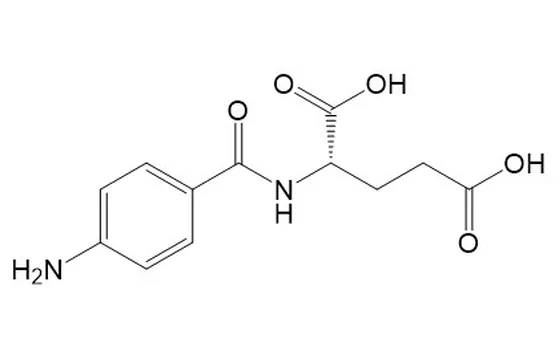
- Cleavage of the C9-N10 bond gives p-aminobenzoyl-L-glutamic acid (266.25, EP impurity A) and 6-formylpterin (191.15), which sum to the parent plus one oxygen atom, so mass balance closes only if both are measured[1].
- 6-Formylpterin oxidises to pterin-6-carboxylic acid (207.15), which decarboxylates to pterin (163.14): a 16 Da step and a 44 Da step, both below 210 Da and both eluting before the parent[1].
- Direct photolysis is about 32 times faster at pH 2.5 than at pH 10.0, and because photoproducts sensitise the reaction the loss is not first order over a full ICH Q1B exposure[2].
Folic acid is pteroyl-L-glutamic acid: C19H19N7O6, 441.40, CAS 59-30-3[1]. Three pieces are joined end to end. A pteridine ring carries an amino group at C2 and a hydroxyl at C4. A methylene bridge at C9 connects it to an N10 nitrogen; below N10 sits a p-aminobenzoyl group whose carbonyl is amided to the alpha carbon of glutamic acid.
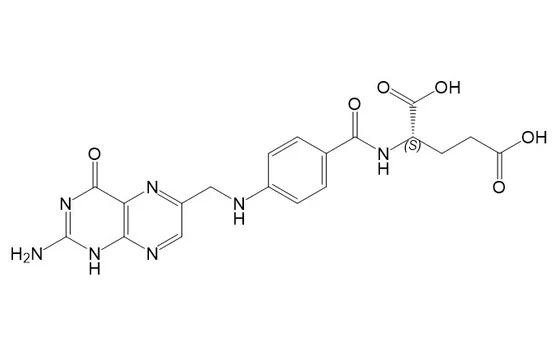
Only the first piece absorbs useful light. The pteridine chromophore covers roughly 250 to 360 nm; the p-aminobenzoyl group also absorbs near 290 nm, but the pteridine dominates above 300 nm, and the glutamate tail is transparent through the near ultraviolet. Every photon that does chemical work here is absorbed within one third of the molecule.
The molecule also changes charge more than once across the pH range a formulation occupies. The 1999 kinetic study fitted two pKa values into its rate profile, 2.3 and 8.3, and the rate falls steadily between them[2]. That fall is not small, and it is the first thing to check before comparing two photostability datasets.
The products leave the window before the parent does
Cleave the C9-N10 bond photochemically and the molecule divides into two pieces, both more polar than what they came from: p-aminobenzoyl-L-glutamic acid, C12H14N2O5, 266.25, which is EP impurity A, and 6-formylpterin, C7H5N5O2, 191.15[1]. Neither is retained on a C18 column run with a high-aqueous acidic mobile phase. Folic acid is retained comfortably. The selectivity is enormous, which sounds like good news and is the start of the problem.
| Entry | Formula and mass | How it relates to folic acid | Behaviour on C18 |
|---|---|---|---|
| Folic acid | C19H19N7O6, 441.40 | parent | retained |
| p-Aminobenzoyl-L-glutamic acid, EP impurity A | C12H14N2O5, 266.25 | one half of the C9-N10 cleavage | early, anionic |
| 6-Formylpterin | C7H5N5O2, 191.15 | other half, as the aldehyde | early, fluorescent |
| Pterin-6-carboxylic acid | C7H5N5O3, 207.15 | 6-formylpterin plus one oxygen | early, fluorescent |
| Pterin | C6H5N5O, 163.14 | pterin-6-carboxylic acid minus CO2 | at the solvent front |
| Pteroic acid, EP impurity D | C14H12N6O3, 312.29 | glutamate lost, pteridine intact | mid, hydrolysis not photolysis |
| 2,5,6-Triamino-4-pyrimidinone, EP impurity B | C4H7N5O, 141.13 | pyrimidine ring opened | before everything above |
The pterins lie between 163 and 207 Da, no two more than 44 Da apart. On a method that resolves folic acid from its aromatic impurities they will not be resolved from each other, and on a method starting at 5 percent organic they may not be resolved from the injection front. What happens is subtler than a missed peak: the window is set around the parent, the pterins fall outside it, and the chromatogram is reported as clean.
The second half is arithmetic. Limits are percentages of the parent, and in a photostability study the parent is falling. A product at 0.4 percent of a sample that has lost 30 percent of label claim is 0.57 percent of what remains. Reporting the ratio without the assay hides a loss a mass balance would catch.
Root cause: a cleavage that consumes one oxygen and is accelerated by its own products
Two mechanisms run here. The first is direct photolysis: the pteridine absorbs, the C9-N10 bond breaks, the C9 methylene is oxidised to an aldehyde and N10 is left as a primary amine. The fragments therefore sum to 457.40, the parent plus a single oxygen atom, so mass balance closes only if both halves are measured on a molar basis.
The second is sensitised. A time-resolved study showed three phases: zero-order formation of photoproducts, then an accelerated phase in which 6-formylpterin and pterin-6-carboxylic acid absorb and pass energy to the parent, then first-order decay of 6-formylpterin to the acid[3]. The same work ran in heavy water and concluded that singlet oxygen is probably not the explanation[3].
The action spectrum confirms the reaction is not a copy of the absorption spectrum: measured from 260 to 400 nm, the wavelength dependence of loss differs from both the absorption and the fluorescence excitation spectra, and both UVB and UVA drive it[4].
Put numbers on the pH dependence. Under one UV source the first-order rate constant ran from 5.04 x 10⁻³ per minute at pH 2.5 to 0.155 x 10⁻³ per minute at pH 10.0[2], half-lives of about 2.3 hours and 75 hours: a factor of 32 across a range one tablet can span between core and film coat.
A sensitiser changes the driver without changing the chemistry. With riboflavin present, photolysis proceeds under visible light and the bimolecular rate peaks at pH 6.2 near 3.0 x 10³ per molar per minute, against 0.63 x 10³ at pH 4.0 and 0.50 x 10³ at pH 9.0[5]: a pH a multivitamin tablet can occupy, at wavelengths an amber bottle attenuates least.
Which product you find depends on when you stop the lamp
Two well-known studies appear to disagree. The pH-rate work reported pterin-6-carboxylic acid and p-aminobenzoylglutamic acid as the products, at maximum yield after 3 to 8 hours depending on pH[2]. The time-resolved work reported 6-formylpterin as the immediate product, with the acid appearing only as irradiation continued[3]. Both are right: the aldehyde is the intermediate and the acid is what it becomes.
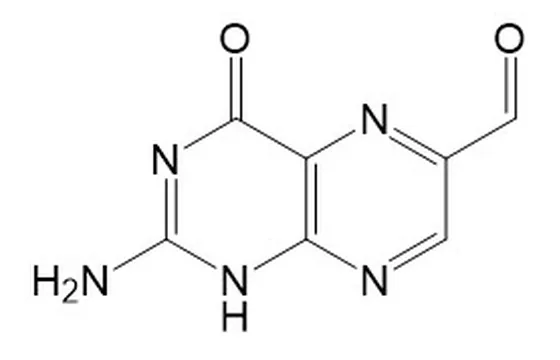
The consequence is a common error. A study that irradiates for seven days and integrates once will find the acid and may find no aldehyde at all, then report that the aldehyde is not formed, when in fact it was formed, consumed and converted. A photolysis study needs at least three time points, the first early enough to catch the intermediate.
Recent quantitative work treats both as analytes. A 2024 LC-MS/MS method measures folic acid, 6-formylpterin and pterin-6-carboxylic acid with oxidised guanine derivatives over 1 to 2000 ng/mL, in animals kept under light and non-light conditions[6]. Both pterins sit in its windows at once, the arrangement a stability programme should copy.
Retention first, response second
Pterins are fluorescent, which is why they are easy to detect and hard to retain. Absorbance at 280 nm is not the limit: the acid and the aldehyde absorb strongly in the same region as the parent. The limit is that all four are small, extensively hydrogen-bonding, and partly ionised at any pH a conventional mobile phase allows.
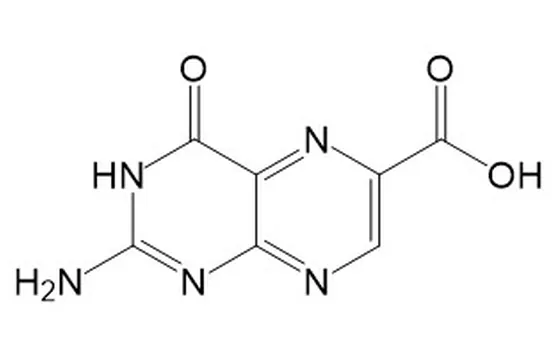
Three approaches work and they are not interchangeable. Lowering pH suppresses ionisation of the pterin ring and buys retention on C18, at the cost of pushing the zwitterionic p-aminobenzoylglutamic acid the other way. Ion-pairing with an alkyl sulfonate retains the acid fragments but is incompatible with the mass spectrometer most laboratories want. HILIC separates the pterin set well and folic acid from almost nothing else.
The pragmatic answer is two methods rather than one better one: reversed-phase for the parent and its aromatic impurities, and a polar or HILIC method with fluorescence or MS detection for the pterin set. Where a single method is mandatory, the 2024 approach used a 2.1 by 100 mm, 5 micrometre HSS T3 column at 0.25 mL per minute, linear from 1 to 2000 ng/mL with correlation above 0.99[6]. Its most important feature is not the column but that both pterins are calibrated separately.
Response factors deserve their own sentence. Pterin-6-carboxylic acid is a documented photosensitiser: once excited it damages DNA at consecutive guanines by electron transfer and generates 8-oxo-7,8-dihydro-2-deoxyguanosine[7], a qualification argument, and a reason to measure it against its own standard.
Regulatory framing: exposure, thresholds, and the point where the nitrosamine limit binds
ICH Q1B sets the exposure; the widely used Option 1 is 1.2 million lux hours of visible light with 200 watt hours per square metre of near ultraviolet[8]. Bracketing is permitted, and for a molecule whose photolysis accelerates once products accumulate it is weaker than it appears: the rate over the first fifth is not the rate that applies to the rest.
ICH Q3B(R2) sets the thresholds for degradation products in the drug product[9]:
| Maximum daily dose | Reporting threshold | Identification threshold | Qualification threshold |
|---|---|---|---|
| 1 g or less | 0.1 percent | 0.5 percent or 1.0 mg per day | 1.0 percent or 1.0 mg per day |
| More than 1 g | 0.05 percent | 0.2 percent or 2.0 mg per day | 0.5 percent or 2.0 mg per day |
Folic acid products are low dose, so the upper row applies, and at 5 mg per day the 0.1 percent reporting threshold is 5 micrograms. That is 3.3 times the 1.5 microgram per day that ICH M7(R2) applies to a nitrosamine with no published acceptable intake[10]. Side by side, the crossover is exact:
| Daily dose | 0.1 percent of the dose | 1.5 micrograms as a percentage | Limit that binds |
|---|---|---|---|
| 400 micrograms | 0.4 micrograms | 0.375 percent | Q3B reporting |
| 1 mg | 1.0 micrograms | 0.15 percent | Q3B reporting |
| 1.5 mg | 1.5 micrograms | 0.10 percent | identical |
| 5 mg | 5.0 micrograms | 0.03 percent | M7 tolerable intake |
Below about 1.5 mg per day the reporting threshold is stricter; above it, the tolerable intake is. Folic acid is supplied at both ends, so one impurity can be a specification item in one strength and a genotoxic impurity in another.
The catalogue carries what the argument needs: two isomeric N-nitroso folates at C19H18N8O7, CAS 26360-21-4 and 29291-35-8, and an N-nitroso derivative of folinic acid at C20H22N8O8, CAS 77314-00-2, filed under USP related compound A[1]. None has a published acceptable intake.
CDE lists 476 accepted filings for folic acid from 226 applicants[11]:
Six ways this study goes wrong
- Area percent against a falling parent. The denominator shrinks while the numerator grows, so a 30 percent loss can present as a 0.4 percent impurity.
- A single time point in an accelerating reaction. One long exposure describes the phase it ended in, not the one the product will see on a shelf.
- Treating the amber bottle as a complete control. Amber glass is a UV filter; the riboflavin pathway runs on visible light and passes through it.
- Summing the pterins into one peak. The four lie within 44 Da of each other and have different response factors, so a sum cannot be converted into a molar balance.
- Attributing pteroic acid to light. It is the glutamate tail lost hydrolytically with the pteridine intact, a different root cause.
- Assuming the main photoproduct is a compendial impurity. The EP A to H set carried here does not include 6-formylpterin or pterin-6-carboxylic acid, and two of its members, impurities C and G, carry the parent formula C19H19N7O6, so they are isobaric with the drug.
That last point cuts both ways: a product can meet every lettered limit and still lose a third of its label claim to compounds the monograph never names.
Which neighbouring molecules you cannot reason from
Methotrexate↗ shares the pteroyl-glutamate architecture, and its differences sit badly for anyone hoping to borrow data: an amino group where folic acid has a hydroxyl at C4, and a methyl on N10. Both sit on the atoms that govern the C9-N10 bond, so methotrexate photostability results cannot set folic acid limits in either direction.
Riboflavin is the opposite case: not a model but an accelerant, moving the driver from UV to visible light with a rate maximum at pH 6.2[5]. Any multivitamin holding both has a photostability problem neither monograph describes.
Excipients are not neutral. Ascorbic acid consumes the oxidant that converts 6-formylpterin to pterin-6-carboxylic acid, so it can change which pterin a study finds without changing how fast the parent disappears. Nicotinamide is photolabile on its own account and its products share the early part of the chromatogram. Neither shows up in a binary study.
The sharpest contrast is with the reduced folates. 5-Methyltetrahydrofolate at CAS 134-35-0 and folinic acid at CAS 58-05-9 sit one and two oxidation levels below folic acid, and they degrade in the dark by oxidation. Folic acid is already at the fully oxidised pteridine level, which is why light rather than oxygen is its principal enemy, and why an antioxidant strategy borrowed from a reduced folate product will underperform here. The same photodegradation logic, for a molecule whose product has two identities, is worked through for furosemide, and the nitrosamine arithmetic is set out in more detail for amlodipine.
The full listing, 62 numbered entries between 1 and 105 plus the EP letters, is at folic acid impurity standards.
What has to be on the bench
A photolysis study on this molecule needs six standards, not two. The parent. p-Aminobenzoyl-L-glutamic acid at 4271-30-1, EP impurity A and the only way to close the mass balance. 6-Formylpterin at 712-30-1, the intermediate most studies never see. Pterin-6-carboxylic acid at 948-60-7. Pterin at 2236-60-4, which appears late in the exposure. And pteroic acid at 119-24-4, EP impurity D, the control that says hydrolysis rather than light.
Two practical notes. The pterin aldehyde and acids are light-sensitive, so a standard left on a bench for a day is no longer the solution prepared. And if a nitrosamine risk assessment is in scope, add the two N-nitroso entries at 26360-21-4 and 29291-35-8, they arise from nitrosation, not photolysis, and a light-only study will never find them.
Frequently Asked Questions
Does folic acid degrade in the dark?
Which photoproduct should I quantify first?
Can I report these products as area percent?
My forced-degradation study showed no impurities after seven days of light. Why?
Is N-nitroso folic acid an NDSRI?
Does an amber bottle solve the problem?
Why is the main photoproduct not a lettered pharmacopoeial impurity?
What is the fastest experiment to test whether my method can see these products?
Related Substances and Reference Standards
- Folic Acid (81 impurity / derivative entries)
- Methotrexate (86 impurity / derivative entries)
- Nicotinamide (286 impurity / derivative entries)
- Ascorbic Acid (26 impurity / derivative entries)
References and Sources
- U.S. National Library of Medicine, PubChem, Folic acid, CAS 59-30-3, C19H19N7O6, molecular weight 441.40; record used for the pteridine, C9 methylene, N10 and glutamate assignments, and for the N-nitroso entries at 26360-21-4, 29291-35-8 and 77314-00-2, accessed 2026-11-11
- Journal of Pharmaceutical and Biomedical Analysis, Akhtar MJ, Khan MA, Ahmad I. Photodegradation of folic acid in aqueous solution. First-order kinetics, pKa 2.3 and 8.3, rate constants from 5.04 x 10⁻³ per minute at pH 2.5 to 0.155 x 10⁻³ per minute at pH 10.0, products pterin-6-carboxylic acid and p-aminobenzoyl-L-glutamic acid, accessed 2026-11-11
- Journal of Photochemistry and Photobiology B, Ultraviolet photodegradation of folic acid. Three-phase kinetics, 6-formylpterin as the first-formed product and its conversion to pterin-6-carboxylic acid, product sensitisation, and the heavy-water experiment that argues against singlet oxygen, accessed 2026-11-11
- Journal of Photochemistry and Photobiology B, The action spectrum for folic acid photodegradation in aqueous solutions. Wavelength dependence measured from 260 to 400 nm, differing from the absorption and fluorescence excitation spectra, with both UVB and UVA active, accessed 2026-11-11
- Journal of Pharmaceutical and Biomedical Analysis, Akhtar MJ, Khan MA, Ahmad I. Effect of riboflavin on the photolysis of folic acid in aqueous solution. Second-order rate constants under visible light, maximum at pH 6.2 of about 3.0 x 10³ per molar per minute against 0.63 x 10³ at pH 4.0 and 0.50 x 10³ at pH 9.0, accessed 2026-11-11
- Journal of Separation ScienceSimultaneous determination of folic acid photolysis products and oxidized guanine derivatives in plasma by liquid chromatography-tandem mass spectrometry. HSS T3 2.1 by 100 mm, 5 micrometre, 0.25 mL per minute, linear from 1 to 2000 ng/mL
- Archives of Biochemistry and Biophysics, Sequence-specific DNA damage induced by ultraviolet A-irradiated folic acid via its photolysis product. Photoexcited pterin-6-carboxylic acid cleaves DNA at consecutive guanines by electron transfer and generates 8-oxo-7,8-dihydro-2-deoxyguanosine, accessed 2026-11-11
- International Council for Harmonisation, Q1B Photostability Testing of New Drug Substances and Products. Option 1 exposure of 1.2 million lux hours of visible light with 200 watt hours per square metre of near ultraviolet, and the provisions for bracketing and confirmatory testing, accessed 2026-11-11
- International Council for Harmonisation, Q3B(R2) Impurities in New Drug Products. Reporting, identification and qualification thresholds for degradation products, 0.1, 0.5 and 1.0 percent at a maximum daily dose of 1 g or less, accessed 2026-11-11
- International Council for Harmonisation, M7(R2) Assessment and Control of DNA Reactive (Mutagenic) Impurities in Pharmaceuticals. Default tolerable intake of 1.5 micrograms per day for an impurity without a compound-specific limit, accessed 2026-11-11
- Center for Drug Evaluation, National Medical Products Administration of China, Public accepted-filing records for folic acid counted by application type and applicant: 476 accepted filings from 226 applicants as retrieved on 11 November 2026, accessed 2026-11-11
This article was prepared by the CATO technical team. Regulatory, pharmacopoeial and published literature content cited above is attributed in the reference list. It is provided for technical exchange and search reference only and does not constitute a quality specification or regulatory advice. For any specific substance, the applicable test methods, limits and filing requirements are governed by the current regulations, pharmacopoeial monographs and official publications.
Product information on this site is provided for research search and selection reference only and is not a quality specification; technical data, purity and structural confirmation are governed by the shipped COA and our written confirmation. All products mentioned are for research use only, not for human or animal diagnostic or therapeutic use.