Gadobutrol Has an Impurity That Is Also an Excipient, and a Metal That Q3D Does Not Cover
Almost every impurity question ends with the same instruction: reduce it. Gadobutrol↗ is the exception. Its EP impurity B is the free macrocyclic ligand, and the same ligand is added on purpose to the finished product as calcobutrol sodium, at about one tenth of a mole per cent of the complex. The specification therefore points in two directions at once, and the elemental impurity framework that should arbitrate the metal has no line for the metal at all.
Note: product names shown in red (marked with ↗) are links - click through to the product page for structure, CAS number, purity and lead time.
A chelate whose impurity list is its own synthesis tree
Key points
- Gadobutrol is C18H31GdN4O9, 604.7, a macrocyclic gadolinium chelate whose ligand carries a (2R,3S)-1,3,4-trihydroxybutan-2-yl arm on a DO3A framework[1].
- EP impurity B is that ligand as the free acid, C18H34N4O9, 450.5, and EP impurity C is DO3A, C14H26N4O6, 346.4; both are ligands rather than degradants[2][3].
- The marketed product contains 604.72 mg of gadobutrol and 0.513 mg of calcobutrol sodium per mL, the calcium salt of the same ligand, which is about 0.105 mole per cent of the complex[4].
- ICH Q3D lists 24 elements and gadolinium is not among them, so the hazard that governs this class, the rate at which the metal leaves the ligand, has to be controlled outside the elemental impurity framework[5].
Gadobutrol is a gadolinium(III) ion held inside a twelve-membered tetraaza macrocycle that carries three acetate arms and one 1,3,4-trihydroxybutan-2-yl arm, C18H31GdN4O9, 604.7[1]. The butrol arm has two stereocentres, (2R,3S), which is the only chirality in the molecule and the only reason a stereochemical question exists here at all. Everything else about the substance follows from the fact that the active species is an equilibrium between a metal and a ligand rather than a covalent molecule.
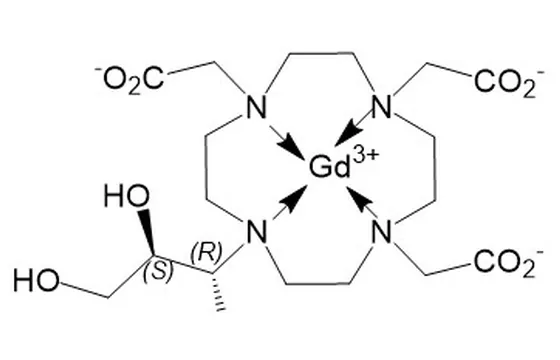
This catalog holds 125 gadobutrol entries and only three EP letters. That ratio is the first useful observation. A corticosteroid with 70 entries carries twelve letters, because every degradant deserves a name. Here the compendium names the species that are structurally close to the ligand and leaves the rest to supplier numbering, which tells you where the monograph thinks the risk sits.
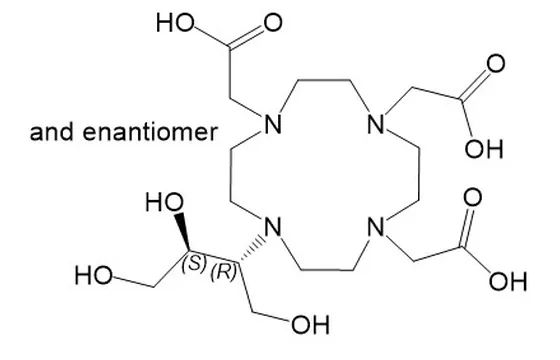
The three letters are all ligands. EP impurity B is the free ligand, butrol, C18H34N4O9, 450.5[2]. EP impurity C is DO3A, the macrocycle with three acetate arms and no butrol, C14H26N4O6, 346.4[3]. EP impurity A is the over-alkylated species, C20H40N4O10, 496.6, which carries two butrol arms on one ring. None of the three is a product of hydrolysis, oxidation or light. They are all products of an alkylation sequence that ran too far, too little, or in the wrong place.
The remaining 120-odd entries are the synthesis tree, and some of them are reagents rather than impurities in any regulatory sense. The catalog lists 1,4,7,10-tetraazacyclododecane, the bare cyclen ring, C8H20N4, 172.3[8], and it lists potassium carbonate.
The ligand that is an impurity in one document and an excipient in the other
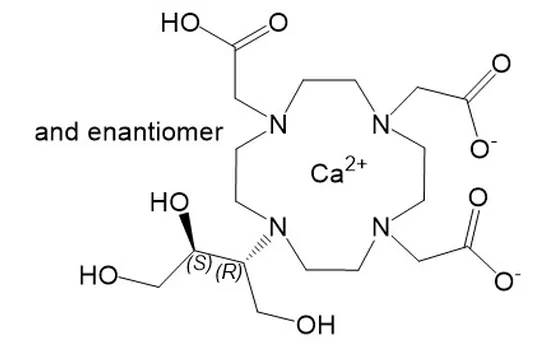
The label resolves the ambiguity in an unexpected direction. Each millilitre of the marketed product contains 604.72 mg of gadobutrol, equivalent to 1 mmol, and 0.513 mg of calcobutrol sodium as an inactive ingredient, together with 1.211 mg of trometamol, hydrochloric acid for pH adjustment and water[4]. Calcobutrol is the calcium salt of the same ligand, C18H32CaN4O9, 488.5[7].
Convert that to moles and the two documents meet. 0.513 mg divided by 488.5 gives 1.05 micromoles per millilitre, against 1.000 millimoles of complex, so the added ligand is 0.105 mole per cent of the gadolinium in the vial. On a mass basis it is 0.085 per cent of the complex, which is above the 0.05 per cent reporting threshold that would apply if the same material arrived as an impurity instead of as an excipient.
The purpose is thermodynamic. The complex dissociates slowly, and the free ligand in solution is a sink for any gadolinium that leaves: the metal is recaptured by the ligand that is already there rather than by phosphate, by zinc, by calcium or by a plasma protein. Adding product at the level of 0.1 mole per cent is, arithmetically, sizing the sink for a dissociation in the region of 0.1 mole per cent. That is a design statement about the acceptable rate of release, expressed as a formulation composition rather than as a specification limit.
The analytical consequence is awkward and rarely stated. A method that measures free ligand in the finished product sees one peak with two sources: residual ligand from the drug substance and the deliberately added calcobutrol. It cannot attribute the peak, and it cannot tell whether a low result means a clean API or an under-dosed excipient. The same molecule has an upper limit in one document and a target in the other, which is why the two limits have to be written by someone who has read both.
The organic method reports ligands, not the metal
An organic related-substances method on this molecule reports ligands. That is all it can do. The complex has no strong chromophore beyond the carboxylate arms, the metal is paramagnetic so nuclear magnetic resonance is not available for identity in the usual sense, and in an electrospray source the complex tends to lose the metal and arrive at the detector as the ligand. A method that reports the ligand peak is not wrong; it is answering a different question from the one the specification appears to ask.
Whether the gadolinium is inside the ring or outside it is a speciation question, and speciation needs a technique chosen for it: elemental determination for total metal, and a species-specific measurement for the free fraction, which is a separate method with a separate validation package. The two numbers are not interchangeable, and a total gadolinium result close to 100 per cent of label says nothing about how much of it is unchelated.
This is where the arithmetic of impurities stops being a percentage. At a 4.2 g dose, one tenth of one per cent of the complex is 4.2 mg of gadolinium. Four milligrams of chelated gadolinium and four milligrams of free gadolinium(III) ion are the same mass and not the same hazard, which is why the control strategy for this class is written around release rate rather than around a mass fraction.
Twenty-four elements, and gadolinium is not one of them
ICH Q3D covers 24 elements in three classes and sets permitted daily exposures for each. Gadolinium is not one of the 24[5]. The omission is not an oversight: the guideline addresses elements that enter as contaminants from reagents, catalysts, equipment and containers, and in this product the element is the active substance. An elemental impurity risk assessment that follows Q3D literally will therefore conclude that gadolinium is not applicable, which is formally correct and substantively useless.
The regulatory history shows which variable the agencies actually used. The 2017 referral under Article 31 of Directive 2001/83/EC concluded on 20 July 2017, with the Commission decision dated 23 November 2017, and it separated the class by architecture rather than by dose or by gadolinium content. The macrocyclic agents were described as more stable and as having a lower propensity to release gadolinium, and were maintained; the intravenous linear agents were suspended[6].
| Product (substance) | Class and route | Outcome of the 2017 EU review |
|---|---|---|
| Gadovist / Gadavist (gadobutrol) | macrocyclic, intravenous | maintained, lowest dose that gives adequate enhancement |
| Dotarem / Artirem (gadoteric acid) | macrocyclic, intravenous and intra-articular | maintained |
| ProHance (gadoteridol) | macrocyclic, intravenous | maintained |
| Magnevist (gadopentetic acid), intravenous | linear | suspended |
| Omniscan (gadodiamide) | linear, intravenous | suspended |
| OptiMARK (gadoversetamide) | linear, intravenous | suspended |
| MultiHance (gadobenic acid), Primovist (gadoxetic acid) | linear, hepatic uptake | restricted to liver imaging |
Table note: outcomes as published by the European Medicines Agency at the close of the Article 31 referral, with the European Commission decision dated 23 November 2017[6].
Note what the table does not contain: a gadolinium limit. Every row is a statement about kinetics, inferred from the behaviour of the complex in plasma and in tissue. The linear agents are not more toxic because they contain more gadolinium; they are more toxic because they let go of it faster, and the released ion is what deposits. A framework built on how much of an element is present cannot express that distinction, which is exactly the gap an applicant has to fill by argument.
Four grams per injection changes which threshold binds
The dose makes the rest of the arithmetic unusual. The product is supplied at 1 mmol per mL and dosed at 0.1 mmol per kg, so a 70 kg patient receives 7 mL, 7 millimoles and 4.23 g of gadobutrol in a single injection[4]. That is a gram-scale dose, unusual outside oral contrast agents.
At 4.23 g, ICH Q3B reporting at 0.05 per cent corresponds to 2.1 mg, and identification at 0.10 per cent would be 4.2 mg. But the identification threshold is the lower of 0.10 per cent and 1.0 mg per day, and 1.0 mg is 0.024 per cent of the dose[5]. The percentage that triggers identification therefore sits below the percentage that triggers reporting, so the usual two-stage cascade collapses into one stage: anything that has to be reported has already had to be identified. The same inversion appears with high-dose aspirin, for the same reason, and it is a property of the dose rather than of the molecule.
The practical effect is that the generic thresholds stop doing any work. At this dose almost any detectable ligand is above 0.05 per cent on a mass basis, so the question is never whether a peak crosses a generic threshold; it is which species the monograph names, at what level, and whether the toxicology of that species supports that level.
What to control, and in which direction
Four groups of species need separate control, and they fail in different ways.
The ligand family comes first: butrol, DO3A, the bis-butrol species and the bare cyclen ring. These are the only entries in the file with a credible toxicological question attached, because a polyamine macrocycle is not inert, and because the concentration at which each of them is present is a direct read-out of how well the alkylation and the deprotection were purged. The finished product adds deliberately to one member of this family, so the drug product method has to be able to separate butrol from calcobutrol and to know which is which.
Elemental control comes second, and it splits. Total gadolinium is essentially an assay and belongs with the content test rather than with impurities. Free gadolinium needs its own method and its own acceptance criterion. The Q3D elements that matter are the ones the route actually introduces, which means the assessment starts from the reagents and the equipment, not from the guideline table.
Residual solvents come third, and here the route is legible from the catalog. The protection of the triol as 2,2-dimethyl-1,3-dioxepane-5,6-diol, C7H14O4, is an acetone acetal, so acetone is in the process by construction rather than by accident. Acetone is a Q3C Class 3 solvent, which makes it a specification question with a generous limit rather than a toxicological argument[5]. Class 2 solvents appear or do not appear depending on the alkylation and ion-exchange steps, and that part of the file cannot be templated from another manufacturer.
Container closure deserves a line of its own. A 1 mmol per mL solution is dense and hypertonic, the label warns that solidification can occur on cold exposure, and glass or rubber in contact with a free chelating ligand is an extractables question that no related-substances method will answer.
Where the gadolinium logic stops
The contrast agent class looks uniform and is not. Iodinated agents such as iohexol, iopamidol and iodixanol hold iodine covalently on an aromatic ring. There is no dissociation equilibrium, no free iodine species to control, and the elemental question is a deiodination question rather than a speciation question. None of the gadolinium logic transfers to them, and a specification written for one class and applied to the other controls the wrong thing.
Within the gadolinium class the architecture is what matters. The linear agents share a backbone that presents the metal to endogenous ligands; the macrocyclics enclose it. Gadoteridol and gadoteric acid share the macrocyclic cage with gadobutrol but differ in the arm, and gadoteridol has no stereocentre in its arm at all. The free-ligand question recurs, but the excipient set differs by product, so the overlap between impurity and excipient has to be read off each label rather than assumed from the class.
The nearest non-gadolinium analogue in this catalog is oxaliplatin, where platinum is also the active element and the oxalate is a leaving group. The similarity is real but shallow: platinum leaves as a reactive species that alkylates DNA, which is the mechanism of action, while gadolinium leaves as a free ion that deposits, which is the mechanism of toxicity. Both sit outside Q3D, for opposite reasons, and the control strategies have nothing in common beyond that.
A concentrated file in every sense
The Chinese acceptance record for gadobutrol is small in absolute terms and concentrated in a different way: few applicants, high technical barriers, and no possibility of copying a tablet specification.
What matters for a filing is the reviewer rather than the competitor list. Anyone who has assessed a macrocyclic chelate will ask about free gadolinium and about the ligand in the finished product, and will not be satisfied by a Q3D table that omits the element.
Reference standards for a ligand family
The catalog carries 125 gadobutrol entries, of which only three hold EP letters, plus the individual ligand species that a stability or release method has to resolve: butrol at CAS 151852-61-8, calcobutrol at CAS 151878-23-8, DO3A at CAS 114873-37-9 and the bare cyclen ring at CAS 294-90-6: [see all gadobutrol entries](gadobutrol impurity and ligand entries)
Frequently Asked Questions
Is EP impurity B an impurity or an excipient?
Why is there no gadolinium limit in ICH Q3D?
What is the safety variable for a macrocyclic chelate?
Can LC-MS confirm the intact complex?
Why does the label include calcobutrol sodium?
Does the same logic apply to iodinated contrast agents?
Is there a nitrosamine question for gadobutrol?
How many EP-lettered impurities are there?
Related Substances and Reference Standards
- Gadobutrol (125 impurity / derivative entries)
- Gadoteridol (24 impurity / derivative entries)
References and Sources
- PubChem, National Center for Biotechnology Information, Gadobutrol, CID 6102852: C18H31GdN4O9, 604.7; the IUPAC name records the (2R,3S)-1,3,4-trihydroxybutan-2-yl arm on the DO3A framework, accessed 2026-11-17
- PubChem, National Center for Biotechnology Information, Butrol, CID 72058: C18H34N4O9, 450.5, the free ligand of gadobutrol and EP impurity B, accessed 2026-11-17
- PubChem, National Center for Biotechnology Information, 1,4,7-Tris(carboxymethyl)-1,4,7,10-tetraazacyclododecane (DO3A), CID 107830: C14H26N4O6, 346.4, EP impurity C, accessed 2026-11-17
- DailyMed, US National Library of Medicine: GADAVIST (gadobutrol) injection, Bayer HealthCare Pharmaceuticals, SPL setid 3c5101a0-0c7e-4078-8dc3-a57beb9a0e92, Prescribing information: 604.72 mg of gadobutrol per mL (1 mmol, containing 1 mmol of gadolinium), inactive ingredients 0.513 mg calcobutrol sodium and 1.211 mg trometamol per mL, dosage 0.1 mL per kg, 1 mmol per mL presentation, accessed 2026-11-17
- International Council for Harmonisation, ICH Quality Guidelines: Q3D(R2) Elemental Impurities (24 elements in three classes), Q3B(R2) Impurities in New Drug Products (0.05 per cent reporting, 0.10 per cent or 1.0 mg per day identification), Q3C(R8) Residual Solvents, accessed 2026-11-17
- European Medicines Agency, Gadolinium-containing contrast agents, Article 31 referral: final opinion of 20 July 2017 and Commission decision of 23 November 2017, macrocyclic agents maintained, intravenous linear agents suspended, accessed 2026-11-17
- PubChem, National Center for Biotechnology Information, Calcobutrol, CID 76967066: C18H32CaN4O9, 488.5, the calcium salt of the gadobutrol ligand used as an excipient, accessed 2026-11-17
- PubChem, National Center for Biotechnology Information, 1,4,7,10-Tetraazacyclododecane (cyclen), CID 64963: C8H20N4, 172.3, the bare macrocyclic ring listed in this catalog as a gadobutrol entry, accessed 2026-11-17
This article was prepared by the CATO technical team. Regulatory, pharmacopoeial and published literature content cited above is attributed in the reference list. It is provided for technical exchange and search reference only and does not constitute a quality specification or regulatory advice. For any specific substance, the applicable test methods, limits and filing requirements are governed by the current regulations, pharmacopoeial monographs and official publications.
Product information on this site is provided for research search and selection reference only and is not a quality specification; technical data, purity and structural confirmation are governed by the shipped COA and our written confirmation. All products mentioned are for research use only, not for human or animal diagnostic or therapeutic use.