Thioctic Acid Fails Two Ways: Light Gives the Reduced Thiol, Heat Above 58 °C Gives a Polymer With No Peak
Thioctic acid is a strained disulfide in a five-membered ring, and that ring is the drug. Above its melting range it opens and reconnects into linear disulfides; under light it is reduced to the dithiol instead. Neither event is hydrolysis, neither produces a convenient new peak, and both lower the same 332 nm absorbance, which is why a stability programme built on a single-wavelength assay can report a falling purity with a clean chromatogram.
Note: product names shown in red (marked with ↗) are links - click through to the product page for structure, CAS number, purity and lead time.
A five-membered ring that is also the pharmacophore
Key points
- Thioctic acid is C8H14O2S2, 206.33, a racemic 1,2-dithiolane, and the strained ring is both the pharmacophore and the failure point[1].
- Heating above the melting range of 58 to 65 °C polymerises it immediately into colourless linear disulfides rather than hydrolysing it[2].
- Light produces a different product entirely: dihydrolipoic acid, C8H16O2S2, 208.3, the reduced and antioxidant-active form[2][3].
- Both events lower the absorbance at 332 nm, so a single-wavelength assay sees one number for two mechanisms, and the polymer appears as no peak at all.
Thioctic acid is 5-(1,2-dithiolan-3-yl)pentanoic acid, C8H14O2S2, 206.33[1]. A five-membered ring holds two sulfur atoms in a disulfide bond, and a pentanoic acid chain with a single stereocentre hangs off position 3. The marketed substance is the racemate.
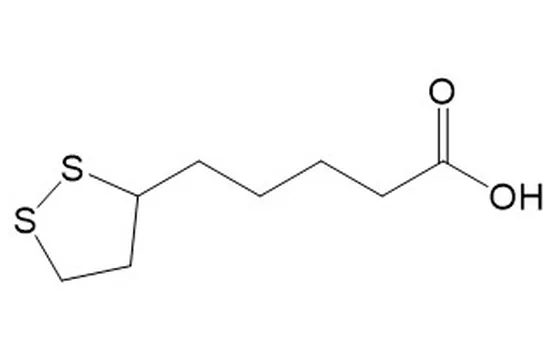
Both halves of that description matter. The carboxylic acid is what makes the molecule a drug with a plausible solubility profile at intestinal pH. The disulfide is what makes it an antioxidant, because disulfide exchange with oxidised glutathione and with protein thiols is the chemistry it was selected for. It is also the part that fails, and it fails in more than one way.
A five-membered ring containing a disulfide is strained. The dihedral angle imposed by the ring is not the one a disulfide prefers, so the S-S bond sits closer to the energy it needs to break than it would in an open-chain disulfide. That is exactly why the ring is reactive enough to be useful, and exactly why it does not survive careless handling.
Heat does not degrade this molecule, it polymerises it
The thermal behaviour of thioctic acid is unlike that of most small-molecule APIs, and the difference is worth stating plainly: the molecule does not lose water, it does not hydrolyse, and it does not oxidise in the usual sense. Above its melting range it opens and reconnects.
A study of silica composites of the drug puts the melting range at 58 to 65 °C and states that temperatures above it cause immediate polymerisation, with the colourless polymers consisting of linear disulfides[2]. That is not a slow degradative drift; it is a phase change followed by a chain reaction. The same ring-opening polymerisation is now used deliberately as a polymerisation method, with the dithiolane opened by radicals to give poly(disulfide) backbones[4].
Three consequences follow for a stability programme. First, a forced-degradation experiment run at 60 °C does not stress the solid — it melts it, and a melt is a different physical system with different mobility. Second, any thermal stress above the melting range answers a question nobody asked, because no real storage condition approaches it. Third, the product of that experiment is not a discrete impurity that can be assigned a relative retention time.
What the experiment should test instead is the solid just below the melt. Between 40 and 55 °C the material is still crystalline, but molecular mobility is high enough that surface molecules can react, and the practical readouts are colour, differential scanning calorimetry and powder diffraction, not only a chromatogram.
Light gives the opposite product
Photodegradation runs the other way. Where heat opens rings and builds chains, light reduces the disulfide. In the same study, irradiation of solid thioctic acid produced dihydrolipoic acid, the dithiol, identified by infrared spectroscopy[2].
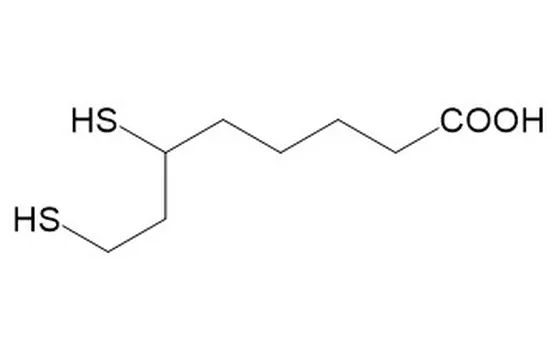
The formula difference is two hydrogen atoms: C8H16O2S2 at 208.3 against 206.33. That is a reduction, not an oxidation, and it changes the interpretation of everything downstream. Dihydrolipoic acid is not a damaged molecule; it is the active antioxidant form, and it is the species that scavenges radicals and regenerates other antioxidants. It is also unstable in air, because two thiols oxidise back to a disulfide readily, which means the photodegradant can disappear from a chromatogram while the sample gets no better.
The catalogue files it as impurity 4 at CAS 462-20-4. Calling it an impurity is a convention, not a judgement: the substance is the reduced form of the drug, and it is the form that does the chemistry people buy the drug for. A specification that limits it should say which of those two things it is limiting.
One wavelength, two mechanisms, and no peak for the polymer
Thioctic acid has no strong chromophore. The ultraviolet absorbance that makes it detectable comes from the disulfide, and the band used is at 332 nm[2]. That single fact determines what a related-substances method can and cannot report.
Polymerisation consumes dithiolane rings, so the 332 nm absorbance falls; the study monitors thermal degradation exactly that way, as a decreasing intensity of that band[2]. Reduction to the dithiol also removes the disulfide, so the same band falls for a completely different reason. Two mechanisms, one signal, and the assay cannot distinguish them.
Worse, the polymer does not appear as a peak. A linear poly(disulfide) is a distribution of chain lengths, not a species; on a reversed-phase column it either elutes as a broad hump at the end of the run or does not elute at all. The result is a mass balance that fails in the least helpful direction: the parent peak shrinks, no new peak appears, and the chromatogram looks clean.
The practical fix is not a better detector but a longer window. If the method's run time was set to cover the parent and the known small impurities, the oligomers are outside it. For a substance that polymerises, gradient length and run time are part of the specification, and a method with a fifteen-minute window is not merely insensitive, it is structurally unable to see the main degradation pathway.
The catalogue's oligomers are exact multiples
What the polymer looks like analytically is visible in the catalogue, because the low oligomers are discrete compounds and someone has made them.
| Entry | CAS | Formula | Mass | Relationship to the parent |
|---|---|---|---|---|
| Thioctic acid | 1077-28-7 | C8H14O2S2 | 206.33 | parent |
| Impurity 40 | 6718-96-3 | C16H28O4S4 | 412.66 | exactly two parent units, ring-closed |
| Impurity 45 | 108841-56-1 | C16H30O4S4 | 414.68 | two units, ring-opened, plus two hydrogen |
| Impurity 91 | 3037485-98-3 | C24H42O6S6 | 618.99 | exactly three parent units |
| Impurity 6, EP A | 1204245-29-3 | C8H14O2S3 | 238.39 | parent plus one sulfur |
Table note: formulas and CAS from the catalogue records[5][6]; masses calculated from the formulas and compared with the parent at 206.33.
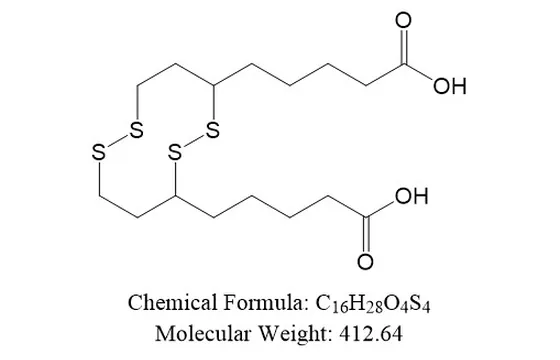
The arithmetic is exact to two decimal places, and it says what the polymer is. A dimer at 412.66 is 2 x 206.33; a trimer at 618.99 is 3 x 206.33. The ring-opened dimer at 414.68 is the same two units with the second ring already open, which is the intermediate that goes on to add a third.
This is the most useful thing a supplier catalogue can offer for a polymerising drug: not a polymer standard, which would be a distribution, but the first three members of the series, each of which is a single compound with a mass and a structure. With those in hand a method can be shown to resolve the dimer from the parent, and the presence of the dimer in a stressed sample becomes evidence rather than an inference from a falling assay.
EP impurity A is a sulfur homologue, and it belongs to the route
The one lettered impurity in this catalogue is impurity A at CAS 1204245-29-3, C8H14O2S3, 238.39, a 1,2,3-trithiane carboxylic acid[6]. One extra sulfur, one extra atom in the ring, and a six-membered ring where the parent has five.
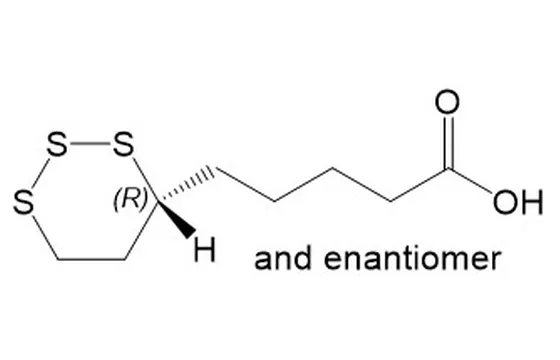
That is a route artefact, not a degradant. The ring is closed by treating a dichloro acid with a sulfide reagent, and a sulfide reagent that contains polysulfide inserts an extra sulfur into the ring. The catalogue carries the substrates as well: 6,8-dichlorooctanoic acid at C8H14Cl2O2, CAS 41443-60-1, and several chloro esters and chloro acids with ten carbons, which are the esterified and partially reacted forms[7].
The presence of the chloro series is itself the argument. A degradative pathway does not produce 6,8-dichlorooctanoic acid; only a synthesis does. So when a batch shows the trisulfide, the question is about the sulfide reagent's polysulfide content and about the stoichiometry of ring closure, not about the stability chamber.
This is worth separating in a filing, because the two sulphur-related questions have different answers: the trisulfide is controlled at the route, while the sulfoxides and the polymer are controlled at the package.
Oxidation at sulfur creates a new stereocentre
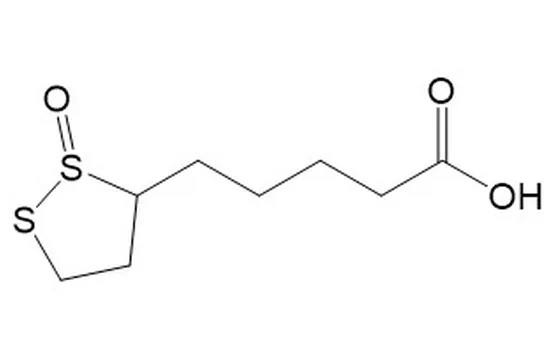
Four catalogue entries share the formula C8H14O3S2 at 222.30, all described as sulfoxides, one of them explicitly as a mixture of regioisomers and diastereomers, CAS 108015-78-7[8]. Four records for one formula is the tell.
A sulfoxide sulfur is pyramidal and its lone pair makes it a stereocentre. Oxidising one of the two sulfurs in the ring therefore does two things at once: it creates a new chiral centre, and in a molecule that already has one it produces diastereomers rather than enantiomers. Two sulfurs can be oxidised, and the two positions are not equivalent, so a single oxidation event already gives more than one peak.
Diastereomers are separable on an achiral column, which is the good news: no chiral method is needed and no derivatisation. The bad news is that each peak has its own response factor, and without standards the assignment is guesswork. This is the case where the four catalogue entries are not redundant — they are the four assignments.
There is a further oxidation state in the file that is easy to miss: 5-(thietan-2-yl)pentanoic acid, C8H14O2S at 174.26, CAS 25636-58-2, a four-membered thietane ring[9]. One sulfur instead of two, and a contracted ring. A sulfur was lost, which points at a route intermediate rather than at oxidation, and it is the kind of entry that makes a mass balance audit worth doing.
Designing the protocol, and what does not transfer
The protocol for this substance has to answer three separate questions, and a single accelerated condition answers only one of them.
| Condition | What it probes | Readout that actually works |
|---|---|---|
| 40 °C / 75 % RH, 6 months | solid-state mobility and slow oxidation | assay, sulfoxide peaks, DSC, colour |
| 25 °C / 60 % RH, long term | the storage claim | assay, dimer, water content |
| ICH Q1B photostability, with dark control | disulfide reduction to the dithiol | dihydrolipoic acid peak, colour, assay |
| 58 °C and above | nothing useful: the solid melts and polymers | not recommended; report as a melt study |
| Peroxide or radical initiator in solution | ring-opening polymerisation | oligomer series by mass, not by 332 nm |
Table note: conditions follow ICH Q1A(R2) and Q1B[10][11]; the readout column is a recommendation based on the mechanisms described above, not a compendial requirement.
The photostability experiment needs its dark control more than most. Because the product of irradiation is the reduced drug, a light-exposed sample can show a lower assay and a peak that looks like an impurity, while a dark control stored at the same temperature shows neither. Without the control there is no way to attribute the change to light rather than to the slow oxidation that happens anyway.
What does not transfer is the model built on captopril. Captopril also contains sulfur and also degrades by oxidation, but its sulfur is a free thiol, and oxidation of two thiols gives one symmetric disulfide — a single, assignable peak with a mass of twice the parent minus two hydrogens. Thioctic acid has no free thiol in the parent; the disulfide is in a ring, and opening it produces a chain that can react again. One molecule gives a peak, the other gives a series. A method borrowed from the thiol case will find the first oligomer and miss the rest. Acetylcysteine is the same lesson in a smaller molecule: one free thiol, one symmetric disulfide, one peak.
Domestic filing activity is substantial for a substance usually filed as a vitamin-like product: CDE public records show 229 accepted filings from 128 applicants as of 16 November 2026[12]. Those are acceptance records, not approvals, and the number reflects how many companies have taken this molecule through review rather than how many are selling it.
This catalogue holds 69 thioctic acid entries, including the two enantiomers, the reduced form, the trisulfide, the sulfoxides and the first three oligomers. For a molecule that fails by growing, that is the set that lets you follow the growth: see all thioctic acid entries, or browse the full catalogue by name.
Frequently Asked Questions
Does thioctic acid hydrolyse like an ordinary carboxylic acid drug?
Why is 60 °C a bad stress condition for this substance?
How can a chromatogram show a falling assay with no new peaks?
Is dihydrolipoic acid really an impurity?
Why are there four catalogue entries with the formula C8H14O3S2?
Is the trisulfide a degradation product?
Can a method developed for captopril be used here?
Related Substances and Reference Standards
- Captopril (34 impurity / derivative entries)
- Acetylcysteine (310 impurity / derivative entries)
References and Sources
- PubChem (National Center for Biotechnology Information), Thioctic acid, CID 864: C8H14O2S2, 206.33; PubChem lists a melting point of 47.5 to 48 °C for this record, while the pharmaceutical literature gives 58 to 65 °C for the racemate, accessed 2026-11-16
- Dolinina ES, Akimsheva EY, Parfenyuk EV, Pharmaceutics 2020;12(3):228, Development of Novel Silica-based Formulation of alpha-Lipoic Acid: Evaluation of Photo and Thermal Stability of the Encapsulated Drug (melting range 58 to 65 °C, immediate polymerisation above it, colourless linear disulfides, 332 nm band, dihydrolipoic acid on irradiation), accessed 2026-11-16
- PubChem, Dihydrolipoic acid, CID 421: C8H16O2S2, 208.3, 6,8-bis(sulfanyl)octanoic acid (catalogue entry thioctic acid impurity 4, CAS 462-20-4), accessed 2026-11-16
- Albanese KR, Morris PT, Read de Alaniz J, Bates CM, Hawker CJ, Journal of the American Chemical Society 2023;145:22728-22734, Controlled-Radical Polymerization of alpha-Lipoic Acid: A General Route to Degradable Vinyl Copolymers (radical ring-opening polymerisation of the 1,2-dithiolane), accessed 2026-11-16
- PubChem, Lipoic acid dimer, CID 154135292: C16H28O4S4, 412.66, a tetrathiecane formed from two lipoic acid units (catalogue entry thioctic acid impurity 40, CAS 6718-96-3), accessed 2026-11-16
- PubChem, 1,2,3-Trithiane-4-pentanoic acid, CID 18417507: C8H14O2S3, 238.39 (catalogue entry thioctic acid EP impurity A, CAS 1204245-29-3), accessed 2026-11-16
- PubChem, 6,8-Dichlorooctanoic acid, CID 9964447: C8H14Cl2O2, 213.10 (catalogue entry thioctic acid impurity 25, CAS 41443-60-1), accessed 2026-11-16
- PubChem, Lipoic acid monosulfoxide, CID 56993069: C8H14O3S2, 222.30, described as a mixture of regioisomers and diastereomers (catalogue entry thioctic acid impurity 7, CAS 108015-78-7), accessed 2026-11-16
- PubChem, 5-(Thietan-2-yl)pentanoic acid, CID 58850426: C8H14O2S, 174.26 (catalogue entry thioctic acid impurity 11, CAS 25636-58-2), accessed 2026-11-16
- ICH (International Council for Harmonisation), ICH Q1A(R2): Stability Testing of New Drug Substances and Products (long-term and accelerated conditions, 40 °C / 75 per cent RH), accessed 2026-11-16
- ICH, ICH Q1B: Photostability Testing of New Drug Substances and Products (option 1 and option 2, dark control), accessed 2026-11-16
- Center for Drug Evaluation, NMPA (CDE), Accepted filing records for thioctic acid, retrieved 16 November 2026: 229 records from 128 applicants. Acceptance records are not approvals, accessed 2026-11-16
This article was prepared by the CATO technical team. Regulatory, pharmacopoeial and published literature content cited above is attributed in the reference list. It is provided for technical exchange and search reference only and does not constitute a quality specification or regulatory advice. For any specific substance, the applicable test methods, limits and filing requirements are governed by the current regulations, pharmacopoeial monographs and official publications.
Product information on this site is provided for research search and selection reference only and is not a quality specification; technical data, purity and structural confirmation are governed by the shipped COA and our written confirmation. All products mentioned are for research use only, not for human or animal diagnostic or therapeutic use.